Which Compact Paint Roller Suits Your Next Repaint
Purdy White Dove mini covers top the list. Woven dralon leaves minimal stipple in latex on cabinets and walls. Wooster’s Jumbo-Koter Sherlock GT frame locks covers against slipping and threads onto a pole. Whizz Xtrasorb microfibre holds the heaviest paint load for panel doors.
Purdy White Dove mini covers suit anyone repainting kitchen cabinets and interior walls. Woven dralon sheds far less than knit, and a 3/8 in nap lands mid-range for smooth drywall. Width measures 4-1/2 in, narrow enough to pass between cabinet stiles. Heavy knockdown texture defeats that shallow nap, so textured rooms need a deeper cover.
Mini rollers look interchangeable on a rack, yet nap depth and fabric decide whether a coat flows out or shows lint tracks. We compared published nap depths, cover materials, core construction and the paint types each maker lists as compatible. Owner feedback about shedding, cover slippage and lap marks settled the final order.
How to pick the right one
What to look for in a compact paint roller Width is the visible change, with 4 in and 4-1/2 in sleeves standing in for the usual 9 in. Narrow covers reach between cabinet stiles, behind a toilet cistern and along stair skirting. Cores shrink too, so a mini sleeve only seats on a mini frame. Frame quality then decides whether that sleeve stays put under pressure. Most compact frames thread onto an extension pole, which turns a small roller into a touch-up tool for high walls.
How to choose nap length for your surface Nap depth should follow surface texture rather than habit. For gloss on doors and trim, 1/4 in mohair blend keeps stipple out of the film. Smooth drywall and cabinet frames sit in 3/8 in territory, which covers most interior repaints. Step up to 1/2 in only for orange peel, stucco or block. Oil-based enamel adds one more check: confirm the cover lists solvent compatibility, since some foam sleeves soften in mineral spirits.
Best compact rollers for cabinet doors and furniture Panel work rewards a cover that holds paint, because a dry roller drags and leaves lap marks. Whizz Xtrasorb microfibre carries the heavier load, while the mohair blend finishes flatter. Roll the centre panel first, then the rails and stiles. Finish each face with one light pass in a single direction and stop touching it. Owners report that a flow additive in latex cuts stipple further than swapping covers does.
Trim, corners and reaching high walls Behind a radiator or beside a door casing, frame design matters more than cover fabric. A locking cage stops the sleeve walking off when you press into a corner. Foam sleeves make sense for small touch-ups, since binning one beats washing it. Skirting boards go faster if you cut in with a brush first, then roll the flat face to level the brush marks. For a narrow strip above a doorway, thread the frame onto a pole instead of moving a ladder twice.
The top picks, ranked

Purdy White Dove Mini Roller Covers
Woven dralon fabric lays latex flat, which is why cabinet painters keep a stack of these in the van. Nap measures 3/8 in, the depth that suits smooth drywall, primed wood and cabinet face frames. At 4-1/2 in wide, a cover clears the stiles on a standard shaker door without loading paint onto the frame.
Pros
- Woven pile sheds less lint than knit covers
- 3/8 in nap suits most interior wall paint
- Rinses out for reuse on the next latex coat
Cons
- Shallow nap skips over knockdown texture
- Pile stiffens if rinsing waits until the paint dries

Wooster Brush Jumbo-Koter Sherlock GT Mini Frame
A sleeve that spins loose mid-stroke is the standard mini roller complaint, and this cage fixes it. Inside the frame a lock grips the cover core, so pressure into a corner will not walk the sleeve off. Both 4-1/2 in and 6-1/2 in Jumbo-Koter covers seat on the same cage.
Pros
- Cage lock holds the cover through corner pressure
- Threaded end takes any standard extension pole
- One frame runs two Jumbo-Koter cover widths
Cons
- Covers must come from the Jumbo-Koter range
- Sold as a frame only, with no sleeve included

Wooster Jumbo-Koter Mohair Blend Covers
Mohair blended with polyester and cut to a 1/4 in nap gives the flattest result in gloss and oil enamel. Shallow pile carries less paint, so passes need closer overlap and the tray gets visited often. Doors and shelves viewed at an angle show stipple first, which is exactly where this cover earns its place.
Pros
- Shortest nap here, closest to a sprayed look
- Mohair holds up in oil enamel without matting
- Seats on the same Jumbo-Koter frames
Cons
- Low paint load means frequent reloading
- Bridges over the valleys in any textured wall
Whizz Xtrasorb Mini Roller Covers
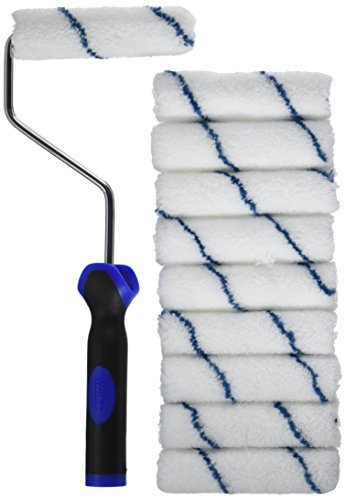
Microfibre pile draws up more paint per dip than knit at the same 3/8 in nap. That larger load keeps a wet edge running across a full cabinet panel instead of dragging halfway. Width sits at 4 in, which covers a standard shaker panel in two passes, and the plastic core shrugs off solvent cleaning.
Pros
- Holds more paint per dip than knit at the same nap
- Wet edge survives a full door panel
- Solvent-resistant core takes a mineral spirits wash
Cons
- Loaded cover feels heavy on the wrist overhead
- Thick paint can dry with a faint orange peel

Bates Paint Roller Kit
Starting from nothing means buying frames, a tray, sleeves and brushes anyway, and this box bundles all four. Roller widths of 4 in and 9 in cover cabinet work and open wall from the same kit. Individual pieces sit below Purdy standard, though a first room gets finished without a second trip to the store.
Pros
- Handles mini and full-size wall work from one box
- Tray and liner included for a first repaint
- Threaded handles accept a standard extension pole
Cons
- Microfibre sleeves shed more than woven covers
- Cage grips the sleeve less firmly than a Sherlock GT
Purdy Colossus Mini Roller Covers
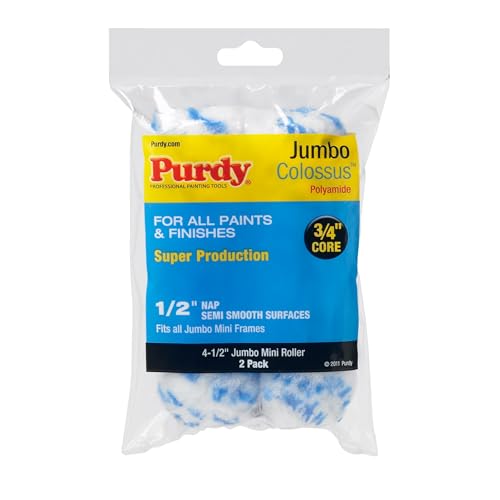
Half-inch pile pushes paint down into orange peel, light knockdown and block wall that shallow covers bridge over. Purdy builds the Colossus for heavy-bodied coatings, including elastomeric products. Roll one over smooth drywall and the stipple shows, so keep these off doors and cabinet frames.
Pros
- Deep nap fills texture valleys in a single pass
- Carries thick and elastomeric coatings
- Woven construction keeps lint down
Cons
- Leaves visible stipple on smooth drywall
- Uses more paint per square foot than a 3/8 in nap

Pro Grade High Density Foam Mini Rollers
High density foam has no fibres to shed, which suits small gloss touch-ups on doors, shelves and metal. Multi-packs make it reasonable to bin a sleeve between colours rather than wash it. Rough stock tears foam quickly, so these belong on primed wood and smooth trim only.
Pros
- Zero lint, even under dark gloss
- Disposable between colour changes
- Crisp edge definition on flat panels
Cons
- Foam tears on textured or rough surfaces
- Rolling fast traps air bubbles in the film
The lineup, side by side
| # | Model | Width | Best for | Score | Price |
|---|---|---|---|---|---|
| 1 | Purdy White Dove Mini Roller Covers | 4-1/2 in | Best overall | 9.4 | Check price |
| 2 | Wooster Brush Jumbo-Koter Sherlock GT Mini Frame | 4-1/2 in and 6-1/2 in | Best frame | 9.2 | Check price |
| 3 | Wooster Jumbo-Koter Mohair Blend Covers | 1/4 in | Best for oil enamel | 9.0 | Check price |
| 4 | Whizz Xtrasorb Mini Roller Covers | 4 in | Best for cabinet doors | 8.8 | Check price |
| 5 | Bates Paint Roller Kit | Frames, covers, tray and brushes | Best value kit | 8.6 | Check price |
| 6 | Purdy Colossus Mini Roller Covers | 1/2 in | Best for textured walls | 8.3 | Check price |
| 7 | Pro Grade High Density Foam Mini Rollers | High density foam | Best budget | 8.0 | Check price |
Good to know
What size roller is best for cabinet doors?
A 4 in or 4-1/2 in cover fits inside most door panels and between face frame stiles. Wider sleeves overhang the panel and dump paint onto the frame edge. Pair the cover with a short handled frame so you can feel the pressure you are applying.
Which nap length gives the smoothest finish on doors?
Use 1/4 in mohair blend or high density foam for the flattest gloss film. A 3/8 in nap still works, but it leaves a fine texture you will see at a low angle. Anything deeper belongs on walls.
Can you use a mini roller with oil-based paint?
Yes, provided the cover is rated for solvents. Mohair blend fabric and solvent-resistant plastic cores both handle oil enamel. Cheap foam can soften or break down, so read the sleeve packaging before you load the tray.
Foam vs microfibre mini roller: which finishes better?
Foam leaves no fibres and suits gloss on flat, primed surfaces. Microfibre holds more paint and covers area faster, at the cost of slightly more texture. Doors usually favour foam or mohair, while walls favour microfibre.
Do compact paint roller frames fit an extension pole?
Most do, including the Wooster Jumbo-Koter Sherlock GT mini frame, which has a threaded handle end. That pairing helps with strips above doorways and along stairwell walls. Some budget frames come with a solid handle, so check the end before buying.
How do you stop a mini roller cover sliding off?
Choose a frame with a locking cage rather than bare wire arms. Push the sleeve on until the core seats fully against the stop. Easing off the pressure at the end of each stroke also helps, since that is what usually walks a cover loose.
Are mini roller covers worth washing or better binned?
Woven covers such as Purdy White Dove rinse clean in water and last several latex jobs. Foam sleeves are designed to be discarded, so washing one wastes more time than it saves. After oil paint, the solvent needed to clean a sleeve rarely justifies the effort.
How many mini roller covers does a kitchen need?
Plan one sleeve per coat per colour, plus a spare. Primer and two topcoats across a set of cabinet doors usually works out at three or four. Keeping a spare in the pack avoids a half-dried cover spoiling the final pass.
Is a compact paint roller good for walls as well as trim?
It works for small walls, alcoves and stairwell strips, and a pole extends the reach. Open wall goes far quicker with a 9 in sleeve, simply because each pass covers twice the width. Many painters keep both and switch as the space narrows.
Final word
Purdy White Dove mini covers take the recommendation for cabinets and walls alike, since woven dralon keeps lint out and the 3/8 in nap fits most interior paint. Add the Wooster Jumbo-Koter Sherlock GT frame if a sleeve has ever spun loose on you. Gloss enamel on doors calls for the mohair blend instead, and anything textured needs the 1/2 in Purdy Colossus.
Jake Monroe
Jake worked as a residential contractor for over a decade before shifting to full-time writing. He evaluates power tools, hand tools and workshop gear through the lens of someone who has actually used them on job sites, not just read the box.