Picking Compact Electrical Wire by Gauge and Bend
Southwire Romex SIMpull 14/2 NM-B covers most 15 amp lighting and receptacle runs behind drywall. Step up to Cerrowire 12/2 NM-B where a 20 amp kitchen or garage circuit is involved. Control boxes and vehicles need BNTECHGO 18 AWG silicone wire, which bends where solid copper cracks.
Southwire Romex SIMpull 14/2 NM-B suits homeowners wiring lights, switch loops and bedroom receptacles. Its slick jacket drags less through drilled studs, which shows on a 40 foot pull. Solid copper is the tradeoff. It fights back in a crowded box and never belongs in a control panel.
Two spools marked 12 AWG can be legal in completely different places, which is where buyers go wrong. NM-B belongs in dry interior framing, THHN goes inside conduit, and silicone wire stays in enclosures and vehicles. Picks below come from published ampacity and temperature ratings, conductor construction, and owner feedback on how each wire behaves at a tight bend.
The top picks, ranked
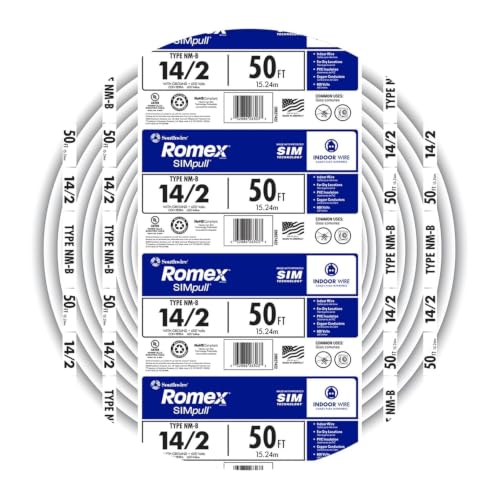
Southwire Romex SIMpull 14/2 NM-B With Ground
Lighting circuits and bedroom receptacles almost always land on 14/2, which makes this the default coil for homeowners. A SIMpull jacket cuts friction against drilled studs, so long pulls take less force. Solid copper seats firmly on a screw terminal, though it resists being folded twice in a crowded box.
Pros
- Jacket slides through studs with less drag
- White sheath flags 14 AWG on sight
- Standard choice for 15 amp branch circuits
Cons
- Solid conductor crowds a full device box
- Not rated for wet, buried or outdoor runs

Cerrowire 12/2 NM-B With Ground
Kitchen small appliance circuits, garage receptacles and bathroom outlets all want 12 AWG copper. Sequential footage marks run along the yellow jacket, so reading what is left on a partial coil takes a glance. Extra copper means extra stiffness, which shows when three cables meet in one box.
Pros
- Handles 20 amp loads at 600 volt
- Printed footage marks track remaining length
- Yellow sheath separates it from 14 AWG
Cons
- Harder to dress into a crowded box
- Coils weigh more when working overhead

Southwire THHN 12 AWG Stranded Building Wire
Conduit runs use individual conductors rather than jacketed cable, and stranded THHN turns elbows without binding. Nylon over PVC insulation earns the dual THHN and THWN-2 rating, so damp conduit is fair game. Buying by colour keeps black, white and green sorted along the whole run.
Pros
- Stranded core rounds elbows without binding
- THWN-2 rating covers damp conduit
- Sold by colour for conductor identification
Cons
- Needs conduit or raceway, never open framing
- Stranded ends will not hold in back-stab terminals

BNTECHGO 18 AWG Flexible Silicone Wire
Silicone insulation stays soft, so a conductor routed around a corner inside a control box stays where you put it. Hundreds of fine tinned strands survive flexing that would work-harden solid copper. Ratings span minus 60 to 200 degrees Celsius at 600 volt, useful next to drivers and heaters.
Pros
- Turns a bend radius solid wire cannot
- Tinned strands slow corrosion at cut ends
- Holds up near motors and LED drivers
Cons
- Soft jacket nicks when dragged across metal
- Cannot replace NM-B cable inside a wall

TEMCo 10 AWG Silicone Wire
Battery banks, winches and inverter leads need copper mass that still coils in one hand. 10 AWG fine strand delivers that, and it stays limber in a cold garage where PVC insulation goes board stiff. Silicone rated to 200 degrees Celsius shrugs off engine bay heat.
Pros
- Moves heavy DC current on short runs
- Stays flexible below freezing
- Silicone jacket tolerates engine bay heat
Cons
- Oversized and bulky for signal wiring
- Fine strands need ferrules under screw terminals

Ancor Marine Grade 16 AWG Primary Wire
Salt air and trailer spray creep into a cut end and turn bare copper green. Every strand here is tinned, which slows that migration and keeps connection resistance low. Oil and abrasion resistant insulation plus UL 1426 compliance is why boatyards specify it.
Pros
- Tinned strands resist salt and moisture
- Meets UL 1426 boat cable requirements
- Takes vibration without strand fatigue
Cons
- More wire than a dry indoor circuit needs
- Spools run shorter than bulk building wire

Striveday 22 AWG Hookup Wire Kit
Breadboards, LED strips and sensor leads call for thin wire in several colours rather than one heavy spool. Six colours arrive on small spools that fit a parts drawer. Solid core at 300 volt keeps this firmly on the low voltage side of the house.
Pros
- Six colours simplify signal tracing
- Solid core seats in breadboard holes
- Spools store in a small parts drawer
Cons
- Never suitable for branch circuit wiring
- Solid core fatigues and snaps when flexed
How to choose
How to match wire gauge to your breaker Ampacity leads every other decision. 14 AWG copper pairs with a 15 amp breaker, 12 AWG with a 20 amp breaker, and 10 AWG with 30 amp loads. Undersizing is what starts fires, because the conductor overheats before the breaker ever trips. Distance matters too. A 60 foot garage run often moves up one gauge to hold voltage drop under three percent. Anything touching a service panel belongs to a licensed electrician and your local code.
Insulation types and where each one is allowed NM-B is the jacketed cable for dry interior framing, and nothing else. THHN conductors live inside conduit, with a THWN-2 rating that covers damp runs. Silicone insulation handles heat and constant flexing, yet no code allows it inside a wall cavity. Marine primary wire adds tinned strands for spray, bilge damp and trailer wiring. Location decides the insulation before gauge even enters the conversation.
Solid vs stranded conductors Solid copper keeps its shape, wraps a screw terminal cleanly and seats in back-stab holes. Stranded copper bends to a tighter radius and shrugs off vibration. Vehicles, panels and anything on a hinge want stranded construction. One catch trips people up. Fine strands splay under a screw head and need a crimped ferrule to stay together.
Wiring tight enclosures and small spaces Bend radius becomes the hard limit inside a control box, camper wall or printer frame. Fine strand silicone in 18 or 16 AWG turns corners that NM-B physically cannot reach. Colour code as you go, since an enclosure holding twelve black wires becomes a future headache. Leave a service loop at each termination so the next repair is a splice rather than a full re-pull.
The lineup, side by side
| # | Model | Gauge | Best for | Score | Price |
|---|---|---|---|---|---|
| 1 | Southwire Romex SIMpull 14/2 NM-B With Ground | 14 AWG solid copper | Best overall | 9.4 | Check price |
| 2 | Cerrowire 12/2 NM-B With Ground | 12 AWG solid copper | Best for 20 amp circuits | 9.2 | Check price |
| 3 | Southwire THHN 12 AWG Stranded Building Wire | 12 AWG stranded copper | Best for conduit pulls | 9.0 | Check price |
| 4 | BNTECHGO 18 AWG Flexible Silicone Wire | 18 AWG fine strand | Best for tight enclosures | 8.8 | Check price |
| 5 | TEMCo 10 AWG Silicone Wire | 10 AWG fine strand | Best for high current in small spaces | 8.6 | Check price |
| 6 | Ancor Marine Grade 16 AWG Primary Wire | 16 AWG stranded | Best for damp locations | 8.3 | Check price |
| 7 | Striveday 22 AWG Hookup Wire Kit | 22 AWG | Best budget | 8.0 | Check price |
Good to know
What gauge wire do I need for a 20 amp circuit?
12 AWG copper is the standard answer. 14 AWG tops out at 15 amps and must not sit on a 20 amp breaker. Runs past roughly 60 feet sometimes move to 10 AWG to hold voltage drop down.
Can I use stranded wire instead of solid in house wiring?
Stranded is permitted in many applications, but terminations change. Back-stab holes are built around a solid conductor. Land stranded wire on screw terminals, or crimp a ferrule onto the end first.
Is silicone wire safe for mains voltage?
Insulation on common silicone hookup wire carries a 600 volt rating, so the voltage level is covered. Wiring method is a separate rule. Codes still require NM-B or conduit inside walls, which keeps silicone wire inside equipment and enclosures.
What does NM-B mean on electrical cable?
Non-metallic sheathed cable with conductors rated to 90 degrees Celsius. It is the jacketed cable used in dry interior residential framing. Wet or buried locations call for UF-B or conduit instead.
Which wire is best for a camper, trailer or boat?
Tinned marine grade primary wire, such as the Ancor 16 AWG. Salt and condensation attack bare copper from the cut end inward. Tinning slows that and keeps connections low in resistance under vibration.
Which wire works best in a tight control panel?
18 AWG silicone handles signals and small loads, while 10 AWG silicone carries battery and inverter current. Both bend sharply without kinking. Add ferrules so fine strands stay together under a terminal screw.
How much wire should I buy for a room rewire?
Measure each run, then add roughly 20 percent for routing, drops and box loops. Footage marks on the jacket make tracking easy mid job. Short leftover coils rarely reach far enough to be useful later.
Does wire colour actually matter?
Yes, and an inspector will check it. White signals neutral, green or bare signals ground, black and red signal ungrounded conductors. Re-identifying a conductor with tape is only permitted in specific sizes and situations.
Is compact stranded wire the same as fine strand silicone wire?
No. Compact stranded conductors are compressed so the finished diameter fits more easily in conduit. Fine strand silicone wire uses many more, much thinner strands purely for flexibility, and it is not a building wire.
How do I stop fine stranded wire from splaying in a terminal?
Crimp a ferrule over the stripped end. Tinning the strands with solder is a common shortcut, though solder creeps under clamping pressure and the joint loosens over time.
Our pick
Buy Southwire Romex SIMpull 14/2 NM-B for the lighting and receptacle circuits that make up most of a house, and give it a roomy box because solid copper does not fold twice. Kitchen, garage and bathroom circuits on a 20 amp breaker need Cerrowire 12/2 instead. Anyone wiring a control panel, camper or battery bank should skip building cable altogether and run BNTECHGO 18 AWG for signals with TEMCo 10 AWG for power.
Jake Monroe
Jake worked as a residential contractor for over a decade before shifting to full-time writing. He evaluates power tools, hand tools and workshop gear through the lens of someone who has actually used them on job sites, not just read the box.