Compact Circuit Breakers for Panels With No Slots Left
Square D HOMT2020CP is the pick for Homeline panels, adding two 20 amp circuits in one slot. Siemens, Murray and ITE boxes take the Q2020 instead. Where the panel is built for half inch breakers, GE THQP120 Q-Line THIN is the part that fits.
Square D HOMT2020CP answers the full Homeline panel. Two 20 amp circuits drop into a single slot, so no subpanel is needed for one more run. Its limit is the panel label, which names the positions allowed to take a tandem. Siemens, Murray and ITE owners buy the Q2020 for the same job.
Breakers do not swap between brands, and physical fit is not approval. Every load centre carries a label listing accepted catalogue numbers and a maximum circuit count. We compared that listed compatibility, amp ratings, interrupting capacity and width, then read owner reports on bus fit and handle access. Work inside a live panel belongs to a licensed electrician.
Our top picks

Square D HOMT2020CP Homeline Tandem Circuit Breaker
Two 20 amp circuits share the body width of one full size Homeline breaker. Plug on stabs grip the bus, so nothing bolts down. CP in the part number signals clamshell packaging rather than a bulk carton, not a different breaker.
Pros
- Adds a circuit without a subpanel
- Plug on stabs seat in seconds
- Stocked everywhere as a repair part
Cons
- Allowed only in label approved positions
- Will not seat on a QO bus

Siemens Q2020 Tandem Circuit Breaker
Siemens, Murray and ITE load centres listed for type QP tandems accept this one, which covers a great many panels from the 1990s onward. Each half runs its own 20 amp 120 volt circuit, so lighting and receptacles can share a space. Handles sit narrow and close together, and owners find resetting with gloves on awkward.
Pros
- Fits a wide span of QP era boxes
- Each half trips on its own
- Sold singly or in multipacks
Cons
- Slim handles are fiddly to reset
- Some QP positions reject tandems

GE THQP120 Q-Line THIN Circuit Breaker
Half the width of a standard breaker, so one 20 amp circuit lands where a full size body will not go. Panels designed around THIN breakers carry roughly double the circuit count inside the same enclosure. Single pole only, which rules out 240 volt loads.
Pros
- Half inch body frees real panel space
- Wiring stays simple single pole
- Widely available as a spare
Cons
- Needs a panel listed for THIN breakers
- Carries one circuit only

Square D QOT2020CP Tandem Circuit Breaker
QO panels run a different bus to Homeline, and this tandem is built for that bus. Visi-Trip flags the tripped half in red, which removes the guesswork of reading handle positions. Footprint matches one full size QO breaker while carrying two 20 amp circuits.
Pros
- Visi-Trip marks which half tripped
- Tight stab contact limits heating
- Keeps decades old QO panels serviceable
Cons
- No fit on Homeline or other buses
- Restricted to tandem approved positions

Eaton BR2020 Type BR Twin Circuit Breaker
BR and older Cutler-Hammer boxes accept this twin, stacking two 20 amp circuits into one space. Multiple wipe contacts hold the bus stab, which limits heat build up under sustained load. No handle tie is fitted, so one circuit can trip while the other keeps running.
Pros
- Direct fit in common BR load centres
- Multi wipe contacts resist stab heating
- Independent trip on each circuit
Cons
- Type CH panels need a different breaker
- Label caps how many twins are allowed
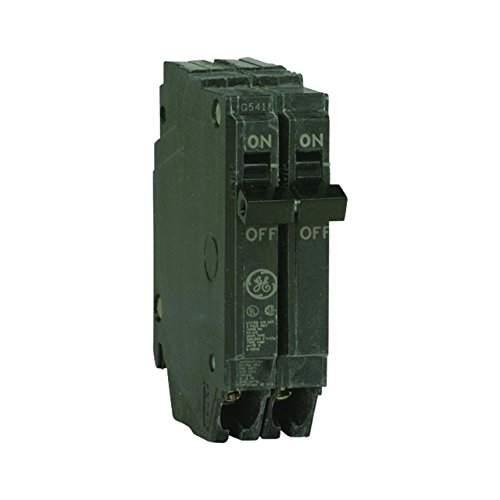
GE THQP220 Q-Line THIN Two-Pole Circuit Breaker
A 240 volt circuit normally consumes two full slots. This two pole THIN breaker does the same job inside one inch of panel width, with a common trip linking both poles. Twenty amps covers a baseboard heater run, a small water heater feed or a shop compressor.
Pros
- Lands a 240 volt circuit in one slot
- Both poles trip together
- Avoids a panel swap for one load
Cons
- Only for panels listed for THIN breakers
- Fixed at 20 amps, so larger loads need a full size breaker

Murray MP2020 Tandem Circuit Breaker
Murray load centres still sit in plenty of houses wired through the 1980s and 1990s. MP tandems keep those boxes repairable, fitting two 20 amp circuits into one slot on the Siemens QP footprint. Read the label first, because some Murray panels permit only a couple of tandems in total.
Pros
- Keeps a legacy panel repairable
- Shares the Siemens QP footprint
- Plug on install with no extra hardware
Cons
- Stock thins as the line is retired
- Older boxes allow very few tandems
Before you buy
What counts as a compact breaker Two designs save panel space. Tandem or twin breakers pack two 120 volt circuits behind one full size body. Half inch units, such as GE Q-Line THIN, run a single circuit in a narrower body. Either type works only in a panel built and listed for it. Inside the door, a printed label states which one applies.
How to read your panel label before buying Load centres are tested with named catalogue numbers, and that list sits on the label beside a maximum circuit count. Many panels accept tandems in outer positions only, enforced by a rejection tab on the bus. Ignore the tab and you void the listing, which also fails an inspection. Photograph the label, then shop from the numbers on it rather than from a breaker that looks similar.
Amp rating, wire size and interrupting capacity Wire gauge sets breaker size, not convenience. 14 gauge takes 15 amps and 12 gauge takes 20. Fitting a bigger breaker to stop nuisance trips leaves the conductor unprotected. Interrupting rating is a separate question, covering how much fault current the breaker can clear. Most residential services are fine on 10,000 AIC, while a house close to a large utility transformer can need 22,000 AIC or more.
When a tandem is the wrong fix Tandems add circuits, not capacity. A panel already near its calculated load needs a subpanel or a service upgrade, and squeezing in more twins hides the real problem. Arc fault and ground fault requirements now cover most new bedroom and kitchen circuits, and those combination breakers are usually full width. Main lugs stay energised with the handle off, which is why a licensed electrician should do the install.
Compared at a glance
| # | Model | Amperage | Best for | Score | Price |
|---|---|---|---|---|---|
| 1 | Square D HOMT2020CP Homeline Tandem Circuit Breaker | Two 20 amp poles | Best overall | 9.4 | Check price |
| 2 | Siemens Q2020 Tandem Circuit Breaker | Two 20 amp poles | Best value | 9.2 | Check price |
| 3 | GE THQP120 Q-Line THIN Circuit Breaker | 20 amp single pole | Best for half inch slots | 9.0 | Check price |
| 4 | Square D QOT2020CP Tandem Circuit Breaker | Two 20 amp poles | Best for QO load centres | 8.8 | Check price |
| 5 | Eaton BR2020 Type BR Twin Circuit Breaker | Two 20 amp poles | Best for Eaton and Cutler-Hammer panels | 8.6 | Check price |
| 6 | GE THQP220 Q-Line THIN Two-Pole Circuit Breaker | 20 amp two pole | Best for 240 volt circuits | 8.3 | Check price |
| 7 | Murray MP2020 Tandem Circuit Breaker | Two 20 amp poles | Best for older Murray panels | 8.0 | Check price |
Good to know
What is a tandem circuit breaker?
One body carrying two separate circuits, commonly 15 or 20 amps each, inside a single full size footprint. Each half has its own handle and trips independently. Panels must be listed to accept them, and the label states how many are permitted.
Can you put a tandem breaker in any panel slot?
No. Most load centres use a rejection tab on the bus so tandems seat only in approved positions. Forcing one into a restricted slot damages the stab and breaks the panel listing.
What is the difference between a half inch breaker and a tandem?
A half inch breaker such as the GE THQP120 runs one circuit in a narrower body. A tandem runs two circuits inside a standard one inch width. Panel design decides which of the two you can use, and very few boxes take both.
Can you mix breaker brands in one panel?
Only where the label lists that brand as classified for the panel. Physical fit is not approval, and a mismatched stab runs hot under sustained load. Stick to the catalogue numbers printed inside the door.
How do you know when a panel is full?
Count the empty spaces, then check the label for maximum circuits. A box can run out of physical room while sitting under its circuit limit, and that is exactly where tandems help. Out of both means a subpanel.
Do tandem breakers overload the panel?
They change neither the main breaker rating nor the bus capacity. Overload comes from connected demand, so total the loads before splitting slots.
Is 10,000 AIC enough for a house?
Yes for most residential services fed from a typical utility transformer. Commercial feeds, or a house sited very close to a large transformer, can require 22,000 AIC or higher. Available fault current at the service settles it.
Which compact breaker fits a Siemens panel?
Type QP tandems such as the Siemens Q2020, which also cover many Murray and ITE boxes of the same era. Square D and Eaton parts will not seat on that bus. Confirm against the label, since some QP positions still reject tandems.
Should you replace a breaker yourself?
Panel interiors stay live at the main lugs even with the main breaker off, which is why licensed electricians handle this work. Buying the correct part yourself is sensible. Installation makes a poor first electrical project.
Our take
Homeline panels with tandem approved slots are the simple case, and the Square D HOMT2020CP is both the correct part and the easiest to find. Siemens, Murray and ITE boxes want the Q2020, while anything built around GE THIN breakers needs the THQP120. Panels already close to their calculated load should get a subpanel rather than more tandems, because extra slots do not add capacity.
Jake Monroe
Jake worked as a residential contractor for over a decade before shifting to full-time writing. He evaluates power tools, hand tools and workshop gear through the lens of someone who has actually used them on job sites, not just read the box.


