Compact Calipers: How to Pick One That Holds Zero
Mitutoyo’s 500-196-30 ranks first. Its ABSOLUTE encoder keeps the origin, so nothing needs re-zeroing at power on. Want a shorter tool? iGaging’s ABSOLUTE ORIGIN 4 Inch puts the same scale in a pocket-length frame. Neiko’s 01407A covers hobby measuring where tenths never matter.
Mitutoyo’s 500-196-30 fits anyone who needs half-thousandth readings they can rely on, because its absolute encoder remembers zero through sleep and cell swaps. Swarf is its weak point, since the slide runs open. Reloaders, machinists and repair techs get the most from it.
Two scale types split this category. Incremental scales reset their origin every time they power up; absolute scales never do. We compared published resolution and accuracy figures, jaw geometry, IP ratings where listed, and owner reports covering drift and storage drain.
How to choose
What matters in a small caliper Resolution and repeatability are separate things. Almost every digital caliper shows 0.0005 in, yet only a good scale returns the same figure twice on one part. Absolute encoders, used by Mitutoyo and iGaging, hold their origin through sleep and cell changes. Jaw hardness counts too, because soft jaws round off and start reading small on shoulders.
Digital vs dial vs vernier Speed favours digital, especially when units change mid-job. Dial tools such as the Mitutoyo 505-742-11 turn movement into needle travel, which makes taper and runout obvious. Vernier scales like the General 147 never fail in a drawer. Plenty of shops keep one mechanical caliper purely to check a digital that looks suspect.
Best compact caliper by job: printing, reloading, woodworking Filament and printed parts need 0.01 mm resolution and quick millimetre reading, which the iGaging and Neiko both deliver. Reloaders repeat case-length and bullet-diameter checks all evening, so an absolute scale saves constant re-zeroing. Woodworkers usually want fraction display, since plans arrive in sixteenths. Bench work near coolant or heavy sawdust pushes you toward an IP54 or IP67 body instead.
Keeping a caliper accurate Wipe the beam before every closure. A single chip under the jaws shifts the reading more than most people expect. Store the tool with jaws slightly open, and pull the cell from budget models known to drain. Verify zero against a gauge block or a known drill shank before precise work. Sealed models like the Starrett 798A tolerate a dirtier bench, yet need the same cleaning habit.
The top picks, ranked

Mitutoyo 500-196-30 ABSOLUTE Digimatic Caliper
An ABSOLUTE linear encoder holds the origin point, so the display reads true the instant it wakes. Range covers 0 to 6 in at 0.0005 in resolution, and hardened stainless jaws stay square after repeated contact with steel. One SR44 cell runs it for years of intermittent work.
Pros
- Zero survives power cycles and cell changes
- Hardened jaws stay square on shoulder measurements
- Single SR44 lasts years under light duty
Cons
- Open slide invites swarf and coolant
- Six inch frame sticks out of a shirt pocket

iGaging ABSOLUTE ORIGIN 4 Inch Digital Caliper
Four inches of range keeps this one apron-pocket sized while retaining an absolute-origin scale. Readout cycles through inch, millimetre and fraction, which helps when plans arrive in sixteenths. Jaw depth is shallower than a six inch tool, so deep bores stay out of reach.
Pros
- Short frame rides in a pocket all day
- Fraction mode removes decimal conversion on site
- Origin survives display sleep
Cons
- Shallow jaws limit internal measurements
- Four inch range rules out longer stock

Clockwise Tools DCLR-0605 Digital Caliper
IP54 sealing keeps dust and splashes out of the electronics, useful on a bench that sees sanding or light cutting fluid. Stainless construction and a thumb roller give a steadier feel than plastic hobby tools. Zero holds through normal use, though pulling the cell wipes it.
Pros
- Dust and splash rating suits a working bench
- Thumb roller sets fine, repeatable jaw pressure
- Storage case and a spare cell come in the box
Cons
- Incremental scale loses zero on a cell swap
- Heavier than a plastic hobby caliper
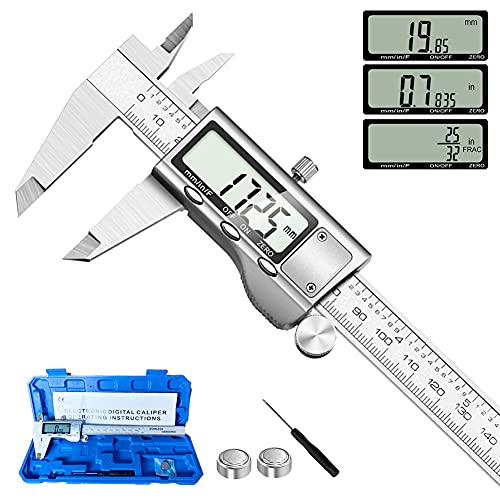
Neiko 01407A Electronic Digital Caliper
Outside, inside, depth and step measurement all sit on one stainless entry-level frame. Accuracy covers joinery, 3D printing and general repair, yet machinists chasing tenths will outgrow it quickly. Owners report the cell draining in storage, so remove it when the tool sits for months.
Pros
- Full stainless frame at entry level
- Inch and millimetre switch instantly
- Resolution suits print tolerances and joinery
Cons
- Parasitic drain empties the cell during storage
- Readings drift when the jaws are clamped hard

Mitutoyo 505-742-11 Dial Caliper
Rack and pinion gearing drives the needle, so nothing goes flat in a drawer. Each dial revolution covers 0.100 in and the marks read to 0.001 in. Grit in the rack is the real enemy, which turns wiping the beam into a habit rather than a chore.
Pros
- Ready after months of storage with no cell
- Needle travel exposes taper and runout at a glance
- Bezel re-zeroes in a second
Cons
- Rack jams when swarf sits on the beam
- Inch graduations only, so metric needs conversion

Starrett 798A-6/150 Digital Caliper
Sealing to IP67 lets this caliper live near coolant mist and washdown that would kill an open slide. Inch and millimetre readouts sit on a hardened stainless frame that resists twist under jaw pressure. Bulk is the trade, so pocket carry is not its job.
Pros
- IP67 sealing survives coolant and cutting fluid
- Rigid frame keeps the jaws parallel under pressure
- Large digits stay legible under shop lighting
Cons
- Thicker and heavier than hobby calipers
- Sealing is wasted on a clean home desk

General Tools 147 Pocket Slide Caliper
Vernier lines replace a display here, and a clip on the beam holds it in a pocket. Nothing drifts and nothing needs power, which makes it a useful sanity check against a digital reading. Fine work slows down, because your eye has to resolve the scale.
Pros
- Clips to a pocket and weighs almost nothing
- No cell, no drift, no power switch
- Acts as a reference when a digital reads oddly
Cons
- Vernier lines are hard to read in dim light
- Slower than a display for repeat checks
How they stack up
| # | Model | Range | Best for | Score | Price |
|---|---|---|---|---|---|
| 1 | Mitutoyo 500-196-30 ABSOLUTE Digimatic Caliper | 0 to 6 in / 0 to 150 mm | Best overall | 9.4 | Check price |
| 2 | iGaging ABSOLUTE ORIGIN 4 Inch Digital Caliper | 0 to 4 in / 0 to 100 mm | Best compact size | 9.2 | Check price |
| 3 | Clockwise Tools DCLR-0605 Digital Caliper | 0 to 6 in / 0 to 150 mm | Best value | 9.0 | Check price |
| 4 | Neiko 01407A Electronic Digital Caliper | 0 to 6 in / 0 to 150 mm | Best budget | 8.8 | Check price |
| 5 | Mitutoyo 505-742-11 Dial Caliper | 0 to 6 in | Best battery-free option | 8.6 | Check price |
| 6 | Starrett 798A-6/150 Digital Caliper | 0 to 6 in / 0 to 150 mm | Best for workshop durability | 8.4 | Check price |
| 7 | General Tools 147 Pocket Slide Caliper | 0 to 4 in | Best for keychain carry | 8.0 | Check price |
Common questions
What size compact caliper should I buy?
Four inches suits pocket carry, fasteners, filament and brass. Six inches handles board thickness and pipe without feeling unwieldy. Pick by the largest part you measure regularly, not the smallest.
Are cheap digital calipers accurate enough?
For woodworking, 3D printing and general repair, yes. Budget units usually hold around 0.001 in in practice. Machining to tenths needs a Mitutoyo or Starrett grade scale instead.
Why does my caliper lose zero?
Most budget models use an incremental scale, which sets its origin at power on. Removing the cell or letting it fade wipes that reference. Absolute encoder tools keep the origin permanently.
Digital vs dial caliper: which is better for a home shop?
Digital wins on reading speed and unit switching. Dial wins on readiness after storage and on showing movement as you rock the jaws. Owning one of each covers both habits.
Can calipers measure inside diameters and depth?
Yes. Four functions are standard: outside, inside, depth and step. Upper knife jaws handle bores and the tail rod handles depth. Small bores read less accurately, since the knife jaws touch only a short arc.
How long does a caliper battery last?
Mitutoyo quotes years from one SR44 cell because the electronics draw very little. Budget models often manage months, and some drain while switched off. Pulling the cell during long storage fixes that.
Is an IP rating worth paying for on a caliper?
It earns its place when coolant, sawdust or rain reach the bench. IP54 blocks dust and splashes; IP67 handles brief immersion. Desk-based hobby users gain very little.
Which compact caliper is best for 3D printing?
Look for 0.01 mm resolution and one-button metric switching, which the iGaging ABSOLUTE ORIGIN and Neiko 01407A both offer. Layer widths and nozzle diameters sit well inside their range. An absolute scale helps if you measure across several sessions.
How do I check whether my caliper is still accurate?
Close the jaws fully and hold them to a light. No gap should show, and the display should read zero. Measure a gauge block three times afterwards to see whether the same figure returns.
Do absolute encoder calipers still need calibration?
They hold zero, which is not the same as staying accurate. Damaged or worn jaws still read short on shoulders. Check against a gauge block once or twice a year, more often after a drop.
Our take
Buy the Mitutoyo 500-196-30. Its absolute encoder removes the most common frustration in digital measuring, which is a tool that forgets zero the moment you change the cell. Anyone who wants genuine pocket carry should take the iGaging ABSOLUTE ORIGIN 4 Inch, and hobbyists measuring printed parts will not outgrow the Neiko 01407A. Work near coolant instead? Step up to the sealed Starrett 798A.
Jake Monroe
Jake worked as a residential contractor for over a decade before shifting to full-time writing. He evaluates power tools, hand tools and workshop gear through the lens of someone who has actually used them on job sites, not just read the box.