Which Watercolor Pad Holds a Wash Without Buckling
Strathmore 400 Series works as the default 140 lb cold press pad, sized firmly enough to lift dried colour. Arches Watercolour Block suits finished pieces that get soaked and reworked. Canson XL Series supplies thirty sheets for daily studies, though its surface pills under hard scrubbing.
Strathmore 400 Series answers most beginner questions at once. Its 140 lb cold press sheets take a wet wash without cockling in the first minute, and colour lifts reasonably from the cellulose surface. Scrub one patch repeatedly and those fibres pill. Painters who lift highlights constantly should start on cotton instead.
Stacked on a shelf, every pad looks interchangeable. We compared gsm ratings, surface pressings, fibre content, sheet counts and binding methods against what each maker states on the listing. Owner feedback covered the rest: buckling, torn corners when freeing a block, and how cleanly dried colour came back up.
The top picks, ranked

Strathmore 400 Series Watercolor Pad
Firm sizing keeps a wash sitting on top of the sheet instead of sinking straight through. Cold press tooth traps granulating pigment in the valleys, so texture reads clearly once dry. Twelve sheets per pad lands between classroom bulk stock and artist grade cotton.
Pros
- Takes wet washes with modest cockling
- Tooth brings out granulating pigments
- Acid free stock is safe to frame
Cons
- Cellulose fibres pill when scrubbed hard
- Single edge binding needs taping for very wet work

Arches Watercolour Block Cold Press
Gelatin sized cotton lets colour come back up days after it dried. Glue seals all four edges, holding each sheet flat through genuinely soaking work. Freeing a finished painting means running a palette knife around the small unglued gap at one corner.
Pros
- Cotton takes repeated lifting and scrubbing
- Four edge block removes the stretching step
- Behaviour stays consistent sheet to sheet
Cons
- Careless knife work tears a corner
- Heavy gelatin sizing slows staining pigments
Canson XL Series Watercolor Pad
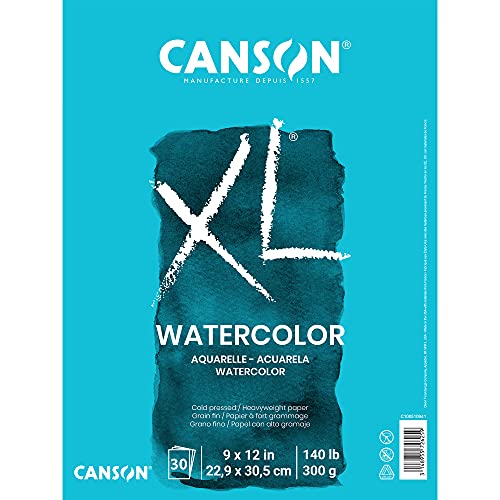
Thirty sheets per pad make daily colour studies practical rather than precious. Sizing runs lighter than Strathmore, pulling washes in faster and drying the sheet flatter. Masking fluid peels away cleanly on most sheets, while aggressive tape frays the edge.
Pros
- Sheet count supports high volume practice
- Cold press tooth reads dry brush marks well
- Fold over cover doubles as a backing board
Cons
- Light sizing soaks up a wash quickly
- Cockles more than any four edge block

U.S. Art Supply Watercolor Paper Pad
Classroom oriented sheet counts fill a lot of pages with colour exercises. Light washes, ink lines and gouache all behave normally on this cellulose surface. Rewet one area several times and it softens sooner than mill branded paper does.
Pros
- Highest sheet count in this group
- Handles ink and gouache alongside watercolor
- Standard 9 by 12 inch sheets fit common boards
Cons
- Surface softens under repeated rewetting
- Dried colour barely lifts back off

Fabriano Studio Watercolour Pad
A 25 percent cotton blend sits between student pads and full artist stock. Hot press sheets stay smooth enough for botanical detail, portraits and pen and wash. Cold press versions granulate more gently than Arches, which helps when a flat even sky is the goal.
Pros
- Cotton blend lifts better than pure cellulose
- Hot press option suits fine linework
- Sizing stays even across the whole sheet
Cons
- Twelve sheets empty quickly
- Less tooth for dramatic granulation

Legion Stonehenge Aqua Watercolor Block
Cotton paper in a four edge block travels without a drawing board, clips or tape. Wind and damp ruin loose sheets outdoors, which glued edges solve outright. Surface sizing feels firmer than Arches, so colour sits brighter on top and lifts a little more readily.
Pros
- Cotton stock in a portable block format
- Stays flat outdoors with nothing holding it
- Firm sizing keeps washes bright
Cons
- Fewer sizes and pressings than Arches
- Firm sizing makes soft blended edges harder

Winsor & Newton Classic Watercolour Paper Pad
Classic sits one step above basic student pads while staying on wood pulp. Even sizing means a wash spreads roughly where you expected it to go. Push lifting hard and the pulp gives out before the Fabriano cotton blend would.
Pros
- Wash spread stays predictable for learners
- Sizing runs consistently sheet to sheet
- Pairs naturally with the brand’s pans and tubes
Cons
- Wood pulp limits scrubbing and lifting
- Twelve sheets vanish during daily practice
Side by side
| # | Model | Weight | Best for | Score | Price |
|---|---|---|---|---|---|
| 1 | Strathmore 400 Series Watercolor Pad | 140 lb / 300 gsm | Best overall | 9.4 | Check price |
| 2 | Arches Watercolour Block Cold Press | 140 lb / 300 gsm | Best for finished paintings | 9.2 | Check price |
| 3 | Canson XL Series Watercolor Pad | 140 lb / 300 gsm | Best value for practice | 9.0 | Check price |
| 4 | U.S. Art Supply Watercolor Paper Pad | 140 lb / 300 gsm | Best budget | 8.7 | Check price |
| 5 | Fabriano Studio Watercolour Pad | 140 lb / 300 gsm | Best for detailed work | 8.5 | Check price |
| 6 | Legion Stonehenge Aqua Watercolor Block | 140 lb / 300 gsm | Best for plein air | 8.3 | Check price |
| 7 | Winsor & Newton Classic Watercolour Paper Pad | 140 lb / 300 gsm | Best for beginners upgrading | 8.0 | Check price |
What matters most
How paper weight and sizing change a wash Weight describes how much water a sheet absorbs before it cockles. Every pad here is 140 lb, or 300 gsm, which handles normal washes; 90 lb stock buckles almost on contact. Sizing is the separate gelatin or synthetic layer that holds pigment near the surface. Firm sizing lets you lift colour later, while lightly sized paper stains the moment a brush touches it.
Cold press, hot press and rough surfaces Cold press carries a medium tooth that grips pigment and suits landscapes, florals and loose work. Hot press runs smooth, favouring botanical illustration, portraits and pen and wash. Rough exaggerates granulation and dry brush marks. Fabriano Studio ships in two pressings, making it a cheap way to find which surface matches how you paint.
Cotton or cellulose: which do you need? Cotton fibres survive scrubbing, so Arches and Stonehenge Aqua let you reclaim highlights long after paint has dried. Cellulose pads such as Canson XL pill instead of releasing colour. Line and wash almost never needs cotton. Anyone painting skies with soft lifted clouds spots the difference on the first attempt.
Blocks, pads and painting outdoors Glue bound pads want taping or stretching before genuinely wet work. Four edge blocks hold each sheet flat until you cut it free, which is why plein air painters carry them into fields. Blocks weigh more and give fewer sheets for the outlay. For studio studies where slight buckling does not matter, a 30 sheet pad buys far more painting time.
Frequently asked questions
What weight of watercolor paper should a beginner buy?
Start at 140 lb, or 300 gsm. Lighter 90 lb stock cockles as soon as a wash lands, which teaches timid brushwork. Heavier 300 lb paper only pays off once you regularly soak whole sheets.
Is cold press or hot press better for watercolor?
Cold press fits most subjects, since its tooth grips pigment and creates natural texture. Hot press suits tight botanical illustration, portraits and ink line work. Buy cold press first, then add a hot press pad once your style settles.
Do you need 100 percent cotton watercolor paper?
Not for sketching, pen and wash, or early practice. Cotton earns its place when you lift highlights, scrub back a sky, or rework one area several times. Arches and Stonehenge Aqua are the cotton options in this group.
How do you stop watercolor paper from buckling?
Tape all four edges of a pad sheet to a board, or paint on a glued block instead. Pre stretching by soaking and stapling also works on cellulose stock. Heavier paper cockles less at any given wetness.
What is the difference between a watercolor block and a pad?
Blocks are glued on all four edges, so the sheet cannot move while wet and you cut it free when finished. Pads bind on one edge only and lift away freely. Blocks give fewer sheets but skip stretching entirely.
Can you use watercolor pads for gouache or acrylic?
Yes. Gouache sits well on 140 lb cold press, and thinned acrylic works on the cotton sheets. Thick acrylic bodies belong on canvas or board, because paper cannot flex with a heavy film.
Why does watercolor dry lighter than it looks wet?
Pigment settles as water evaporates, and sizing draws part of it below the surface. Firmly sized cotton holds more colour on top, so the shift looks smaller. Building two or three glazes compensates on cellulose pads.
Arches vs Canson XL: which should you choose?
Canson XL fits volume practice where most sheets get binned. An Arches block suits paintings you plan to frame, since cotton absorbs lifting, masking and repeated washes that would pill the XL surface.
Which watercolor pad is best for painting outdoors?
Stonehenge Aqua, because four glued edges keep the sheet flat when wind picks up and no board is needed. Arches blocks do the same job on heavier cotton. Loose pad sheets need clips and a board, which is extra weight to carry.
Our take
Strathmore 400 Series is the pad to buy if you paint a few times a week and want washes that behave without moving to cotton. Move up to an Arches block once lifting highlights and soaking whole skies become normal, because cellulose pills long before cotton does. Students grinding through daily studies should stock Canson XL and keep cotton sheets for pieces that get framed.
Jake Monroe
Jake worked as a residential contractor for over a decade before shifting to full-time writing. He evaluates power tools, hand tools and workshop gear through the lens of someone who has actually used them on job sites, not just read the box.