Clay Tools for Throwing, Slab Work and Polymer
Kemper Tools 8-Piece Pottery Tool Kit handles the most jobs per box, from scoring slabs to trimming leather hard feet. Sculpey Essential Tool Kit fits polymer work, where wipe clean handles beat wood. Mont Marte Pottery and Clay Modelling Tools give hand builders eleven profiles for one purchase.
Kemper Tools 8-Piece Pottery Tool Kit is the first buy that makes sense for wheel and slab work alike, since one box carries a needle tool, wire cutter, loops and ribs. Hardwood handles swell under constant water, which is the real tradeoff. Anyone sculpting polymer clay should start with the Sculpey Essential Tool Kit.
Kits get marketed as universal, yet a throwing rib does nothing for polymer detail work. We compared piece counts, tip materials, handle construction and the clay bodies each maker names. Owner feedback filled the gaps on wire fatigue, rust spotting and tips that flex when they should stay rigid.
The shortlist, ranked

Kemper Tools 8-Piece Pottery Tool Kit
Scoring, cutting, trimming and smoothing each get a dedicated tool, so nothing in the box duplicates another. Ceramics classrooms issue this same eight piece format, which means studio instructions map onto what you already own. Snapped loop wires are replaceable as singles rather than forcing a whole new kit.
Pros
- Five core ceramics jobs covered without buying singles
- Replacement tools sold one at a time
- Matches the kit list most pottery classes hand out
Cons
- Hardwood handles swell under constant water exposure
- Loop wires fatigue against heavily grogged clay

Sculpey Essential Tool Kit
Polymer clay carries plasticiser oils that soak into bare wood, while moulded plastic handles wipe clean instead. Ball styluses press eye sockets and rounded detail into miniature figures. Blade length suits slicing conditioned canes, though every tool feels undersized once a piece grows past fist size.
Pros
- Plastic handles rinse free of polymer residue
- Ball styluses shape faces and small curves
- Rigid blade slices conditioned canes cleanly
Cons
- Tool scale is too small for large sculpture
- Contains no ribs, so wheel work needs another kit
Mont Marte Pottery and Clay Modelling Tools
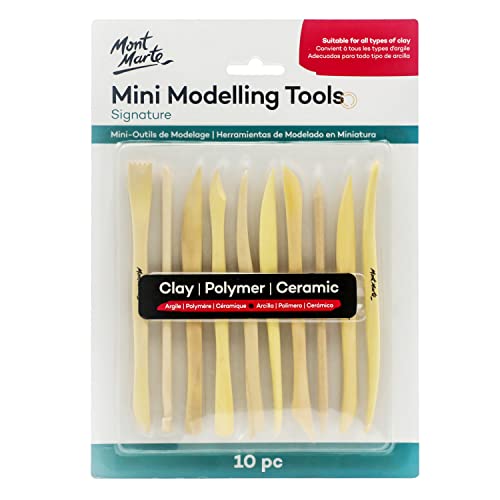
Eleven beechwood profiles cover texture, undercuts and ribbing from a single purchase. Breadth matters early, because beginners rarely know which shape they need until they hold it. Machining runs inconsistent across the set, so a minute with fine sandpaper removes edges that catch on soft clay.
Pros
- Eleven distinct profiles from one purchase
- Low weight helps during long modelling sessions
- Wooden ends will not score a plaster bat
Cons
- Finish quality varies between pieces
- Wire loops are thinner than studio grade trim tools

Blisstime 24 Piece Clay Sculpting Tool Set
Double ended shafts turn twenty four tools into roughly forty eight working tips. Sorting through that many shapes is the fastest route to learning which three you reach for daily. Steel runs softer than studio grade here, so points round over against grogged stoneware.
Pros
- Wide profile range helps beginners find favourites
- Roll pouch stops tips knocking against each other
- Double ended shafts double the usable shapes
Cons
- Softer steel rounds off on grogged clay
- Several profiles overlap and stay unused

Mudtools Mudrib Red Rib
Red sits at the softest end of the Mudtools durometer range, bending into bowl interiors no wooden rib can follow. Potters run it around a fresh rim to compress the clay and close hairline cracks before drying. Leather hard scraping falls outside its range, since the blade flexes away instead of cutting.
Pros
- Follows curved bowl walls without chatter
- Compresses rims while clay is still soft
- Neither rusts nor splinters after long soaking
Cons
- Too flexible for leather hard trimming
- Red pigment can mark white clay bodies

Xiem Tools Ultimate Rib
Stainless holds an edge rigid enough to shear throwing lines off a leather hard wall in one pass. Several contours are cut into the same blade, reaching curves a single wooden shape would skip. Rigidity cuts both ways, and clay touched too early gouges rather than smooths.
Pros
- Rigid edge clears throwing rings in one pass
- One blade replaces several shaped wooden ribs
- Stainless resists spotting when dried after use
Cons
- Gouges clay that is still too soft
- Thin edges need protected storage

U.S. Art Supply 11 Piece Wood Clay Sculpting Tool Set
Hardwood ends leave air dry clay matte, where steel tends to burnish a faint metallic sheen into the surface. Tapered points slip into drapery folds and relief undercuts too tight for a loop tool. Moisture is the weak spot, since grain left damp in a pouch lifts and needs resanding.
Pros
- Leaves a matte surface rather than a burnished one
- Tapered tips reach folds and undercuts
- Light enough for detail work across long sittings
Cons
- Grain roughens if tools are stored damp
- No wire loops, so hollowing needs a second tool
What matters most
What to look for in a clay tool kit Five jobs cover most ceramics work: cutting, scoring, shaping, hollowing and smoothing. Those map to a wire cutter, a needle tool, a modelling tool, a wire loop and a rib. Kits bundling all five remove the guesswork of buying singles blind. Count those five functions before counting total pieces, because a twenty four piece set can still arrive without a rib.
Clay tools for wheel throwing vs hand building Throwers reach for ribs, a needle tool to level rims and loop tools to cut a foot ring. Slab and coil work runs instead on scoring tools, paddles and shaped wooden ends for joins. Ribs earn their keep against a spinning wall and sit idle away from it. Buying a throwing focused kit for slab work leaves half the box unused, and the reverse wastes just as much.
Matching tools to polymer, stoneware and air dry clay Polymer clay leaves oils that soak into bare wood and stain it permanently. Grog in stoneware behaves like sandpaper, rounding soft steel tips within a few pots. Air dry clay sits between the two, taking a matte finish from wood and a sheen from steel. Check which clay bodies a maker actually lists rather than assuming any kit is universal.
When single tools beat buying another kit Most potters settle on four or five favourites within a few months and ignore the rest of the drawer. That is the point to spend on singles, such as a Mudtools Red Rib for soft curves or a Xiem steel rib for leather hard walls. Sculptors working only on small figures should skip ribs entirely and put the money into finer steel points. A second mixed kit mainly duplicates what already sits unused.
How they compare
| # | Model | Pieces | Best for | Score | Price |
|---|---|---|---|---|---|
| 1 | Kemper Tools 8-Piece Pottery Tool Kit | 8 | Best overall | 9.4 | Check price |
| 2 | Sculpey Essential Tool Kit | 5 tools | Best for polymer clay | 9.2 | Check price |
| 3 | Mont Marte Pottery and Clay Modelling Tools | 11 | Best value | 9.0 | Check price |
| 4 | Blisstime 24 Piece Clay Sculpting Tool Set | 24 | Best budget | 8.8 | Check price |
| 5 | Mudtools Mudrib Red Rib | Soft durometer polymer | Best flexible rib | 8.6 | Check price |
| 6 | Xiem Tools Ultimate Rib | Stainless steel | Best steel rib for trimming | 8.3 | Check price |
| 7 | U.S. Art Supply 11 Piece Wood Clay Sculpting Tool Set | 11 | Best for fine detail in air dry clay | 8.0 | Check price |
Common questions
What clay tools do beginners actually need?
A wire cutter, needle tool, wooden modelling tool, wire loop and one rib handle nearly all early work. Eight piece kits cover that list. Add a sponge and a plastic scraper to finish a first setup.
Which clay tools work best for polymer clay?
Stainless tips paired with plastic or coated handles, since polymer oils stain bare wood. Ball styluses, a rigid blade and a smooth roller cover most projects. Keep polymer tools separate from the ones used with water based clay.
What is the difference between a rib and a scraper?
Ribs follow a curve and compress the surface, usually while clay is still soft. Scrapers hold a straight rigid edge and remove material at leather hard. Flexible polymer and rigid steel ribs do opposite jobs on the same pot.
Are metal or wooden clay tools better?
Metal keeps a crisper edge and survives grogged stoneware far longer. Wood leaves a matte surface and will not scratch a plaster bat. Studios usually keep both and pick by clay stage rather than preference.
How do you stop clay tools from rusting?
Rinse before clay dries onto the metal, then towel dry rather than leaving tools in a water bucket. Stainless resists spotting without being immune to it. Closed roll pouches trap damp air, so leave yours open overnight.
Can you use pottery tools on air dry clay?
Yes, and most makers list air dry clay on the packaging. Wooden ends suit it best because the finish stays matte. Air dry clay stiffens faster than stoneware, so keep a damp sponge within reach while detailing.
Which tool trims a foot ring on the wheel?
A wire loop trimming tool removes the bulk, then a steel rib cleans the wall behind it. Trim at leather hard, when the pot holds shape but still cuts. Clay left too dry chips at the rim instead.
Do you need a needle tool if you already have a craft knife?
Yes, because a needle tool levels an uneven rim and tests wall thickness without slicing. Knife blades cut but cannot score evenly for joins. Both live in most studio kits for different reasons.
Is a 24 piece clay tool set overkill?
As a first purchase it is a cheap way to find which profiles suit your hands. Four or five tools usually become the regulars within a few months. Replacing those favourites with studio grade singles later is the common path.
The verdict
Kemper Tools 8-Piece Pottery Tool Kit covers the widest ground for a first buy, carrying scoring, trimming and smoothing for both wheel and slab work. Polymer sculptors gain nothing from ribs and should take the Sculpey Essential Tool Kit for its stainless tips and wipe clean handles. Once your favourites emerge, a Mudtools Red Rib or a Xiem steel rib changes your surfaces more than any third mixed set will.
Jake Monroe
Jake worked as a residential contractor for over a decade before shifting to full-time writing. He evaluates power tools, hand tools and workshop gear through the lens of someone who has actually used them on job sites, not just read the box.