8 Claw Hammers Built for Everyday Framing Work
Estwing’s E3-16C leads with one piece forged steel and a shock reduction grip that survives decades of use. Framers get more from the Stanley FatMax AntiVibe, which pairs a rip claw with real vibration damping. Anyone who prefers hickory should pick the Vaughan 999ML with its replaceable handle.
For general work the Estwing E3-16C is the pick, the Stanley FatMax AntiVibe rip claw takes framing and demolition, and the Vaughan 999ML serves anyone who wants a traditional hickory handle. All three designs have proven themselves on job sites for decades.
Hammers seem simple until the wrong one spends an hour punishing your forearm. Head weight, handle material and claw geometry decide whether a tool drives nails accurately or beats up your wrist, and face type changes what surfaces it can touch. We ranked these seven on published construction, weight and claw type, plus what owners report about vibration and durability over years of use.
Our top picks

Estwing E3-16C 16 oz Curved Claw Hammer
Forged from a single piece of American steel, the E3-16C has no head to work loose and no handle joint to fail. Its 16 ounce head and curved claw form the most useful general purpose configuration for household work and trim. A moulded shock reduction grip takes the edge off the solid steel handle.
Pros
- One piece forging cannot loosen at the head
- Balance favors accurate nail driving
- Owners report decades of service life
Cons
- Steel transmits more shock than fibreglass or hickory
- Heavier in hand than a wooden handled equivalent

Stanley FatMax AntiVibe Rip Claw Nailing Hammer
A tuning fork style dampener inside the FatMax AntiVibe handle cuts the sting of an off center hit. Its straight rip claw pries boards and sheathing apart, which suits framing and demolition better than a curved claw. One handed nail setting comes from a magnetic starter, a real help on ladders.
Pros
- Dampener genuinely reduces hand fatigue
- Rip claw doubles as a prying tool
- Magnetic starter allows one handed nail setting
Cons
- Heavier swing weight than a general purpose hammer
- Rip claw pulls bent nails less efficiently

Vaughan 999ML 20 oz Curved Claw Hammer
Hickory absorbs shock better than steel, and Vaughan has hung the benchmark 999 head on hickory for well over a century. A broken handle gets replaced rather than the whole tool, which one piece designs cannot offer. Its 20 ounce head and smooth face suit general carpentry more than fine trim.
Pros
- Hickory dampens shock naturally
- Handle can be replaced instead of the whole tool
- Classic balance many carpenters prefer
Cons
- Wood needs care and can dry out or split
- 20 ounces is heavy for light trim

DEWALT DWHT51054 20 oz Rip Claw Hammer
Twenty ounces of head weight gives the DWHT51054 real driving power for framing lumber without reaching full framing hammer territory. A checkered face bites into nail heads to reduce glancing blows, and the over moulded grip stays secure in work gloves. One piece steel construction leaves no joint to loosen.
Pros
- Solid one piece build with no head to loosen
- Grip stays secure with work gloves on
- Rip claw handles prying and board separation
Cons
- Checkered face marks finished surfaces
- Less vibration damping than dedicated anti shock designs
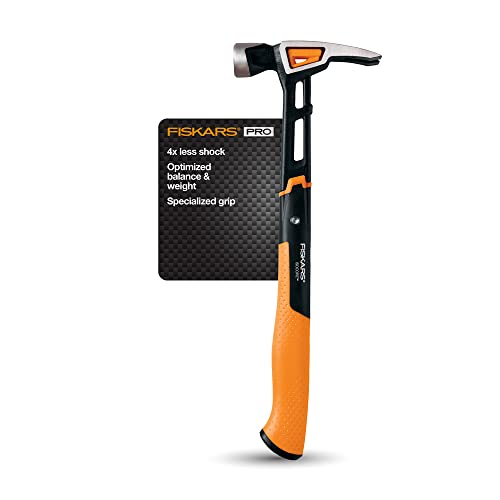
Fiskars IsoCore 16 oz General Use Hammer
An insulating sleeve separates the IsoCore’s steel core from its outer handle, interrupting shock before it reaches your hand. At 16 ounces the general use version balances well for household repairs and light carpentry. Owners rate the textured grip comfortable through long sessions on smaller nails.
Pros
- Among the best vibration reduction available
- Comfortable grip texture for extended use
- Well balanced for accurate light work
Cons
- Multi part construction is not repairable
- Bulkier handle than traditional designs
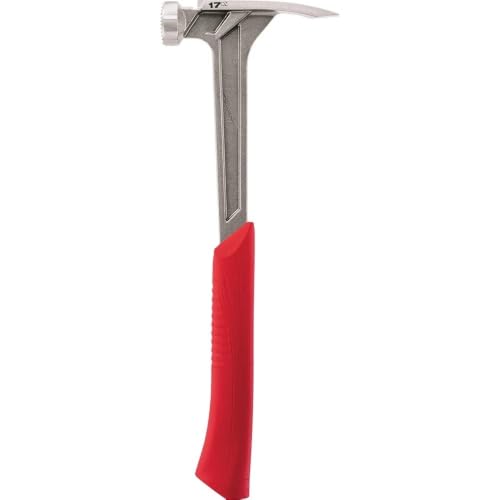
Milwaukee 48-22-9016 16 oz Milled Face Hammer
A milled face sets the 48-22-9016 apart, gripping nail heads so blows rarely glance during structural work. Waffle marks on the workpiece rule it out for cabinetry and visible trim. Beyond the curved claw, a side nail puller machined into the head adds a second extraction point.
Pros
- Milled face reduces glancing off nail heads
- Side nail puller adds a useful extra function
- Contoured handle stays comfortable
Cons
- Milled face leaves marks on visible surfaces
- Not suited to finish carpentry

TEKTON 16 oz Jacketed Fiberglass Claw Hammer
Household basics are the TEKTON’s territory: picture hooks, flat pack furniture and small repairs. Jacketed fiberglass absorbs more shock than bare steel while keeping the outlay lowest in this group. A smooth face and 16 ounce curved claw head stay safe around visible surfaces.
Pros
- Lowest outlay of the group
- Fiberglass absorbs more shock than steel
- Smooth face is safe on visible surfaces
Cons
- Handle to head joint can fail under abuse
- Not intended for sustained heavy framing
Compared at a glance
| # | Model | Head weight | Best for | Score | Price |
|---|---|---|---|---|---|
| 1 | Estwing E3-16C 16 oz Curved Claw Hammer | 16 oz | Best overall | 9.4 | Check price |
| 2 | Stanley FatMax AntiVibe Rip Claw Nailing Hammer | Available in framing weights | Best for framing | 9.2 | Check price |
| 3 | Vaughan 999ML 20 oz Curved Claw Hammer | 20 oz | Best hickory handle | 9.0 | Check price |
| 4 | DEWALT DWHT51054 20 oz Rip Claw Hammer | 20 oz | Best for demolition | 8.7 | Check price |
| 5 | Fiskars IsoCore 16 oz General Use Hammer | 16 oz | Best shock absorption | 8.5 | Check price |
| 6 | Milwaukee 48-22-9016 16 oz Milled Face Hammer | 16 oz | Best face grip | 8.2 | Check price |
| 7 | TEKTON 16 oz Jacketed Fiberglass Claw Hammer | 16 oz | Best budget | 8.0 | Check price |
Before you buy
Which head weight is right for each job? Sixteen ounces is the general purpose default, comfortable for household repairs, trim and light carpentry. Twenty ounces drives framing nails with fewer swings but tires your arm faster and feels clumsy on small work. Heavier heads belong to dedicated framing and demolition tools. If you will own one hammer, 16 ounces is almost always the right answer.
Curved claw or rip claw: which do you need? Curved claws curl tightly under the nail head, which multiplies leverage for extraction and makes them the better general purpose choice. Rip claws run nearly straight so they slide between boards for prying, splitting sheathing and demolition. Framers reach for rip claws like the Stanley FatMax AntiVibe, while homeowners and trim carpenters get more from curved designs.
Is a steel, hickory or fiberglass handle best? One piece forged steel cannot fail at the head joint but transmits the most shock unless the design adds damping. Hickory absorbs vibration naturally and can be rehandled, though wood dries out without occasional care. Fiberglass sits between the two, damping well at a modest outlay while carrying a head joint that can eventually loosen under abuse.
Do you need a milled face or a smooth face? Milled faces carry a waffle pattern that grips nail heads and cuts glancing blows during framing, at the cost of marking anything visible. Smooth faces leave finished surfaces clean, so they suit trim and household work. Whatever the face, wear eye protection, never strike another hardened tool, and retire any hammer showing chips, cracks or mushrooming.
Questions worth asking
What weight claw hammer should I buy first?
Sixteen ounces balances driving power with control for smaller nails, which makes it the standard first hammer. Add heavier tools later if framing enters the picture.
Is a 16 oz or 20 oz hammer better for home use?
For mixed household jobs, 16 ounces wins on control and comfort. Twenty ounce heads like the Vaughan 999ML or DEWALT DWHT51054 make sense once regular framing or deck work justifies the extra swing weight.
Can a rip claw hammer pull nails?
It can, just less efficiently than a curved claw because the straighter geometry gives less leverage. Rip claws trade that pulling power for prying ability between boards.
Why does my hammer sting my hand?
Vibration through the handle is the usual cause, made worse by a loose grip, an undamped steel handle or off center strikes. Anti vibration designs and hickory both reduce it, and a relaxed grip with accurate hits helps more than any feature.
What is a milled face hammer used for?
Framing and other structural nailing. The waffle pattern grips nail heads so the hammer glances off less, but it stamps a visible mark, so keep it away from finish surfaces.
How do I hammer nails without denting the wood?
Stop swinging just before the head sits flush, then finish with a nail set that drives the head below the surface. Fill the small hole afterwards for an invisible finish. Trim carpenters treat this as standard practice.
When should a hammer be replaced?
Retire any hammer with a chipped or mushroomed face, cracks in the head, or a loose or split handle, since damaged faces can throw steel fragments. Hickory handled models can often be rehandled instead of replaced.
Can I use a claw hammer to pull large or seized nails?
Slip a block of wood under the head for extra leverage and surface protection first. Long or seized nails belong to a pry bar or cat’s paw, because over levering a claw can bend or snap it.
Are wooden handled hammers still worth buying?
Yes, for the feel and the repairability. Hickory damps shock naturally, and a snapped handle costs a replacement handle rather than a new tool. The trade off is occasional care to stop the wood drying out.
Final word
Estwing’s E3-16C stays on top because a one piece forged hammer with a shock reduction grip is about as close to unbreakable as hand tools get. Framers should take the Stanley FatMax AntiVibe for its damping and rip claw, while the Vaughan 999ML rewards anyone who values hickory and a rehandleable head. Match the weight to your work and retire any hammer with a damaged face.
Jake Monroe
Jake worked as a residential contractor for over a decade before shifting to full-time writing. He evaluates power tools, hand tools and workshop gear through the lens of someone who has actually used them on job sites, not just read the box.