Dual Action vs Rotary Polishers: Which Suits Your Paint
The Porter-Cable 7424XP leads this comparison as a dual action polisher forgiving enough for beginners while still correcting moderate swirl marks. Chemical Guys TORQ10FX suits owners needing a compact tool for tight panels. TACKLIFE PPGJ01A fits budget buyers polishing a vehicle occasionally.
The Porter-Cable 7424XP is the strongest pick here for most owners because its random orbital action corrects light to moderate swirl marks while staying forgiving enough that a new user will not burn through clear coat. Variable speed control lets you match pad speed to the polish being used. The main limitation is that it lacks the aggressive cutting power a rotary polisher brings to deeper defects.
Polisher shopping gets confusing because dual action and rotary machines solve different correction problems, and picking the wrong type risks either wasted effort or paint damage. We compared orbital versus rotary action, speed range, and owner reports on heat buildup and swirl risk across each listing.
The shortlist, ranked

Porter-Cable 7424XP
This random orbital polisher has built a reputation among home detailers as a forgiving entry point into machine polishing. Variable speed control from 2500 to 6800 orbits per minute covers compounding through final polish steps. The 6 inch backing plate size suits most body panels without excessive arm fatigue.
Pros
- Forgiving action reduces risk of burning through clear coat
- Variable speed covers compounding through finishing polish
- Lightweight design reduces arm fatigue on long sessions
Cons
- Less aggressive correction than a rotary polisher on deep defects
- Random orbital motion needs more passes for heavy correction

FLEX XC3401VRG
FLEX built this dual action polisher with a longer stroke length than typical random orbital machines, which increases correction power without switching to rotary action. Professional detailers use it for both compounding and finishing, and its motor runs cooler under sustained use than entry-level units.
Pros
- Longer throw length increases correction without rotary risk
- Motor runs cooler during extended polishing sessions
- Compatible with multiple backing plate sizes
Cons
- Higher price point than entry-level dual action polishers
- Heavier body adds fatigue on extended overhead sections

Chemical Guys TORQ10FX
Chemical Guys sized this polisher smaller and lighter than standard dual action machines, aimed at tight panels like mirrors, door jambs, and bumper curves. A forced rotation feature adds correction power beyond typical random orbital action when switched on.
Pros
- Compact size maneuvers around tight curves and trim
- Forced rotation mode adds correction when needed
- Lighter weight reduces fatigue on detailed work
Cons
- Smaller backing plate covers less area per pass
- Forced rotation mode carries more swirl risk than pure random orbital
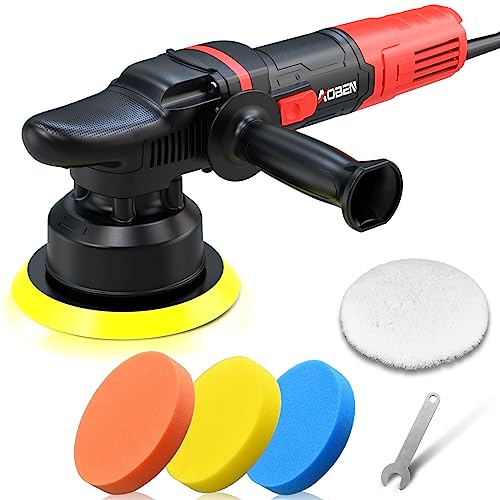
Meguiar’s MT300 Dual Action Polisher
Meguiar’s positions this polisher toward first-time owners who want a complete, straightforward tool rather than researching separate pads and backing plates. The dual action motion keeps swirl risk low, and the brand’s wide availability makes matching compounds and pads simple.
Pros
- Straightforward operation suits first-time buyers
- Wide compound and pad availability from the same brand
- Dual action motion keeps swirl risk low for beginners
Cons
- Speed range is narrower than premium competitors
- Less correction power than a rotary or extended-throw machine

Griot’s Garage 6-Inch Random Orbital
Griot’s Garage designed this polisher with ergonomics as a priority, including a balanced grip that reduces wrist strain during long sessions. The random orbital action stays beginner-friendly while a textured housing improves control on vertical panels.
Pros
- Ergonomic grip reduces wrist fatigue on long sessions
- Textured housing improves control on vertical panels
- Beginner-friendly random orbital action
Cons
- Correction power similar to other entry-level dual action units
- Costs more than comparable Porter-Cable or Meguiar’s models

DEWALT DWP849X
This rotary polisher spins in a single direction rather than the oscillating motion of a dual action tool, which generates more heat and cutting power for deep scratches and heavy oxidation. It demands more operator skill since rotary action carries a higher risk of burning paint if held in one spot too long.
Pros
- Highest correction power for deep scratches and oxidation
- Variable speed allows control over cutting aggressiveness
- Durable motor built for sustained professional use
Cons
- Higher risk of burning through clear coat without experience
- Not recommended as a first polisher for beginners
TACKLIFE PPGJ01A Dual Action Polisher
TACKLIFE offers a dual action polisher at a lower price point for owners who polish occasionally rather than professionally. It includes a variable speed dial and several foam pads in the box, which keeps initial cost down compared to buying pads separately.
Pros
- Lowest price point among polishers compared here
- Included pads reduce initial accessory cost
- Six-speed dial covers basic compounding and finishing needs
Cons
- Motor is less durable under frequent heavy use
- Vibration is more noticeable than premium-brand units
What matters most
Random orbital versus rotary, the core tradeoff A dual action polisher oscillates and spins at the same time, which spreads heat and reduces the chance of burning through clear coat. A rotary polisher like the DEWALT DWP849X spins in one direction only, cutting faster but requiring steady technique to avoid paint damage.
Backing plate size and panel coverage Larger 6 to 8 inch backing plates like those on the Porter-Cable and FLEX cover more area per pass, which speeds up work on hoods and doors. Smaller plates like the Chemical Guys TORQ10FX maneuver better around mirrors, bumpers, and trim curves.
Matching speed range to the correction task Heavier compounding for scratch removal needs higher speed settings, while finishing polish for a final shine works better at lower speeds. Variable speed dials on most machines here let you adjust between those two needs without switching tools.
Who should start with which machine First-time owners benefit most from a forgiving dual action polisher like the Porter-Cable 7424XP or Meguiar’s MT300 rather than risking paint damage with a rotary tool. Experienced detailers correcting heavy oxidation or deep scratches get more value from the DEWALT’s rotary cutting power.
How they compare
| # | Model | Action Type | Best for | Score | Price |
|---|---|---|---|---|---|
| 1 | Porter-Cable 7424XP | Random orbital (dual action) | Best Overall | 9.3 | Check price |
| 2 | FLEX XC3401VRG | Random orbital with extended throw | Best Professional-Grade | 9.1 | Check price |
| 3 | Chemical Guys TORQ10FX | Dual action with forced rotation mode | Best for Tight Spaces | 8.9 | Check price |
| 4 | Meguiar’s MT300 Dual Action Polisher | Random orbital (dual action) | Best for a DIY Starter Kit | 8.6 | Check price |
| 5 | Griot’s Garage 6-Inch Random Orbital | Random orbital (dual action) | Best for Ease of Use | 8.5 | Check price |
| 6 | DEWALT DWP849X | Rotary, single direction | Best for Heavy Paint Correction | 8.3 | Check price |
| 7 | TACKLIFE PPGJ01A Dual Action Polisher | Random orbital (dual action) | Best Budget | 7.9 | Check price |
Good to know
What is the difference between a dual action and rotary polisher?
A dual action polisher oscillates while spinning, which reduces heat buildup and swirl risk. A rotary polisher spins in one direction only, cutting more aggressively but requiring more careful technique.
Can a beginner safely use a car polisher?
Yes, with a dual action polisher and the correct pad and compound combination, beginners can safely correct light swirl marks. Rotary polishers carry more risk and are better suited to experienced users.
How much correction power do I actually need?
Light swirl marks and minor oxidation respond well to a dual action polisher. Deep scratches or heavy oxidation typically need a rotary polisher or an extended-throw dual action machine for full correction.
Does backing plate size affect how long polishing takes?
Yes, a larger backing plate covers more surface area per pass, which speeds up work on large flat panels like hoods and doors. Smaller plates take longer on big panels but handle tight curves better.
Can a car polisher burn through clear coat?
Rotary polishers carry the highest risk if held in one spot too long or used with too aggressive a pad and compound combination. Dual action polishers are more forgiving but can still cause damage with improper technique.
Do I need different pads for compounding versus finishing?
Yes, compounding pads are more abrasive to cut through heavier defects, while finishing pads are softer for removing fine swirl and adding shine. Most polisher kits include multiple pad types for this reason.
Is a compact polisher worth it for a full-size vehicle?
A compact polisher like the Chemical Guys TORQ10FX works well for tight curves and trim but takes longer on large flat panels compared to a 6 inch standard machine. Many detailers use both sizes for different sections.
How long does a typical polishing session take on a full car?
A full correction pass on an average sedan typically takes several hours depending on paint condition and machine speed. Light maintenance polishing on a car already in good condition takes considerably less time.
Our pick
The Porter-Cable 7424XP is the best overall pick for most owners because its forgiving random orbital action handles common swirl correction without the paint-burning risk of a rotary tool. Detailers correcting deep scratches or heavy oxidation should step up to the DEWALT DWP849X for its rotary cutting power. Anyone polishing occasionally on a budget should choose the TACKLIFE PPGJ01A instead for its lower cost and included pads.
Tony Russo
Tony trained as an automotive technician and spent years in service and parts retail before moving into writing. He focuses on garage tools, car care products and accessories from a hands-on maintenance perspective.


