7 Box Fans That Move Real Air Without the Noise
Lasko’s 3723 Weather-Shield tops this list since its sealed motor can sit in an open window through rain. The Air King 9723 moves the most air of any model here, built for garages and workshops. Lasko’s own B20200 classic is the best value pick, quiet enough on low for a bedroom.
Lasko’s 3723 Weather-Shield is the box fan to buy for most homes, since its sealed motor survives an open window during rain. Serious airflow for a garage or basement comes from the Air King 9723 instead. Lasko’s own B20200 classic covers the same 20 inch format at the best price, with a low speed quiet enough for a bedroom.
Box fans look interchangeable, yet manufacturers publish airflow figures inconsistently, so a fan that moves plenty of air on high can be unusable at night. Blade pitch, motor mounting and housing rigidity decide how much of that airflow arrives as noise instead of breeze. We compared published airflow figures, motor and blade design, speed counts, weather-rated housings and what owners report about rattle after a couple of summers.
The top picks, ranked
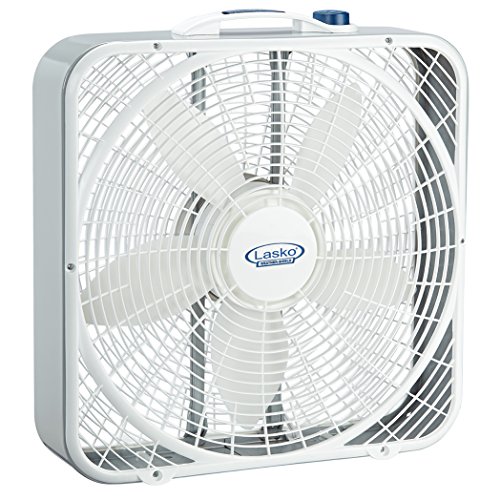
Lasko 3723 Weather-Shield 20-Inch Box Fan
A sealed, weather-resistant motor lets this fan sit in an open window through a rain shower without damage. Three speeds cover everything from overnight background air to a genuine breeze. The trade for that airflow is real noise on the top speed, and there is no thermostat or timer.
Pros
- Rated to sit in an open window during rain
- Strong airflow across all three speeds
- Molded frame includes an integrated handle
Cons
- Noticeably loud on the top speed
- No thermostat or timer functions

Air King 9723 20-Inch Box Fan
A stronger motor and steeper blade pitch push considerably more air than household box fans manage. Garages, basements drying out after a leak, and job sites are where this fan earns its keep. Weight and noise both run higher than a domestic model, so bedroom use is out.
Pros
- Highest airflow in this comparison
- Steel housing withstands workshop knocks
- Effective for drying or ventilating a space
Cons
- Too loud for bedroom use
- Heavier than plastic-framed fans
Lasko B20200 20-Inch Classic Box Fan
Three speeds and a simple rotary dial define this classic, slim enough to lean against a wall when idle. Airflow stays strong for the size, and the low setting is quiet enough for overnight bedroom use. Weather sealing is absent, so keep it indoors or in a window that stays dry.
Pros
- Low speed stays quiet enough for sleeping
- Slim profile stores flat against a wall
- Simple controls with no learning curve
Cons
- Not weather sealed for open windows
- Frame flexes if lifted by the grille

Hurricane Classic 20 Inch Box Fan HGC736501
A stiffer housing and a motor rated for extended continuous runs separate this fan from household models built for occasional evening use. Weeks of nonstop operation in a greenhouse or workshop are within its design intent. Styling stays purely functional, and it runs louder than fans built for bedrooms.
Pros
- Built for long continuous running
- Stiff housing keeps vibration rattle low
- Common choice for greenhouses and workshops
Cons
- Utilitarian appearance with no frills
- Louder than bedroom-focused fans

Comfort Zone CZ200A 20-Inch Box Fan
Three speeds and a light plastic frame cover a bedroom or small office at a low purchase price. This is the fan to grab when a second or third unit is needed without much thought. A thinner build than Lasko equivalents means it fits better staying in one spot rather than moving daily.
Pros
- Cheapest way to add another fan
- Light enough for anyone to move
- Adequate airflow for a single room
Cons
- Thin frame feels less solid
- More motor hum than premium models

Genesis 20 Inch 3 Speed Box Fan
Quiet running takes priority over raw output here, and the low setting counts among the calmer ones in this lineup for white-noise sleepers. A slim depth and carry handle make it easy to move between rooms through the day. High speed trails the workshop-grade fans, the expected tradeoff for a quieter low.
Pros
- Calm low speed suits light sleepers
- Easy to carry between rooms
- Straightforward, familiar controls
Cons
- Less airflow on high than rivals
- Plastic grille flexes easily

PELONIS 3-Speed Box Fan, 20 Inch
A flat top makes this fan easier to wedge securely into a standard double-hung window than models with raised handles. Three speeds and a simple dial keep operation obvious for anyone. No weather sealing means it belongs in a dry window rather than one exposed to storms.
Pros
- Sits securely in a standard window frame
- Flat top simplifies wedging in place
- Simple, familiar dial controls
Cons
- Not rated for wet conditions
- Airflow is average for the size
How to choose
How to read box fan airflow ratings Cubic feet per minute is the standard measurement, though manufacturers do not all test it the same way. A workshop fan like the Air King 9723 quotes a figure well above a bedroom fan, and that gap is real rather than marketing. Match the rating to the job, since a high-output fan in a small bedroom just gets run on low, gaining nothing but extra weight.
Which box fans are safe to leave in an open window Rain blowing straight into an exposed motor is the classic box fan mistake, usually discovered at 2am. Weather-resistant models such as the Lasko 3723 use sealed motor housings built for exactly that situation. Any other fan should sit in a window shielded from rain, or come inside once weather turns.
Using two fans for real cooling, not just airflow A single fan moves air across skin, which feels cooler without changing the room temperature. Actual cooling comes from swapping hot indoor air for cooler outdoor air, which takes one fan blowing out a window on the warm side and another drawing in on the cool side. Set this up in the evening once outdoor temperature drops below indoor, and the effect beats any single fan by a wide margin.
Cleaning a box fan and fixing rattles Dust collects on blade leading edges and throws off their balance, turning a quiet fan into a rattling one that stresses the bearings. Unplug the fan, remove the front grille where the design allows, and wipe each blade clean. Loose grille fasteners, not a failing motor, cause most rattles, and tightening them takes about two minutes.
Compared at a glance
| # | Model | Size | Best for | Score | Price |
|---|---|---|---|---|---|
| 1 | Lasko 3723 Weather-Shield 20-Inch Box Fan | 20 inch | Best overall | 9.4 | Check price |
| 2 | Air King 9723 20-Inch Box Fan | 20 inch | Best airflow | 9.2 | Check price |
| 3 | Lasko B20200 20-Inch Classic Box Fan | 20 inch | Best value | 9.0 | Check price |
| 4 | Hurricane Classic 20 Inch Box Fan HGC736501 | 20 inch | Best for garages and grow spaces | 8.8 | Check price |
| 5 | Comfort Zone CZ200A 20-Inch Box Fan | 20 inch | Best budget | 8.6 | Check price |
| 6 | Genesis 20 Inch 3 Speed Box Fan | 20 inch | Best for bedrooms | 8.3 | Check price |
| 7 | PELONIS 3-Speed Box Fan, 20 Inch | 20 inch | Best for window fitting | 8.0 | Check price |
Common questions
Do box fans actually cool a room?
Not on their own. They move air, which cools skin through evaporation but does not lower room temperature. Real cooling needs cross ventilation, exhausting hot air out one window while drawing cooler air in through another.
Can you leave a box fan in a window when it rains?
Only weather-resistant models such as the Lasko 3723 are built for that. Standard fans have exposed motors that water can damage, creating both a repair cost and a shock hazard.
Is it safe to run a box fan all night?
Yes, provided the fan sits on a stable, flat surface with clear airflow and plugs directly into a wall outlet. Avoid thin extension cords, and never let bedding or curtains cover the fan.
Box fan vs tower fan: which is quieter?
Tower fans usually run quieter at comparable settings, while box fans move far more air. A box fan on low is often quieter than a tower fan on high, so compare at the setting you would actually use.
Can a box fan double as an air purifier?
Taping a furnace filter to a box fan is a well-known DIY approach for cutting dust and smoke particles. It is no substitute for a proper purifier, and an overly restrictive filter strains the motor and risks overheating.
How much electricity does a box fan use?
Far less than air conditioning, roughly in the range of a bright light bulb rather than a heating appliance. Running two fans for cross ventilation still costs a fraction of mechanical cooling for the same space.
How do you stop a box fan from rattling?
Clean dust off the blades so they stay balanced, then check the grille fasteners and feet. Rattles almost always trace back to loose panels rather than the motor itself.
What size box fan should you buy?
Twenty inches is the standard size and fits most double-hung windows and doorways. Smaller fans exist for tight windows but move noticeably less air for the same effort.
Which box fan is best for a garage or workshop?
The Air King 9723 and Hurricane Classic HGC736501 both move more air and tolerate longer continuous runs than household fans. Steel or reinforced housings on both hold up better to workshop knocks.
The bottom line
Lasko’s 3723 Weather-Shield remains the box fan to buy for most households, delivering strong airflow and the only sealed motor here rated for an open window in rain. Step up to the Air King 9723 for workshop-grade output in a garage or basement. Choose the Genesis 20 Inch instead when quiet running at night matters most.
Jake Monroe
Jake worked as a residential contractor for over a decade before shifting to full-time writing. He evaluates power tools, hand tools and workshop gear through the lens of someone who has actually used them on job sites, not just read the box.