Bottle Drying Racks Ranked by Airflow and Capacity
Boon GRASS leads for most homes, since flexible blades keep bottles, teats and valves apart while water drains into a lift out tray. OXO Tot Space Saving Drying Rack folds flat for narrow counters. Munchkin High Capacity Bottle Drying Rack suits pumping parents washing sixteen pieces at once.
Boon GRASS fits most bottle feeding households. Upright blades hold each bottle clear of its neighbour, and water runs straight down into a shallow tray. Teats, valves and sippy lids wedge between blades, so no separate peg bar is needed. Standing water in the base needs tipping out every morning.
Racks look interchangeable in a listing photo, yet layout decides whether a bottle dries in two hours or stays damp until lunch. We compared usable bottle counts, counter footprint, drainage path, spacing for small parts, and dishwasher compatibility for the rack itself. Owner reports about mould in sealed hollow bases ruled several designs out.
What we recommend

Boon GRASS Countertop Drying Rack
Flexible polypropylene blades rise from a shallow base, so bottles stand separated instead of leaning together. Valves, teats and sippy lids wedge between blades at any angle, which removes the need for a peg bar. Water tracks down each blade into the base tray, and that tray lifts out for the dishwasher.
Pros
- Spaced blades let air reach the inside of every bottle
- Odd shaped teats and valves slot in without pegs
- Base tray lifts free for rinsing or a dishwasher cycle
Cons
- Base holds standing water until you empty it daily
- Heavy glass bottles splay the blades outward

OXO Tot Space Saving Drying Rack
Folding frame drops flat once bottles are put away, freeing a galley counter between washes. Pegs and tubes pull out and move, so the layout follows bottles, teats and pump flanges through the first year. A spout on the drip tray pours collected water into the sink rather than across the worktop.
Pros
- Collapses to a flat panel for cupboard storage
- Peg positions change as bottle sizes change
- Spouted tray empties without spilling on the counter
Cons
- Hinge recesses hold water and want towel drying
- Six bottle capacity trails the fixed frame racks

Munchkin High Capacity Bottle Drying Rack
Sixteen bottles plus teats and rings fit in one load, which covers a full day for twins or exclusive pumping. An angled spout sends drained water toward the sink instead of letting it sit under the pegs. Every piece survives a dishwasher cycle, useful because a rack this busy needs sanitising weekly.
Pros
- Holds a whole day of bottles in a single load
- Angled drainage keeps water off the worktop
- All components go through the dishwasher
Cons
- Needs a long stretch of counter when fully loaded
- Tight peg spacing slows airflow at full capacity
Boon LAWN Countertop Drying Rack
A wider blade field than the Grass gives flanges, connectors and tubing their own space beside bottles. Pump parts defeat rigid pegs because of their cone shapes, whereas blades simply bend around them. Drainage follows the same route, down the blades into a removable tray.
Pros
- Blade spacing suits cone shaped pump flanges
- Accepts Boon Twig and Stem add ons
- Tray slides out the same way as the Grass
Cons
- Deeper footprint than the Grass on a narrow counter
- Droplets cling where blades meet the base
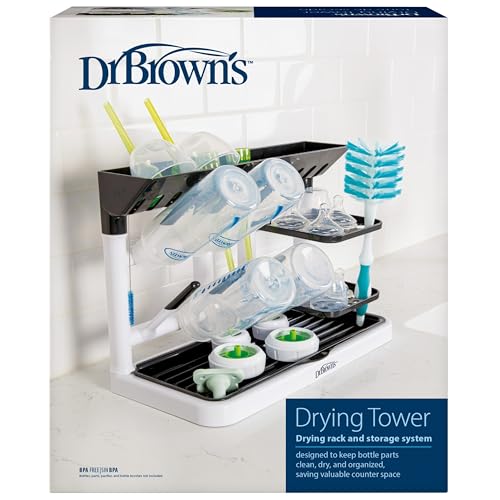
Dr. Brown’s Universal Drying Rack
Vent inserts and reservoir tubes separate from Dr. Brown’s bottles and roll off most racks. Narrow slots here hold those pieces upright, so water runs out of the tube instead of sitting in it. Bottle pegs and a teat shelf cover the rest of the wash load.
Pros
- Slots keep vent inserts and tubes standing upright
- Sized around the higher part count of vented bottles
- Teat shelf stops nipples rolling onto the counter
Cons
- Extra slots go unused with simpler bottle systems
- Cleaning inside the narrow slots needs a bottle brush

Termichy Stainless Steel Bottle Drying Rack
Grade 304 stainless replaces plastic throughout, so the frame will not yellow or hold milk odour after a year of daily washing. Rods unclip, letting you take the rack apart and wash every surface rather than scrubbing around fixed posts. Underneath, a drip tray slides out for emptying.
Pros
- Steel resists staining and absorbed milk smell
- Detachable rods make deep cleaning straightforward
- Extra weight keeps it steady when loading one handed
Cons
- Hard water leaves visible spots on the steel
- Straight rods suit bottles better than pump flanges

Philips Avent Bottle and Cup Drying Rack
A shallow tray with removable pegs handles roughly five bottles plus teats, enough for combination feeding. Pull the pegs out and it becomes a flat draining tray for beakers and weaning cups. Low weight means it moves to the sink or dish drainer without unloading first.
Pros
- Takes the least counter space of the racks here
- Converts to a flat tray once toddler cups arrive
- Light enough to lift and empty one handed
Cons
- Five bottle capacity runs short for exclusive bottle feeding
- Shallow tray fills quickly when several bottles drain together
What matters most
What to look for in a bottle drying rack Air does the drying, so spacing between bottles matters more than a headline capacity number. Follow the water: open trays that lift out beat sealed hollow bases, which grow a film within days. Blades flex around teats, valves and membranes, while pegs suit bottles and cups more than pump parts. Confirm the rack itself is dishwasher safe, since it needs sanitising as often as what sits on it. Material comes last, though stainless avoids the yellowing plastic shows after a year of daily use.
Matching capacity to your feeding routine Combination feeding produces two or three bottles a day, which the Philips Avent tray absorbs easily. Exclusive bottle feeding pushes that toward eight bottles plus teats and rings. Add pumping and the count doubles again, once flanges, valves, membranes and connectors join the pile. Twins or a twice daily pumping routine justify the Munchkin High Capacity rack. On a narrow counter, a folding OXO Tot frame beats an oversized rack you cannot leave out.
Drying pump parts, valves and vent inserts Silicone membranes cling to flat surfaces and stay wet for hours when stacked. Lay them out singly, away from valves, so both sides meet air. Cone shaped flanges tip sideways on pegs and trap water inside, which is why the Boon LAWN blade field handles them better. Dr. Brown’s vent inserts and reservoir tubes need a vertical slot or they roll off. Anything with a narrow bore should point downward to drain.
Keeping the rack itself clean Tip the drip tray out each morning, because warm water carrying milk residue is where bacteria multiply first. Wash the whole rack weekly, by dishwasher where the manufacturer allows it. Two spots hide growth: the roots of flexible blades and the inside of narrow slots. Rinse plastic racks under hot water rather than leaving them to soak, since trapped moisture is the underlying problem. Stainless frames such as the Termichy age better if the rack will serve a second child.
The lineup, side by side
| # | Model | Capacity | Best for | Score | Price |
|---|---|---|---|---|---|
| 1 | Boon GRASS Countertop Drying Rack | Around 8 bottles plus parts | Best overall | 9.4 | Check price |
| 2 | OXO Tot Space Saving Drying Rack | Around 6 bottles plus accessories | Best for small counters | 9.2 | Check price |
| 3 | Munchkin High Capacity Bottle Drying Rack | Around 16 bottles and parts | Best high capacity | 9.0 | Check price |
| 4 | Boon LAWN Countertop Drying Rack | Bottles plus full pump part sets | Best for pump parts | 8.8 | Check price |
| 5 | Dr. Brown’s Universal Drying Rack | Around 6 bottles plus vent parts | Best for vented bottle systems | 8.6 | Check price |
| 6 | Termichy Stainless Steel Bottle Drying Rack | 304 stainless steel | Best stainless steel | 8.3 | Check price |
| 7 | Philips Avent Bottle and Cup Drying Rack | Around 5 bottles plus teats | Best budget | 8.0 | Check price |
Frequently asked questions
Do you need a bottle drying rack, or will a dish rack do?
Air has to reach inside the bottle, and that happens only when the neck points down with clear space around it. Standard dish drainers let bottles lean against plates and each other. Anyone washing more than two bottles a day notices the difference within a week.
How do you stop mould growing in a bottle drying rack?
Empty the tray daily instead of letting water stand. Give the rack a weekly wash, focusing on blade roots and narrow slots. Sealed hollow bases cause the worst problems, since water enters and never fully dries, so open tray designs are the safer buy.
Which bottle drying rack is best for pump parts?
Boon LAWN handles flanges, connectors and tubing better than peg racks, because blades bend around cone shapes without sealing against them. Pegs hold a flange at an angle and trap water in the cone. Split membranes from valves before laying them out.
Are bottle drying racks dishwasher safe?
Most plastic racks here go on the top rack, including the two Boon models, Dr. Brown’s and Philips Avent. Munchkin lists the whole rack as dishwasher safe. Treat the drip tray separately, because thin trays can warp in a heated dry cycle.
Boon Grass vs Boon Lawn: which should you buy?
Both share the same flexible blades and removable base tray. Lawn spreads blades over a wider field, which fits pump sets and larger daily loads. Grass keeps a smaller footprint, better on shallow counters behind a sink.
How long do baby bottles take to air dry?
Two to four hours is normal for bottles standing neck down with airflow around them. Teats and valves dry faster once laid out singly rather than stacked. Bottles still damp after four hours are usually packed too closely.
Is a stainless steel bottle rack better than plastic?
Steel will not yellow or absorb milk odour, and detachable rods let you clean every surface. Plastic blades adapt better to irregular pump parts. For a rack that has to last through a second baby, stainless ages more cleanly.
What size rack do you need for exclusive pumping?
Count bottles plus flanges, valves, membranes and connectors, which often reaches twenty pieces in a day. Munchkin High Capacity or the wide blade field on Boon LAWN absorbs that volume. Compact trays fill by mid afternoon and force a second wash cycle.
Can a bottle drying rack hold sippy cups and toddler bottles?
Racks with removable pegs convert easily, since taking the pegs out leaves a flat draining surface for beakers. Philips Avent is designed around that transition. Fixed blade racks still hold cups, though tall tumblers can lean against each other.
Where should a drying rack go in a small kitchen?
Beside the sink on the draining side works best, so tray water goes straight down the plughole. Keep it away from a hob, where grease settles on wet surfaces. A folding OXO Tot frame is the option for counters with no permanent free space.
Our pick
Buy the Boon GRASS unless something specific rules it out, because blade spacing solves the exact problem a rack exists for: keeping wet surfaces apart. Households washing a full day of bottles at once will hit its ceiling and should order the Munchkin High Capacity rack instead. Parents pumping daily get more from the Boon LAWN, whose wider blade field takes flanges and tubing that pegs mishandle.
Dana Whitfield
Dana spent eight years buying and merchandising for a regional kitchenware retailer before moving into editorial work. She has handled thousands of SKUs across cookware, small appliances and kitchen organization, and focuses on the practical differences that matter once a product is actually in daily use.
You might also need

Wall-Mounted Shelves Ranked by Weight Capacity and Material
EKOCSIO Magnetic Air Vent Deflector: Redirecting Airflow Without Tools
How Does a Dish Drying Rack’s Material Affect How Fast Dishes Dry?
