Road trip jump starters and the Bluetooth question
NOCO Boost Plus GB40 fits most road trips, with 1000 peak amps for gas engines to 6 liters. Diesel pickups need the GOOLOO GT4000S and its 4000 amp rating. Want a tire compressor in the same case? Carry the DEWALT DXAEPS14 instead.
NOCO Boost Plus GB40 belongs under the seat of most road trip cars. Its 1000 peak amps cover gas engines to 6 liters. Weight sits near 2.4 pounds, so the pack actually stays in the glovebox instead of the garage. Micro USB input is the catch, and recharging drags.
Bluetooth muddies this search. Very few packs pair with a phone, and most smart labels just mean an LCD readout. We compared peak amp ratings, published engine limits, cell capacity in mAh, port selection and weight. Owner reports on freezing morning starts and charge retention in storage broke the close calls.
How to choose
How many peak amps your engine actually needs Peak amps is a burst number, not a sustained one. Treat the engine size limit printed on the box as the real spec. Four cylinder gas cars start comfortably on 1000 amps. A 6 liter V8 wants 1000 to 1500. Diesels compress harder, so a 6 liter diesel pickup calls for 2000 amps and up. Cold shifts the math twice over: the battery delivers less and the engine turns tighter. Size one tier above your everyday need if winter driving is normal.
Capacity, ports and how fast it refills Capacity in mAh sets how many restarts you get and how long the pack feeds a phone. A 20000mAh unit like the Hulkman Alpha 85 covers several starts plus camp charging. Ports decide your evening. USB-C Power Delivery, as on the NOCO GBX55, refills in roughly an hour from a laptop charger. Micro USB packs eat most of a night. Heat quietly kills lithium cells, so keep a pack off a summer dashboard. Storing it between about 40 and 80 percent charge extends cell life.
Does any jump starter pair with your phone? Bluetooth barely exists in this category. None of the seven packs above connects to a phone. Smart, in listing language, usually means a display plus automatic fault detection. Want battery data on screen? Clip a dedicated Bluetooth monitor such as the Ancel BM200 onto the terminals. That device logs voltage and cranking health while the starter stays a simple, reliable tool. Splitting the two jobs also helps on the morning your phone is flat.
Extras that earn their space on a long drive Starting power settled, the extras decide the buy. Punctures outnumber dead batteries on long trips, which is the real DEWALT DXAEPS14 argument despite its weight. Most breakdowns happen after dark, so the strobe modes on the NOCO and AVAPOW lights earn their place. Families travelling with tablets get more from 60 watt USB-C output than from a higher amp headline. Skip the compressor entirely if a plug kit and a separate inflator already live in the trunk.
The top picks, ranked
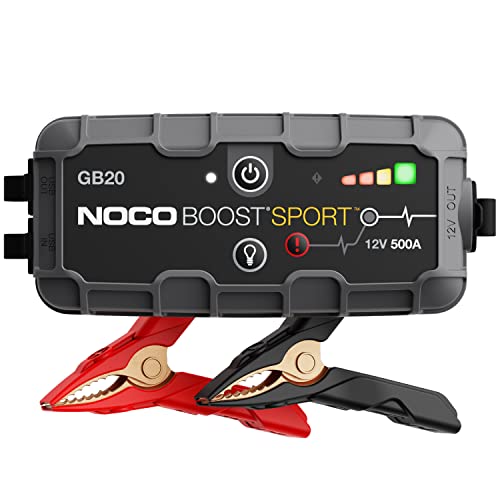
NOCO Boost Plus GB40
Door pockets fit it, yet a 6 liter V8 still fires. Reverse polarity protection and spark proof clamps matter when you work by feel on gravel. A 100 lumen light adds strobe and SOS modes, and the USB port tops up a phone while traffic clears.
Pros
- Spark proof clamps hold current back until polarity is right
- Under 2.5 pounds, light enough to live in a glovebox
- Owners report strong charge retention between trips
Cons
- Micro USB input stretches recharging across hours
- Amp rating falls short on large diesel engines
NOCO Boost X GBX55
Scaled up GB40 thinking: 1750 peak amps, gas engines to 7.5 liters, diesels to 5. USB-C Power Delivery moves 60 watts in both directions, refilling the pack in roughly an hour from a laptop brick. Bigger cells add bulk you notice in a door pocket.
Pros
- Refills in about an hour over USB-C
- 60 watt output runs a laptop on long drives
- Covers most SUVs, vans and light trucks
Cons
- Heavier than the GB40 by a clear margin
- More pack than a small commuter car needs

Hulkman Alpha 85
A color display replaces the usual row of cryptic LEDs, reporting charge level, clamp status and plain language faults. Ratings of 2000 peak amps and a 20000mAh cell cover 8.5 liter gas engines and 6 liter diesels. First timers working under stress gain the most from that screen.
Pros
- Screen names the fault instead of blinking a code
- 2000 amps and 20000mAh for a mid range outlay
- Recharges faster than older micro USB packs
Cons
- Bulkier than pocket sized NOCO units
- Display draws a little standby power

GOOLOO GT4000S
Towing rigs pull reserve that small packs never held. GOOLOO rates 4000 peak amps beside a 26800mAh cell, reaching gas engines of 10 liters and diesels of 8. Repeat starts on one charge suit a cold camper morning with an aging battery.
Pros
- Enough reserve for several starts on one charge
- Cranks diesel engines that smaller packs refuse
- 26800mAh doubles as a large phone power bank
Cons
- Too heavy for a glovebox, so it rides in a trunk bag
- Full recharge runs several hours

DEWALT DXAEPS14 Portable Power Station Jump Starter
Punctures strand more trips than dead batteries, and this unit answers both faults. A 120 PSI compressor with auto shutoff sits beside a 1400 peak amp starter, plus USB ports and a 12V socket. Lead acid construction puts it in the trunk rather than the cabin.
Pros
- Covers flats and dead batteries in one box
- 12V socket feeds a cooler or inflator at camp
- Auto shutoff gauge sets tire pressure accurately
Cons
- Much heavier than any lithium pack here
- Lead acid cells need top up charging in storage

Fanttik T8 Apex
Cupholder sized, yet rated at 2000 peak amps. Stated range reaches gas engines of 8.5 liters and diesels of 6, and the alloy shell sheds heat better than a plastic case. Smart clamps verify polarity before current flows, which calms a nervous first attempt.
Pros
- Strong amp rating inside a very small body
- Alloy case dumps heat faster than plastic shells
- Clamp indicator confirms a good connection
Cons
- Small cell limits how many starts per charge
- Short cables struggle on deep engine bays
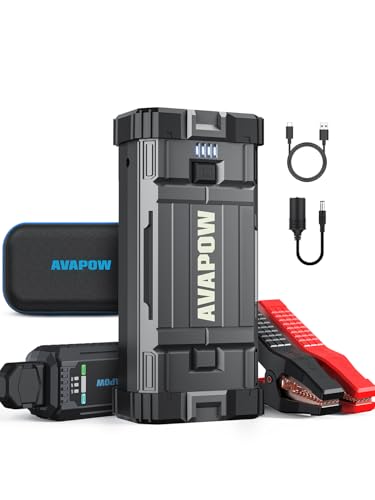
AVAPOW A58 Car Battery Jump Starter
Cheaper packs usually surrender amps. This one claims 2500 peak, an 8 liter gas limit and a USB-C input that skips the slow micro USB trap. A strobe capable work light helps at the roadside, though charge retention trails the premium brands.
Pros
- 2500 peak amps at entry level outlay
- USB-C input recharges without an overnight wait
- Work light is bright enough for real repairs
Cons
- Owners report faster self discharge in storage
- Clamps feel lighter than NOCO or DEWALT hardware
How they stack up
| # | Model | Peak current | Best for | Score | Price |
|---|---|---|---|---|---|
| 1 | NOCO Boost Plus GB40 | 1000 amps | Best overall | 9.4 | Check price |
| 2 | NOCO Boost X GBX55 | 1750 amps | Best for big engines | 9.2 | Check price |
| 3 | Hulkman Alpha 85 | 2000 amps | Best value | 9.0 | Check price |
| 4 | GOOLOO GT4000S | 4000 amps | Best for diesel trucks | 8.8 | Check price |
| 5 | DEWALT DXAEPS14 Portable Power Station Jump Starter | 1400 amps | Best for roadside kit | 8.5 | Check price |
| 6 | Fanttik T8 Apex | 2000 amps | Best compact pick | 8.3 | Check price |
| 7 | AVAPOW A58 Car Battery Jump Starter | 2500 amps | Best budget | 8.0 | Check price |
Common questions
Do any car jump starters have Bluetooth?
Almost none. Packs marketed as smart usually mean an LCD screen and automatic safety detection. For phone alerts on battery health, add a dedicated Bluetooth battery monitor at the terminals instead.
How many amps do I need to jump start my car?
Match the engine, not the headline. Four cylinder gas engines start on 1000 peak amps. Large V8s want 1500 or more. Diesels above 5 liters need 2000 amps upward.
Which jump starter is best for a diesel truck?
GOOLOO GT4000S carries the most reserve here at 4000 peak amps and 26800mAh, with a stated 8 liter diesel limit. NOCO Boost X GBX55 covers diesels to 5 liters in a smaller body.
Is it safe to leave a jump starter in a hot car?
A trunk treats lithium cells better than a dashboard, though repeated high heat still shortens life. Check the charge monthly in summer and keep the pack out of direct sun.
How often should you recharge a jump starter?
Every three months is the common guidance for lithium packs. Lead acid units like the DEWALT need topping up more often. Owners report most failures come from packs left unchecked for a year.
Will a jump starter work on a completely dead battery?
Often yes. Many packs refuse to engage at zero volts until you press a manual override, so confirm your model has a force or boost mode before you need it.
Do jump starters work in freezing weather?
They work, but lithium cells give up output below freezing. Keep the pack in the cabin overnight rather than the trunk, and choose a rating above your engine size for winter trips.
NOCO GB40 vs GBX55: which suits long road trips?
GB40 is lighter and enough for gas engines to 6 liters. GBX55 brings 1750 peak amps, a 5 liter diesel rating and 60 watt USB-C charging both ways. Big engines and long drives favor the GBX55.
Can a jump starter charge a laptop?
All seven charge phones. Laptops need USB-C Power Delivery output, which the NOCO GBX55 supplies at 60 watts. USB-A only packs cannot run a modern laptop.
What happens if the clamps go on backwards?
Quality packs block current until polarity is correct. NOCO, Fanttik and GOOLOO all list reverse polarity protection with an audible or visual warning. Unbranded units may not, which is where sparks and damage start.
The verdict
Keep the NOCO Boost Plus GB40 as the road trip default. 1000 amps covers most gas engines, and 2.4 pounds means the pack never gets left behind. Trailer and diesel duty points to the GOOLOO GT4000S for its 4000 amp reserve and repeat starts. Drivers more likely to meet a nail than a flat battery get more from the DEWALT DXAEPS14 and its 120 PSI compressor.
Tony Russo
Tony trained as an automotive technician and spent years in service and parts retail before moving into writing. He focuses on garage tools, car care products and accessories from a hands-on maintenance perspective.


