Heavy duty battery testers that fit a road trip glovebox
ANCEL BA101 suits most road trips, reading 100 to 2000 CCA on 12V batteries and running cranking plus charging checks in one pass. TOPDON BT100 delivers the same coverage in a door pocket shell. FOXWELL BT705 adds 24V support for motorhomes and box trucks.
ANCEL BA101 fits most drivers facing a long drive, since it reads 100 to 2000 CCA and checks cranking and charging voltage without a second meter. Its clamps are the weak link, so heavily corroded terminals need a wire brush first.
Battery failure on the road gives little warning, because a weak cell still spins a warm engine. We compared CCA range, supported chemistries, whether cranking and alternator tests are included, clamp construction and case size. Owner reports then showed which units repeat a reading consistently and which drift.
Before you buy
What a battery tester actually measures Two methods dominate. Conductance testers, which cover most of this list, push a small signal through the battery and compare the response against its rated CCA. Carbon pile units such as the Schumacher BT-100 pull a real 100 amp load and watch the voltage sag. Both spot a dying battery, though only a load test proves behaviour under strain.
Matching CCA range and voltage to your vehicle Read the number printed on your battery label first. Most cars land between 400 and 800 CCA, so a 100 to 2000 range covers them with room spare. Diesel pickups climb higher, and motorhomes often run 24V, which is where the FOXWELL BT705 earns its slot. Entering the wrong rated CCA produces a health score that means nothing.
What to pack for a long drive Glovebox space is finite, so size outranks features on a trip. ANCEL BA101 and TOPDON BT100 both disappear into a door pocket. Run a test before you leave and again at any long stop, since underhood heat speeds up failure. Pack jumper cables alongside, because knowing the battery is dead will not start the engine.
Reading the results and what to do next Health below 60 percent means replace soon rather than eventually. Resting voltage under 12.4 volts signals undercharge, usually from a run of short trips. Cranking voltage below 9.6 volts says the battery folds under load. Anything above 14.7 volts while running points at a regulator fault, not the battery, and no tester fixes that for you.
The best picks, ranked

ANCEL BA101 Automotive Battery Load Tester
Conductance testing skips the load bank and the waste heat, which is how the BA101 stays glovebox sized. Coverage spans 100 to 2000 CCA across flooded, AGM and gel batteries. One set of clamps runs both the cranking and charging tests, so you learn whether the alternator or the battery is at fault.
Pros
- Covers 100 to 2000 CCA in one unit
- Separates battery faults from alternator faults
- Draws power from the vehicle, no internal cells
Cons
- Clamps bite poorly on corroded terminals
- Screen washes out in direct sun

TOPDON BT100 Car Battery Tester
Small enough to live in a door pocket, the BT100 still covers 100 to 2000 CCA. That range takes in almost every car and light truck battery on the road, including EFB units in start stop cars. Results land on a backlit screen as a health percentage, which reads fast at a rest stop.
Pros
- Fits a door pocket or centre console
- Supports EFB start stop batteries
- Health percentage needs no interpretation
Cons
- Short cable limits reach in deep engine bays
- No printing or data logging
FOXWELL BT705 Battery Analyzer
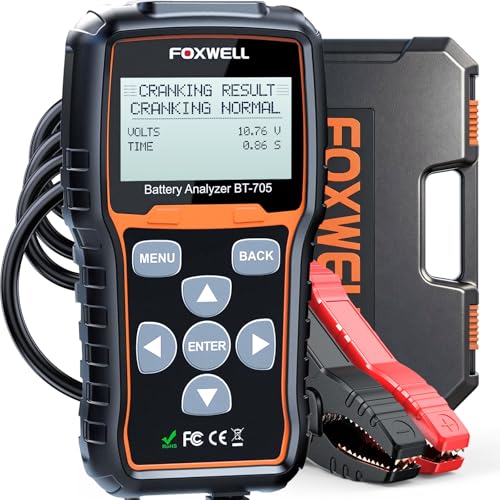
Support for 24V systems makes this the pick for motorhomes, box trucks and dual battery builds. Coverage runs 100 to 2000 CCA with cranking, charging and ripple analysis included. A colour screen and menu tree take longer to learn than the one button testers here, so read the manual before you need it roadside.
Pros
- Handles 24V truck and RV systems
- Ripple test flags failing alternator diodes
- Colour screen shows the full result set at once
Cons
- Menu navigation takes learning
- Bulkier than pocket testers

KONNWEI KW600 Car Battery Tester
Press one button and a result appears within seconds. KW600 reads 100 to 2000 CCA and reports internal resistance, the figure that flags a battery about to quit. Housing quality is basic, so keep it in a case instead of loose under a seat.
Pros
- Reports internal resistance alongside CCA
- Anyone can run it without training
- Light enough to forget it is packed
Cons
- Plastic housing feels fragile
- Clamps are small for large truck terminals

ANCEL BST500 Battery Load Tester with Printer
A built in thermal printer puts every test on paper, useful when you track battery health across several vehicles. Coverage reaches 12V and 24V from 100 to 2000 CCA on a colour display. Size and weight make this a garage tool that rides in a trunk, not a glovebox companion.
Pros
- Printed records for multi vehicle logs
- Covers both 12V and 24V systems
- Large colour display reads at arm’s length
Cons
- Too large for a glovebox
- Printer paper needs restocking

Schumacher BT-100 Battery Load Tester
Instead of calculating from conductance, this pulls a genuine 100 amp carbon pile load and shows the voltage drop on an analog dial. Mechanics have trusted that method for decades to catch a shorted cell. Heat builds during the test, so it needs a cool down before the next battery.
Pros
- Applies a true load rather than estimating
- No firmware or internal cells to fail
- Also exposes heavy starter draw
Cons
- Runs hot and needs cool down time
- Gives no CCA figure or digital record

TOPDON BTMobile Bluetooth Battery Tester
Clip it to the terminals and results travel to a phone over Bluetooth, with no screen to crack in a toolbox. Its app keeps test history, which shows a battery sliding across a summer of driving. Phone dependency is the catch, because a flat handset leaves you with no readout at all.
Pros
- Stores test history in the app
- No display to break in a toolbox
- Palm sized and easy to stash
Cons
- Needs a charged phone to work
- Bluetooth drops inside metal engine bays
How they compare
| # | Model | Voltage | Best for | Score | Price |
|---|---|---|---|---|---|
| 1 | ANCEL BA101 Automotive Battery Load Tester | 12V | Best overall | 9.4 | Check price |
| 2 | TOPDON BT100 Car Battery Tester | 12V | Best value | 9.2 | Check price |
| 3 | FOXWELL BT705 Battery Analyzer | 12V and 24V | Best for RVs and trucks | 9.0 | Check price |
| 4 | KONNWEI KW600 Car Battery Tester | 12V | Best budget | 8.8 | Check price |
| 5 | ANCEL BST500 Battery Load Tester with Printer | 12V and 24V | Best for fleet record keeping | 8.5 | Check price |
| 6 | Schumacher BT-100 Battery Load Tester | 6V and 12V | Best analog load tester | 8.2 | Check price |
| 7 | TOPDON BTMobile Bluetooth Battery Tester | 12V | Best for phone based checks | 8.0 | Check price |
Questions worth asking
Do I need a battery tester for a road trip?
If the battery is past three years old, yes. Heat and long idling speed up failure, and a weak cell often passes a warm morning start before quitting at a rest stop.
What CCA range should a battery tester cover?
100 to 2000 CCA handles cars, vans and most light trucks. Every tester here reaches that ceiling. Only large diesel fleets and 24V systems ask for more.
Can a battery tester check the alternator too?
Most digital units can. ANCEL BA101, TOPDON BT100 and FOXWELL BT705 each run a charging system test that reports output voltage and ripple behaviour.
Which battery tester works on 24V RV systems?
FOXWELL BT705 and ANCEL BST500 both cover 24V. Everything else here is 12V only, apart from the Schumacher BT-100, which handles 6V and 12V.
Is a load tester better than a digital battery tester?
A carbon pile tester shows real behaviour under draw and catches a shorted cell that conductance testing can miss. Digital testers win on speed, heat and roadside convenience.
Will a tester work on AGM and start stop batteries?
Yes, as long as you select the correct type before testing. TOPDON BT100 and FOXWELL BT705 both list EFB support, the chemistry most start stop cars use.
What health percentage means I should replace the battery?
Under 60 percent, replace it before any long drive. Between 60 and 75 percent it will usually start a warm engine yet struggle on a cold morning.
Do these battery testers need their own batteries?
Most draw power from the vehicle battery under test, including the ANCEL BA101. TOPDON BTMobile is the exception, since it relies on a charged phone.
How often should you test a car battery?
Twice a year is a sensible baseline, plus once before any trip over a few hundred miles. Tow vehicles and RVs that sit for months deserve a check after every long layup.
Which tester suits a diesel pickup with two batteries?
FOXWELL BT705, because it reads 24V pairs and flags alternator ripple. Test each battery on its own first, since one failing unit drags the healthy one down.
Our pick
ANCEL BA101 is the tester to leave in a normal car, since it tells a tired battery apart from a failing alternator in about thirty seconds. Motorhome and box truck drivers should step up to the FOXWELL BT705 for 24V coverage. Anyone who wants proof under real load rather than a calculation should carry the Schumacher BT-100.
Tony Russo
Tony trained as an automotive technician and spent years in service and parts retail before moving into writing. He focuses on garage tools, car care products and accessories from a hands-on maintenance perspective.