Bluetooth or brute amps: garage jump starters ranked
NOCO Boost X GBX55 leads for a home garage, pairing 1750 peak amps with 60 watt USB-C in both directions. CTEK CS FREE is the one real Bluetooth pick, adding app monitoring and battery maintenance. HULKMAN Alpha 85 buys more raw amps and an onboard status screen.
NOCO Boost X GBX55 fits a garage running one or two petrol cars. Its 1750 peak amps cover most four and six cylinder engines, and a 60 watt USB-C port refills the pack in about an hour. Spark proof clamps forgive a wrong hookup. Bluetooth is the missing piece.
That gap runs across the whole category, since almost nothing on Amazon genuinely pairs with a phone. We compared peak amps, chemistry, recharge time, clamp protection, cable length and stated engine limits. Listings claiming wireless features were checked against what the app actually controls. Owner reports on cold cranking and self discharge set the final order.
The top picks, ranked
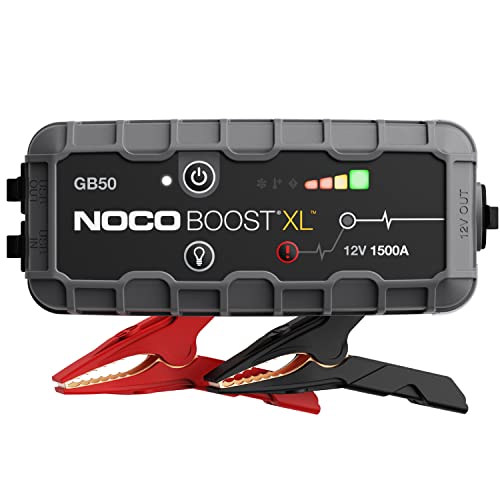
NOCO Boost X GBX55
Rated at 1750 peak amps, this lithium pack turns petrol engines near 7.5 litres and diesels close to 5 litres. USB-C Power Delivery moves 60 watts in and out, so a full refill takes roughly an hour and a laptop can borrow the charge. Spark proof clamps and reverse polarity protection make it safe to hand over to a neighbour.
Pros
- Refills in about an hour over USB-C
- Clamps stay inert until they touch the right posts
- Compact enough to live in a glovebox
Cons
- No Bluetooth or companion app
- Wants a top up charge every few months

CTEK CS FREE
Pairing over Bluetooth, the CTEK app reports charge state and switches modes without a walk to the garage. Four jobs share one body: jump starting, adaptive charging, long term maintenance and USB-C power bank duty. Adaptive boost feeds a flat battery first, rather than dumping current in a single hit.
Pros
- App control that exists in practice, not just the listing
- Keeps a stored car topped up for months
- Gentler on an ageing battery than a raw amp dump
Cons
- Adaptive boost runs for minutes before cranking
- Peak output trails brute force lithium packs

HULKMAN Alpha 85
Peak output reaches 2000 amps, and a 20000mAh cell covers several starts across a weekend of garage work. Colour LCD shows pack charge, clamp status and fault codes, so a failed attempt explains itself instead of leaving you guessing. IP65 sealing lets it sit on a damp workshop shelf without a case.
Pros
- Screen names the fault when a start fails
- Capacity covers repeated attempts per charge
- Thick clamps bite through terminal corrosion
Cons
- No wireless link of any kind
- Bulkier than pocket sized lithium packs

GOOLOO GT4000S
Four thousand peak amps leave headroom for big block petrol engines and heavy diesel pickups parked at home. Cold mornings expose weaker packs on the second attempt, where this one still delivers. USB-C Power Delivery covers recharging and phone top ups between jobs, and a built in LED lights the engine bay.
Pros
- Headroom suits V8 and diesel truck starting
- Output holds up in an unheated garage
- Works as a high capacity power bank
Cons
- Heavier than most lithium starters
- Overkill for a small commuter car
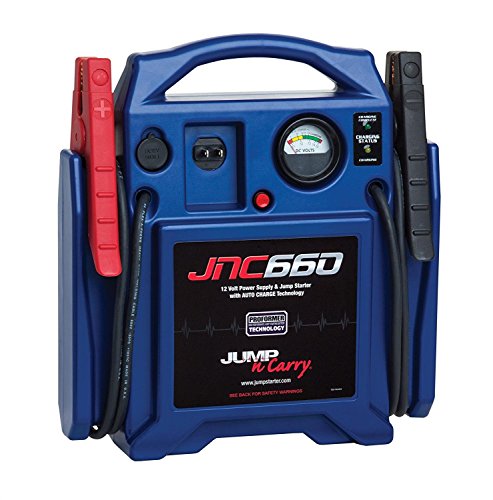
Clore Automotive Jump-N-Carry JNC660
AGM lead acid replaces lithium inside, trading pocket size for stamina across many starts in a row. Cables run 46 inches, long enough to cross an engine bay or reach a car parked at an awkward angle. Workshop techs leave these on a charger for years, which tells you how little goes wrong.
Pros
- Long cables reach buried battery positions
- Handles repeated heavy cranking without sulking
- Few moving parts, so little to break
Cons
- Much heavier than any lithium pack
- Needs regular recharging to stay healthy

DEWALT DXAEPS2 Professional Power Station
Jump starting shares a wheeled case with a 120 PSI air compressor, USB charging and a 12V DC outlet. Garages that also inflate tyres, bike wheels and air beds lose a separate tool from the shelf. Sheer weight rules out leaving this one in a car boot.
Pros
- Inflates tyres and starts engines from one case
- 700 instant cranking amps for stubborn starts
- Wheels roll it across a flat garage floor
Cons
- Too heavy to carry as a roadside kit
- No wireless monitoring or app

Autowit SuperCap 2 Lite
Supercapacitors stand in for a lithium cell, so nothing ages while this waits a year in a drawer. It draws energy from the car battery itself, then releases that charge in one burst to turn the engine. One catch is real: some residual voltage has to remain, or a USB source must supply it.
Pros
- Never needs a maintenance charge
- Shrugs off freezing garage temperatures
- No lithium cell to age in storage
Cons
- A fully dead battery needs a USB top up first
- Cannot charge phones or other devices
Compared at a glance
| # | Model | Peak amps | Best for | Score | Price |
|---|---|---|---|---|---|
| 1 | NOCO Boost X GBX55 | 1750 A | Best overall | 9.4 | Check price |
| 2 | CTEK CS FREE | Bluetooth with CTEK app | Best for Bluetooth app control | 9.1 | Check price |
| 3 | HULKMAN Alpha 85 | 2000 A | Best value | 8.9 | Check price |
| 4 | GOOLOO GT4000S | 4000 A | Best for large V8 engines | 8.6 | Check price |
| 5 | Clore Automotive Jump-N-Carry JNC660 | 1700 A | Best for repeated starts | 8.4 | Check price |
| 6 | DEWALT DXAEPS2 Professional Power Station | 1200 A | Best all-in-one with a compressor | 8.2 | Check price |
| 7 | Autowit SuperCap 2 Lite | Supercapacitors, no internal battery | Best for a unit that sits unused | 8.0 | Check price |
Before you buy
What to look for in a home garage jump starter Start with peak amps, then match them to the largest engine on your driveway. A 1000 amp pack suits a small petrol hatchback. Move up to 2000 amps once a 3 litre diesel is involved. Capacity in milliamp hours decides how many attempts you get per charge, which matters when a car needs three tries. Clamp protection comes next, since spark proof and reverse polarity circuits stop a costly mistake. Cable length is the spec most buyers skip, and short leads hurt on cars with the battery in the boot. Chemistry sets your storage habits: lithium self discharges, AGM prefers a maintainer, supercapacitors store nothing at all.
Matching peak amps to your engine size Read the stated engine limits before trusting a peak amp headline, because makers derate hard for diesel. Petrol engines up to 4 litres sit comfortably on 1000 to 1500 amps. Six and seven litre engines want 1750 amps or more, which is where the NOCO Boost X GBX55 lands. Heavy diesel pickups justify the 4000 amp GOOLOO GT4000S instead. Cranking amps deserve more attention than peak, since that figure describes sustained output while the starter motor turns. Cold weather raises the requirement again, so buy margin rather than the exact number on paper.
Does a jump starter really need Bluetooth? Almost none of them have it, whatever a product title implies. CTEK CS FREE is the genuine exception here, and its app shows charge state, active mode and progress while a battery conditions. That helps when a classic or seasonal car sits on charge for weeks and you want a status check from indoors. For an ordinary jump start, an onboard screen like the one on the HULKMAN Alpha 85 tells you everything an app would. Many listings that mention Bluetooth are describing a separate battery monitor or a wireless phone pad bundled in the box. Treat wireless as a maintenance convenience, not a starting feature.
Cold garages, long storage and safe hookup Lithium packs bleed charge on a shelf, and a unit untouched for a year is often flat when it finally matters. Set a three month reminder, or choose hardware that sidesteps the problem. Autowit SuperCap 2 Lite stores no energy at all, so it cannot go flat in a drawer. CTEK attacks it from the other end by keeping the car battery topped up, which means jump starting rarely comes up. Below freezing, lithium output sags, and that is why the AGM based Clore JNC660 still has followers in unheated spaces. On hookup, clamp red to positive first, then black to bare engine metal rather than the negative post. Wait for the ready light, crank for a few seconds only, and pause between attempts to spare the starter.
Frequently asked questions
Are there jump starters with Bluetooth?
Only a few, and CTEK CS FREE is the clearest example on Amazon. Most listings that mention Bluetooth are describing a bundled battery monitor or wireless phone pad, not app control of the starting function.
How many amps do I need to jump start my car?
Around 1000 peak amps handles a small petrol engine. Family cars and light diesels want 1750 amps, and anything above 3 litres of diesel benefits from 2000 amps or more.
What is the difference between peak amps and cranking amps?
Peak amps describe a very brief maximum surge, often lasting a fraction of a second. Cranking amps measure sustained output while the starter motor turns, and that is the number that actually starts an engine.
Can a jump starter charge a completely dead battery?
No. A jump starter supplies a short burst to crank the engine, not a full recharge. For a battery sitting near zero volts, use a proper charger such as the CTEK CS FREE in charging mode.
How often should I recharge a jump starter in storage?
Every three months for lithium units, following most manufacturer guidance. Lead acid models like the Clore JNC660 prefer to live on a maintenance charger between jobs.
Which is better in a cold garage, lithium or supercapacitor?
Supercapacitors hold performance in deep cold and never self discharge, which suits an unheated space. Lithium packs weigh less and charge phones, but output drops once temperatures fall below freezing.
Which jump starter is best for a truck or V8?
GOOLOO GT4000S, because 4000 peak amps give real margin on large petrol and diesel engines. Choose the Clore JNC660 instead when several starts in a row are likely.
Is it safe to leave a jump starter in the car all year?
Lithium cells dislike sustained heat and deep cold, so a garage shelf treats them better than a boot. If it has to live in the vehicle, check the charge level monthly.
Do I still need jumper cables if I own a jump starter?
Cables stay useful as a backup, since they work even when a pack is flat. They do need a second running vehicle, which is exactly the problem a jump starter removes.
The verdict
Buy the NOCO Boost X GBX55 for a typical home garage. It starts the engines most people actually own, and it refills from the same USB-C cable as a laptop. Anyone who wants status on a phone should take the CTEK CS FREE and run it mainly as a maintainer for a car that sits. Owners of a big diesel pickup should skip both and pick the GOOLOO GT4000S for cranking margin.
Tony Russo
Tony trained as an automotive technician and spent years in service and parts retail before moving into writing. He focuses on garage tools, car care products and accessories from a hands-on maintenance perspective.


