Which Bluetooth battery tester suits a home garage
TOPDON BT100 suits most home garages. It reads 100 to 2000 CCA on 6V and 12V packs, then sends health, cranking and charging results to a phone. KONNWEI BK100 matches that range with Bluetooth 5.0 pairing. Stored vehicles need the ANCEL BM200, which stays bolted to the posts.
TOPDON BT100 fits the home garage best. Coverage runs 6V and 12V, 100 to 2000 CCA, across flooded, AGM, EFB and gel cells. Cranking and charging tests work from the same clamps. Its limitation is the missing screen, so a flat phone means no reading that day. Permanent monitoring is a separate job, and the ANCEL BM200 handles it.
App-only clamps, screen testers and always-connected monitors all get sold under one label, which muddies the search. We compared voltage support, CCA ceilings, recognised chemistries, and whether each unit checks starter draw and alternator output. App logging and report export counted too. Owner reports on pairing dropouts and clamp bite at side-post terminals settled the close calls.
How to pick the right one
What a Bluetooth battery tester measures Consumer clamps push a small AC signal through the battery and calculate internal resistance. That figure converts to an estimated cold cranking amp number. Your entered CCA rating becomes the yardstick, which is why reading the label on the case matters before anything else. Voltage gives state of charge, while resistance gives state of health. Neither is a carbon pile load test, though conductance tracking is close enough for a keep or replace decision.
How to match CCA, voltage and chemistry Guess the CCA rating and the verdict means nothing, so copy the number printed on the battery case. Chemistry shifts the maths as well. AGM and EFB cells return different resistance curves than flooded ones, and gel differs again. Lithium powersports packs need a tester that lists lithium outright, which here means the BT608. Older bikes, tractors and some vintage machines still run 6V, and the Autel BT506 stops at 12V.
Handheld tester or permanent monitor A clamp tester answers one question: is this battery still good today. Monitors like the BM200 and BM300 answer a different one, namely whether voltage drifts down over weeks. One daily driver in the garage points to a tester. Project cars, boats and seasonal motorcycles point to a monitor plus a maintainer. Owning both is common, since each solves a problem the other cannot.
Testing the alternator and starter at the same time Batteries that fail twice in a year are often innocent. Cranking tests watch how far voltage sags while the starter turns, and a deep dip implicates the starter or corroded cables. Charging tests read alternator output and ripple at idle and at raised revs, which exposes a failing diode pack. TOPDON BT100 and both Autel units run these routines; the ANCEL monitors do not. Clean the terminals first, because corrosion manufactures false failures.
What we recommend

TOPDON BT100
Clamp on, open the app, and health, charge and internal resistance appear within seconds. Chemistry support covers flooded, AGM, EFB and gel across a 100 to 2000 CCA window, which stretches from motorcycles to full-size trucks. Starter draw and alternator output test from the same clamps, so a second tool stays in the drawer.
Pros
- One CCA range covers bikes, cars and light trucks
- Cranking and charging tests expose a tired alternator
- Saved app reports can be forwarded to a mechanic
Cons
- No built-in screen, so a charged phone is mandatory
- Clamp jaws feel bulky on tight side-post terminals

Autel MaxiBAS BT506
Adaptive conductance replaces a plain resistance reading here, which steadies the verdict on an aged battery. Cranking voltage and alternator ripple get measured on 12V and 24V systems, so the fault gets pinned on the right part. Pairing goes to a phone app or to an Autel scan tablet, and an internal cell keeps it alive away from mains power.
Pros
- Separates a weak battery from a failing alternator
- Adaptive conductance shrugs off surface charge
- Feeds results into Autel diagnostic tablets you already own
Cons
- Skips 6V motorcycle and tractor batteries
- Tool registration comes before the first test

KONNWEI BK100
Line up the sheets and BK100 shadows the BT100: 6V and 12V support, 100 to 2000 CCA, and the four common lead-acid chemistries. Bluetooth 5.0 holds a steadier link across a two-bay garage than older 4.0 radios. Results land as pass, recharge or replace, which suits owners who would rather not read resistance figures.
Pros
- Bluetooth 5.0 link stays solid at garage distances
- Plain verdict instead of raw resistance numbers
- Clamp body drops into a glovebox
Cons
- Charging system detail trails the Autel units
- App wording reads awkwardly in places

ANCEL BM200
Instead of testing on demand, BM200 bolts to the battery posts and reports voltage whenever your phone comes near the car. Every start logs a cranking figure, so gradual decline shows as a curve rather than a dead morning. Support stops at 12V, which still covers cars and most current motorcycles.
Pros
- Trend logging catches a battery dying slowly
- Nothing to fetch, because it is already wired on
- Small enough to sit under a plastic battery cover
Cons
- Reads voltage rather than CCA, so no capacity verdict
- Adds a small standing draw to the battery
LAUNCH BST-360
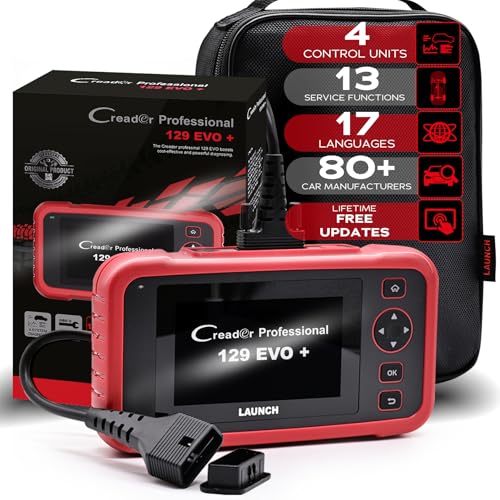
Speed is the whole point of the BST-360. Clip it on and health plus charge figures arrive before the bonnet prop goes back, across 6V and 12V batteries from 100 to 2000 CCA on flooded, AGM and gel cells. Anyone already running LAUNCH scan tools reads the results inside the same app used for fault codes.
Pros
- Verdict arrives with almost no menu tapping
- Shares one app with LAUNCH diagnostic hardware
- Compact shell fits a door pocket
Cons
- Fewer chemistry presets than the Autel testers
- Short leads struggle with deep-set batteries

Autel MaxiBAS BT608
Buy this one if neighbours and relatives keep asking you to check their batteries. A five inch colour touchscreen runs the whole test standalone, while Bluetooth and Wi-Fi handle report sharing and firmware updates. Chemistry coverage adds lithium to flooded, AGM, EFB and gel, which matters as powersports packs move to LiFePO4.
Pros
- Onboard screen removes the phone dependency
- Handles lithium packs alongside lead-acid
- Firmware updates arrive over Wi-Fi
Cons
- Bigger and heavier than a clamp-only tester
- Far more capability than a one-car household uses
ANCEL BM300
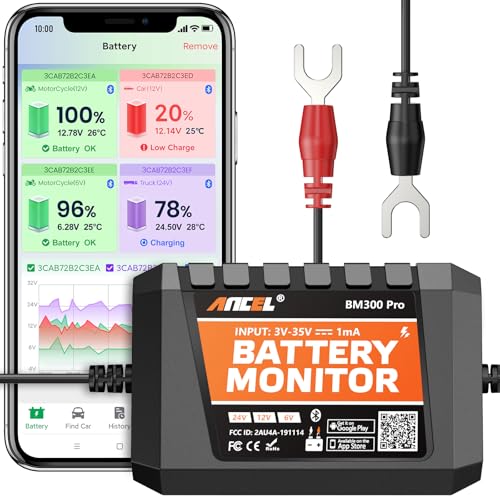
Classic cars, camper vans and ride-on mowers usually die from sitting, not from driving. BM300 stays wired to the posts and builds a voltage history in the ANCEL app, so you can see whether a maintainer is really holding the pack. Cranking and charging events join the log, showing how the vehicle behaved after each layup.
Pros
- Proves whether a trickle charger is doing its job
- Low voltage alerts prompt a charge before sulphation
- Built for vehicles parked for months
Cons
- Data only appears when a phone is within Bluetooth range
- No CCA or load testing of any kind
How they compare
| # | Model | Voltage | Best for | Score | Price |
|---|---|---|---|---|---|
| 1 | TOPDON BT100 | 6V and 12V batteries | Best overall | 9.4 | Check price |
| 2 | Autel MaxiBAS BT506 | 12V batteries, 12V and 24V systems | Best for charging system diagnosis | 9.2 | Check price |
| 3 | KONNWEI BK100 | 6V and 12V batteries | Best value | 9.0 | Check price |
| 4 | ANCEL BM200 | 12V only | Best budget monitor | 8.8 | Check price |
| 5 | LAUNCH BST-360 | 6V and 12V batteries | Best for quick clamp-on checks | 8.6 | Check price |
| 6 | Autel MaxiBAS BT608 | 5 inch colour touchscreen | Best for a busy home shop | 8.3 | Check price |
| 7 | ANCEL BM300 | 12V only | Best for stored and seasonal vehicles | 8.0 | Check price |
Questions worth asking
How accurate are Bluetooth battery testers?
Conductance testers give dependable keep or replace guidance once you enter the correct CCA rating and let the battery rest. Surface charge from a recent drive skews the result, so wait an hour or run the headlights briefly first. Shop carbon pile load testing still measures capacity more directly.
Do I need 6V support for motorcycle batteries?
Only for older bikes, tractors and some vintage machinery. Current motorcycles use 12V, and many powersports packs have moved to lithium. TOPDON BT100, KONNWEI BK100 and LAUNCH BST-360 all read 6V; the Autel BT506 does not.
Can a battery tester tell me if my alternator is bad?
Yes, when the tool includes a charging system test. Those routines read voltage and ripple with the engine idling and again at higher revs. A monitor that logs voltage alone will show strange charging behaviour but cannot name the cause.
What is the difference between a battery tester and a battery monitor?
Testers clamp on, run a CCA calculation and hand back a one-off health verdict. Monitors stay bolted to the posts and record voltage over weeks. Replacement decisions come from testers; parasitic drain and storage questions come from monitors.
Will a Bluetooth battery monitor drain my battery?
Standing draw from these monitors sits far below the vehicle’s own parasitic load. On a car driven weekly it changes nothing. Pair the monitor with a maintainer if the vehicle sleeps for months at a time.
Is it safe to test a battery inside a closed garage?
Conductance testing produces no hydrogen, unlike a charging cycle, so the test itself carries little risk. Open the door before running the engine for cranking and charging checks. Eye protection helps, and removing rings avoids a dead short across the terminals.
TOPDON BT100 vs KONNWEI BK100: which is better for a home garage?
Both read 6V and 12V from 100 to 2000 CCA. BT100 returns richer charging system data and tidier exported reports. BK100 leans on Bluetooth 5.0 and a simpler verdict, which fits occasional use.
Should a home garage buy a battery tester with its own screen?
Testing several vehicles a year makes a screen worth it, because the phone stops being a point of failure. Autel BT608 is the example here. One family car is better served by a small app-only clamp that stores anywhere.
Which Bluetooth battery tester works for a stored classic car?
Neither handheld suits that job well. ANCEL BM200 covers basic storage monitoring, and BM300 adds voltage history and low voltage alerts across longer layups. Add a maintainer, because monitoring alone will not recharge anything.
The bottom line
TOPDON BT100 is the pick for a home garage, since 6V and 12V coverage plus cranking and charging tests answer nearly every driveway question. Chasing a repeat failure is different work, and the Autel MaxiBAS BT506 earns its place there because adaptive conductance and system tests split battery faults from alternator faults. Skip handhelds entirely for a stored classic or seasonal bike, and fit the ANCEL BM200 alongside a maintainer.
Tony Russo
Tony trained as an automotive technician and spent years in service and parts retail before moving into writing. He focuses on garage tools, car care products and accessories from a hands-on maintenance perspective.