Indoor Bird Cages Compared for Space and Safety
Prevue Hendryx F040 Flight Cage wins on the number that matters indoors: horizontal span, paired with a bar gap safe for budgies and finches. Hagen Vision Bird Cage cuts daily cleaning through its deep moulded base. Yaheetech 69 Inch Rolling Bird Cage suits climbing parrots.
Budgies, finches and canaries need width, which is why Prevue Hendryx F040 Flight Cage heads this list. Hagen Vision Bird Cage answers the daily mess problem instead. For a medium or large parrot that climbs rather than flies, Yaheetech 69 Inch Rolling Bird Cage is the practical choice.
Comparing cages is awkward because listings lead with total height, and that figure often includes a stand nobody stands in. Clear interior span is the useful number. Our ranking compared interior dimensions, bar gap, door and tray layout, plus what owners report about seed scatter, latch security and rust.
Before you buy
What size cage does an indoor bird need? Measure the clear interior span and ignore the headline height, which usually includes a stand. Small birds fly in short horizontal bursts, so width does the work. Climbing parrots use vertical space instead, clambering bar to bar. Whatever the species, a bird should turn fully without its tail touching the bars.
How to check bar spacing for your species Bar gap is a safety specification, not a preference. A head that fits through and a body that does not is the worst outcome in cage keeping. Finches and canaries need roughly three eighths to half an inch, budgies and cockatiels about half an inch, medium parrots three quarters to one inch. Measure the actual gap rather than trusting a listing phrase.
Which cage design makes daily cleaning fastest? Deep moulded bases like the Hagen Vision hold most debris inside the cage footprint. Seed skirts catch a useful share on wrought iron models. Bare wire cages send it across the floor. Front loading slide out trays beat trays you fish through a door, and a grate above the tray keeps birds off their own waste.
What to check on finishes, latches and castors Powder coated wrought iron is the standard, and the coat must be non toxic and evenly applied, since bar chewers swallow whatever flakes. Galvanised wire has no place around a parrot. Cockatiels crack simple slide catches within days, so favour two action latches or fit bird safe clips. Castors need locks, or the cage drifts when a bird lands hard.
The shortlist, ranked

Prevue Hendryx F040 Flight Cage
Width takes priority over height in this rectangular flight layout, matching how small birds actually travel. Bar gap sits around half an inch, safe for budgies, finches and canaries. Its rolling stand lifts the cage to waist level, which makes daily liner changes quicker and less disruptive for the birds.
Pros
- Horizontal span allows genuine short flights
- Half inch bar gap is correct for finches and budgies
- Rolling stand puts the tray at working height
Cons
- Bar gap is too narrow to suit larger parrots
- Assembly runs long and needs two people

Hagen Vision Bird Cage Model L01
Everything here is built around a deep moulded plastic base that traps hulls and droppings instead of letting them spread across a room. A debris guard rings the interior, and the tray pulls out from the front. Plastic will not corrode, so bath splash and daily washing cause no rust over time.
Pros
- Deep base contains almost all seed scatter
- Front tray empties in about two minutes
- Plastic base resists rust and corrosion
Cons
- Less flight span than a dedicated flight cage
- Base panels scratch with repeated scrubbing
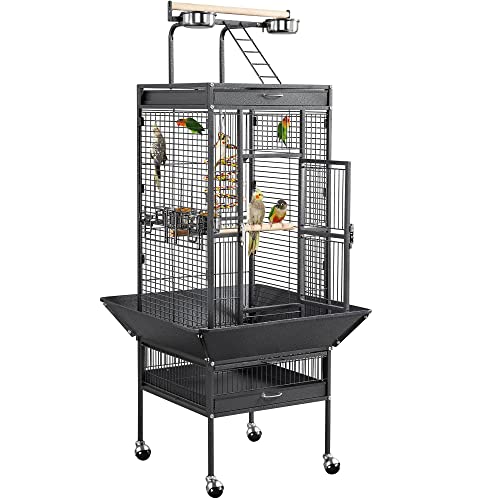
Yaheetech 69 Inch Rolling Bird Cage with Play Top
Wrought iron construction and a wider bar gap put this cage in medium to large parrot territory. An open play top with perch and cups gives out of cage time without the bird wandering the house. Lockable castors carry roughly 69 inches of cage, so repositioning for cleaning takes one person.
Pros
- Play top keeps out of cage time in one spot
- Heavier gauge wire stands up to chewing
- Locking castors make repositioning simple
Cons
- Wide bar gap is unsafe for finches and budgies
- Footprint dominates a small room

Prevue Hendryx Wrought Iron Select Bird Cage
Heavier wrought iron and a non toxic powder coat put this cage a tier above budget wire models. Flaking coating is a genuine hazard for bar chewers, and owners report this finish resists chipping well. A seed skirt rings the base, catching a fair share of what gets flicked out.
Pros
- Powder coat resists chipping and flaking
- Seed skirt cuts floor mess noticeably
- Frame holds up to medium parrots that chew bars
Cons
- Heavy and awkward to move once assembled
- Multiple doors mean more latches to check

VIVOHOME 61 Inch Wrought Iron Bird Cage
Around 61 inches with the stand, this wrought iron cage suits cockatiels and medium parrots. Perches and feeding cups arrive in the box, so the cage is usable the day it is built. A play top sits above the main enclosure, and castors let it roll clear of the wall for cleaning.
Pros
- Arrives with perches and cups included
- Rolls forward easily for cleaning behind
- Play top adds usable space above the cage
Cons
- Powder coat is thinner than on heavier cages
- Door latches need checking with clever birds

A and E Cage Company Flight Bird Cage
Span and height combine here to house several small birds at once, with room for perches on multiple levels. Wire gauge runs heavier than typical retail flight cages, so the frame holds shape. Large doors reach every corner, which matters when you are catching one bird out of five.
Pros
- Genuinely fits a group of finches or budgies
- Large doors reach the whole interior
- Sturdier frame than typical flight cages
Cons
- Claims substantial floor space in a room
- Weight makes relocation a two person job

Yaheetech 30 Inch Portable Hanging Bird Cage
At around 30 inches tall this is a secondary cage: a travel carrier, a vet trip cage or a quarantine setup for one small bird. Light wire keeps it carryable between rooms. Small size also means a full clean takes minutes, though an active bird should not live here full time.
Pros
- Carries between rooms with one hand
- Works as a hospital or travel cage
- Full clean takes only a few minutes
Cons
- Too small for full time housing
- Light wire bends if handled roughly
How they compare
| # | Model | Interior span | Best for | Score | Price |
|---|---|---|---|---|---|
| 1 | Prevue Hendryx F040 Flight Cage | Wide rectangular flight layout | Best overall | 9.4 | Check price |
| 2 | Hagen Vision Bird Cage Model L01 | Deep moulded plastic with debris guard | Best for easy cleaning | 9.2 | Check price |
| 3 | Yaheetech 69 Inch Rolling Bird Cage with Play Top | Around 69 inches including stand | Best for large parrots | 9.0 | Check price |
| 4 | Prevue Hendryx Wrought Iron Select Bird Cage | Wrought iron with non toxic powder coat | Best build quality | 8.8 | Check price |
| 5 | VIVOHOME 61 Inch Wrought Iron Bird Cage | Around 61 inches with stand | Best value large cage | 8.6 | Check price |
| 6 | A and E Cage Company Flight Bird Cage | Wide flight cage for multiple birds | Best for multiple birds | 8.3 | Check price |
| 7 | Yaheetech 30 Inch Portable Hanging Bird Cage | Around 30 inches tall | Best budget | 8.0 | Check price |
Good to know
What size cage does a budgie need?
Eighteen by eighteen by eighteen inches is the floor, not the target, for a single budgie. Go wider wherever the room allows, since budgies fly rather than climb. For a pair, treat a flight cage as the sensible starting point.
Where should I put a bird cage indoors?
Against a wall in a family room, so the bird has one secure side and daily company. Keep it clear of kitchens, draughts and direct sun. Fumes from overheated non stick cookware kill birds quickly, which makes kitchen distance the single most important placement rule.
How often should an indoor bird cage be cleaned?
Change the liner and wash dishes daily. Wipe perches and the grate weekly. Strip and wash the whole cage monthly. Deep based cages such as the Hagen Vision shorten the daily part, which is where most of the effort actually goes.
Are round cages bad for birds?
Most keepers avoid them. Curved walls waste usable span for the floor area they occupy, and no corner exists for a bird to retreat into. A rectangular cage of the same footprint gives more genuine flight room.
Do I need a cage cover at night?
Many birds settle faster under one, since it blocks household light and signals sleep. Use breathable fabric and leave part of one side open for airflow. Introduce it over several nights, because sudden darkness unsettles some birds.
How do I stop seed getting everywhere?
Choose a deep base or seed skirt at purchase, which does more than any later fix. Add an acrylic guard around the lower section and a washable mat underneath. Covered feeder cups and pelleted diets reduce scatter further than open seed dishes.
Can two birds share one cage?
Budgies and compatible finch types often pair well, provided the cage is wide enough that both can move without conflict. Introduce gradually and watch feeding stations for aggression. Duplicate every dish and perch, since competition over one bowl causes most trouble.
Are wrought iron cages safe for parrots?
Yes, when the finish is a non toxic powder coat, as on the Prevue Hendryx Wrought Iron Select. Reject galvanised wire and any cage with chipping coating, because a parrot chewing bars swallows what comes loose.
Flight cage vs tall cage: which suits my bird?
Match the cage to how the bird moves. Finches, canaries and budgies fly across, so span wins. Conures, amazons and greys climb, so height with a play top serves them better.
Final word
Prevue Hendryx F040 Flight Cage is the buy for budgies, finches and canaries, because span is the dimension small birds actually use. Choose Hagen Vision Bird Cage instead if daily mess is what puts you off keeping birds indoors. Once you move up to a medium parrot, Yaheetech 69 Inch Rolling Bird Cage covers the height and chew resistance that species needs.
Olivia Hartley
Olivia spent several years working at an animal shelter and a pet-supply retailer before joining the editorial team. She researches pet gear with an emphasis on safety, comfort and the fine print that owners often miss.