6 Bike Computers for Tracking Speed and Distance
Garmin Edge 540 suits most riders, pairing routable maps with power meter support in a compact case. Wahoo Elemnt Bolt V2 sets up from a phone and ships with an out front mount. For rides that run past dark, Garmin Edge 1040 Solar adds solar charging and the largest screen.
Garmin Edge 540 covers the widest range of riding here. Routable maps, power meter support and multi band GNSS fit into a case narrow enough for road bars. Wahoo Elemnt Bolt V2 hands setup to a phone app rather than button menus, which shortens the first ride considerably. Edge 1040 Solar exists for riders still moving after sunset, where daylight charging buys extra hours.
Listings lead on screen size, and that rarely decides anything. What matters is whether the unit builds a new route after a missed turn, which sensor protocols it speaks, and how the battery holds up at hour eight with the backlight on. We compared published run times, ANT+ and Bluetooth support, mount hardware and map types, then weighed owner reports on rerouting speed and daylight legibility.
Our top picks

Garmin Edge 540
Routable colour mapping and full power analysis arrive in a case that suits crowded road bars. Multi band GNSS locks onto two satellite frequencies, which steadies the track through wooded valleys and city streets. Buttons handle every input instead of a touchscreen, so wet or gloved hands still work.
Pros
- Builds a new route after a missed turn
- Reads power, heart rate and cadence sensors
- Compact enough for a busy cockpit
Cons
- Menu structure takes several rides to learn
- Buttons only, no touchscreen input

Wahoo Elemnt Bolt V2
Setup runs entirely through the Wahoo app, so routes, sensors and data pages transfer without menu diving. A colour screen carries turn prompts, backed by an LED strip along the top edge for direction cues. Aero out front mount ships in the box, which few rivals bother to include.
Pros
- Fastest setup of any unit listed
- Turn prompts stay legible at speed
- Out front mount supplied as standard
Cons
- Training analysis is shallower than Garmin
- Map detail trails the Edge units
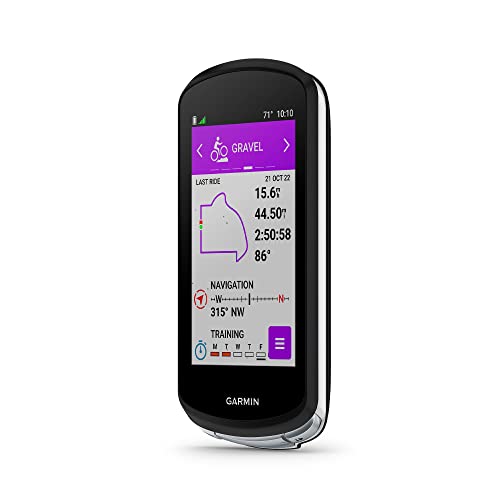
Garmin Edge 1040 Solar
A 3.5 inch touchscreen makes map reading practical without zooming every few minutes. Solar cells in the bezel top up the battery through daylight, pushing run time into multi day territory for randonneurs and bikepackers. Everything else matches the top of Garmin’s range, multi band positioning included.
Pros
- Longest run time of the seven
- Largest and clearest map view
- Complete training and navigation feature set
Cons
- Wide case crowds narrow handlebars
- Touchscreen is awkward in thick winter gloves
Garmin Edge 130 Plus
A monochrome display keeps this unit tiny and readable in direct sun without any backlight. Navigation is breadcrumb only, drawing the loaded line with no surrounding road network. Sensor support stays complete though, covering power meters, heart rate straps and speed sensors.
Pros
- Barely noticeable on the handlebars
- Reads clearly in bright sunlight
- Pairs with power and heart rate sensors
Cons
- Breadcrumbs only, no routable maps
- Small screen limits visible data fields
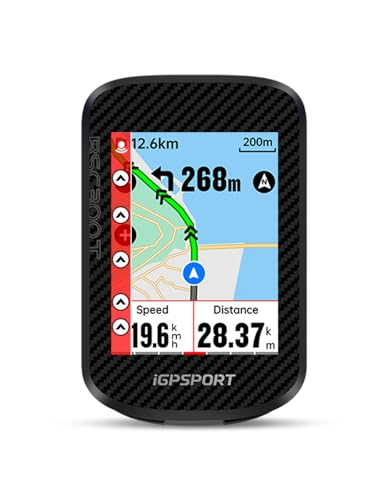
iGPSPORT BSC300
A colour display, dual protocol sensor pairing and a long stated run time land this near the top on value. Navigation follows a loaded course rather than recalculating a new one. Rides sync to common training platforms through the companion app, which owners describe as functional rather than polished.
Pros
- Colour screen and sensor support at entry level
- Runs through long days between charges
- Uploads to the usual training platforms
Cons
- Cannot rebuild a route once off course
- App polish trails Garmin and Wahoo

CatEye Velo 9
A wheel magnet and fork sensor feed speed and distance with no satellites involved. One coin cell runs the head unit for a long stretch, so charging never enters the routine. Functions stop at speed, distance, elapsed time and a calorie estimate, which covers a commuter bike perfectly well.
Pros
- Nothing to charge or sync, ever
- Coin cell outlasts any rechargeable here
- Reads accurately once wheel size is set
Cons
- No GPS track or route recording
- Sensor wire has to be routed down the fork

Lezyne Mega XL GPS
Lezyne quotes one of the longest run times in the category, which is why touring riders keep buying it. Display rotates between portrait and landscape, so it works on a stem or a bar extender. Navigation follows a loaded course, with no road network underneath to reroute across.
Pros
- Run time suits multi day touring
- Mounts in portrait or landscape
- Works with ANT+ and Bluetooth sensors
Cons
- Interface feels dated beside rivals
- Companion app is less refined
What matters most
What should you look for in a bike computer? Five things separate these units. Navigation type comes first, because routable maps recalculate and breadcrumbs do not. Sensor protocols decide whether your power meter connects at all. Battery figures decide whether long days need a cache battery in your pocket. Screen size trades legibility against cockpit space. Mount type matters more than most buyers expect, since an out front mount sits in your natural sight line while a stem mount forces you to look down.
Do you need maps, or is breadcrumb navigation enough? Routable units carry a road network, so a wrong turn triggers a fresh path back to the course. Breadcrumb units draw only the line you loaded, leaving you to retrace by eye. Anyone exploring unfamiliar roads wants the first kind. On known routes, breadcrumbs do the job and the saving goes toward better tyres. Among these seven, the Edge 540 and Edge 1040 Solar reroute, while the 130 Plus, BSC300 and Mega XL follow a fixed line.
Will a bike computer work with your power meter? Power meters, heart rate straps and speed sensors talk over ANT+ or Bluetooth. Every GPS unit here handles both, which removes most compatibility worry. Older or very cheap computers sometimes carry one protocol only. Write down the sensors you already own, then confirm before ordering, because replacing a power meter costs far more than replacing a head unit. Smart trainers and radar units add another pairing question worth checking.
How long do bike computer batteries really last? Quoted run times assume the backlight is off and navigation idle. Switch on mapping, a bright screen and three sensor connections, and the number falls. Plan on roughly two thirds of the claim for a hard ride with navigation running. Cold weather cuts it further, since lithium cells lose capacity near freezing. For events past 24 hours, either pick the Edge 1040 Solar or carry a cache battery and charge on the move.
The lineup, side by side
| # | Model | Display | Best for | Score | Price |
|---|---|---|---|---|---|
| 1 | Garmin Edge 540 | Colour, about 2.6 inches | Best overall | 9.4 | Check price |
| 2 | Wahoo Elemnt Bolt V2 | Colour, about 2.2 inches | Best value | 9.2 | Check price |
| 3 | Garmin Edge 1040 Solar | Colour touchscreen, about 3.5 inches | Best for very long rides | 9.0 | Check price |
| 4 | Garmin Edge 130 Plus | Monochrome, about 1.8 inches | Best compact unit | 8.8 | Check price |
| 5 | iGPSPORT BSC300 | Colour | Best budget GPS | 8.6 | Check price |
| 6 | CatEye Velo 9 | Wired wheel sensor | Best with nothing to charge | 8.3 | Check price |
| 7 | Lezyne Mega XL GPS | Monochrome, rotatable orientation | Best battery life on a budget | 8.0 | Check price |
Good to know
Do you need a bike computer if you already have a phone?
A phone handles casual rides fine. A dedicated unit reads better in sunlight, shrugs off rain, mounts securely and leaves your phone battery intact for emergencies. For structured training with power or heart rate, the difference in usability is large.
What is the difference between breadcrumb and routable navigation?
Breadcrumb shows your loaded route as a bare line with no roads around it, so you follow it visually. Routable navigation carries the road network and can calculate a new path when you go off course. Exploring new areas is where that second ability earns its cost.
Will a bike computer connect to my power meter?
Almost certainly, provided the computer supports ANT+ or Bluetooth. Every GPS unit in this roundup does. Pairing means waking the sensor by spinning the cranks, then searching from the computer. Very old or very cheap units sometimes carry one protocol only.
Is GPS distance as accurate as a wheel speed sensor?
Over a full ride, GPS is close. For instantaneous speed and short distances it wanders under tree cover and between tall buildings. A calibrated wheel sensor is steadier. Many riders run both and let the computer take speed from the sensor and the track from GPS.
Can you use a touchscreen bike computer with gloves?
Thin liner gloves usually work. Thick winter gloves and heavy rain both make touch input unreliable. Button driven units such as the Edge 540 and Elemnt Bolt V2 sidestep the problem, which is exactly why performance models still keep physical buttons.
How do you load a route from Strava or Komoot?
Link the platform to your computer’s companion app once, then routes appear on the device automatically or after a manual sync. Alternatively, export a GPX file and copy it to the unit over a cable. Deviating mid ride is where routable units pull ahead.
Do bike computers work without a phone signal?
Yes. Recording, navigation and sensor pairing all run standalone. A phone is only needed for syncing rides, live tracking and notifications. Remote area riders can leave the phone in a pocket in airplane mode and lose nothing important.
What screen size works best on road handlebars?
Around two to two and a half inches suits most road and gravel cockpits and stays readable at speed. Bigger screens help with map detail but crowd the bars and add weight. Route followers benefit from the larger view; data watchers rarely do.
Which bike computer has the longest battery life?
Among GPS units here, the Edge 1040 Solar and the Lezyne Mega XL post the longest figures, one through solar top up and the other through sheer cell capacity. Non GPS options change the question entirely, since the CatEye Velo 9 runs on a coin cell for a very long time.
Are budget bike computers accurate?
Recording accuracy is broadly similar, because they use the same satellite systems. What you give up is rerouting, app polish and firmware updates over time. Owners of the iGPSPORT BSC300 report reliable data logging and unremarkable software.
Final word
Garmin Edge 540 fits the widest range of riders, delivering routable maps and complete training data in a case that suits normal handlebars. Pick the Wahoo Elemnt Bolt V2 when a phone based setup and an included mount matter more than deep analytics. Choose the Edge 1040 Solar only if your rides run long enough that battery life outranks every other consideration.
Derek Holt
Derek has a background coaching recreational and amateur athletes and has worked the sales floor at specialty fitness retailers. He focuses on equipment durability, ergonomics and realistic use cases rather than marketing claims.