CO2 Regulators That Keep Keg Pressure Steady Pour After Pour
Taprite’s T752HP single gauge regulator delivers reliable pressure for most single keg home setups, making it the strongest overall pick. Kegco’s dual gauge regulator suits anyone who wants to monitor both tank and line pressure at once. Micro Matic’s Pro Series fits buyers who want commercial-grade build quality.
Taprite’s T752HP leads this list for most home kegging setups because it holds a steady line pressure without the cost of a dual gauge system most casual users do not need. It only shows line pressure, so anyone wanting to track remaining tank pressure too should look at Kegco’s dual gauge regulator instead. Multi-keg setups benefit from a secondary regulator down the line.
CO2 regulators for beer split mainly between single gauge models, which show only line pressure, and dual gauge models, which also track tank pressure. We compared gauge configuration, build material, and pressure range across seven regulators to match home kegging needs against commercial-grade overkill.
The shortlist, ranked

Taprite T752HP Single Gauge Primary Regulator
Taprite builds this regulator around a single gauge showing line pressure, which covers the main need for most single keg home kegerators. A solid brass body resists the corrosion that cheaper regulators develop over repeated CO2 tank changes. Standard CGA320 inlet fits most home CO2 tank sizes without an adapter.
Pros
- Brass body resists corrosion over repeated tank changes
- Standard CGA320 fitting works with most home CO2 tanks
- Reliable line pressure for single keg setups
Cons
- No secondary gauge for tank pressure monitoring
- Not built for multi-keg distribution

Kegco Dual Gauge CO2 Regulator
Kegco adds a second gauge to show tank pressure alongside line pressure, giving a clearer sense of when a CO2 tank is running low before it empties mid-pour. A chrome-plated body resists rust in a humid kegerator environment. Standard fittings match most common home kegging hardware.
Pros
- Dual gauges show both tank and line pressure at a glance
- Chrome plating resists rust in humid kegerator setups
- Standard fittings match common home kegging hardware
Cons
- Costs more than single gauge regulators
- Extra gauge adds a part that can need recalibration over time
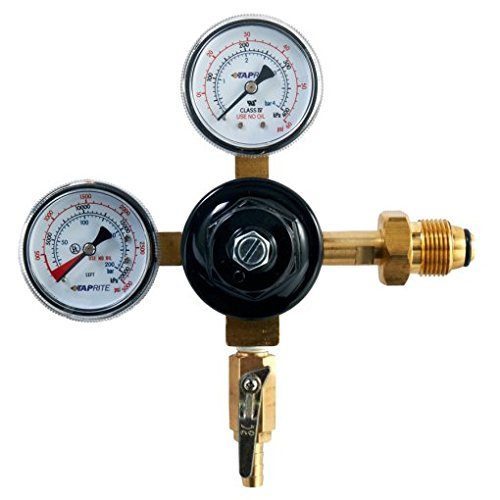
Micro Matic Pro Series Dual Gauge Regulator
Micro Matic supplies much of the bar and restaurant draft industry, and this Pro Series regulator brings that commercial-grade construction to home setups. Heavier internal components hold calibration longer under daily pressure cycling than lighter consumer regulators. A dual gauge setup tracks both tank and line pressure clearly.
Pros
- Commercial-grade internals hold calibration longer
- Trusted by bars and restaurants for daily draft use
- Dual gauge tracks both pressures clearly
Cons
- Higher price than most home-focused regulators
- More capability than light occasional home use needs

KegWorks Dual Gauge CO2 Regulator
KegWorks packages this regulator with clear labeling and a straightforward design aimed at people kegging their first homebrew batch. Dual gauges teach new kegerator owners to watch both tank level and line pressure from the start. A mid-range price point avoids the premium cost of commercial-grade models.
Pros
- Clear labeling helps beginners learn pressure monitoring
- Dual gauge setup teaches good kegging habits early
- Reasonable price point for a dual gauge regulator
Cons
- Build quality sits below Micro Matic’s commercial-grade line
- Standard finish shows wear faster than premium options

NutriChef Dual Gauge Beer Regulator
NutriChef keeps this dual gauge regulator priced below most dedicated kegging brand competitors. Both gauges cover the basics of tank and line pressure monitoring without extra features. It suits occasional home kegging rather than daily heavy use.
Pros
- Lower price than most dual gauge competitors
- Covers basic tank and line pressure monitoring
- Suits occasional home kegging setups
Cons
- Less durable long-term than Taprite’s or Micro Matic’s builds
- Gauges may need more frequent recalibration

Beverage Factory Economy CO2 Regulator
Beverage Factory keeps this regulator simple and affordable, aimed at someone kegging occasionally rather than running a dedicated home bar. A single gauge shows line pressure, enough information for basic pour consistency. Lighter construction keeps the price down compared to heavier brass regulators.
Pros
- Lowest price point among regulators on this list
- Simple single gauge suits occasional kegging
- Standard fitting works with common home CO2 tanks
Cons
- Lighter construction than brass-bodied competitors
- No tank pressure gauge for monitoring remaining CO2

Blichmann Engineering CO2 Regulator
Blichmann Engineering applies the same precision focus from its brewing equipment line to this regulator, built for homebrewers who already invest heavily in their setup. Tight manufacturing tolerances keep pressure readings accurate over long-term use. A dual gauge configuration matches the detail-oriented approach of a serious home brewing rig.
Pros
- Precision manufacturing keeps readings accurate long-term
- Matches the build quality of a serious home brewing setup
- Dual gauge covers tank and line pressure monitoring
Cons
- Priced higher than most home kegging regulators
- More precision than casual kegging setups typically need
The lineup, side by side
| # | Model | Gauge configuration | Best for | Score | Price |
|---|---|---|---|---|---|
| 1 | Taprite T752HP Single Gauge Primary Regulator | Single gauge, line pressure | Best overall for single keg home setups | 9.2 | Check price |
| 2 | Kegco Dual Gauge CO2 Regulator | Dual gauge, tank and line pressure | Best dual gauge for monitoring both pressures | 9.0 | Check price |
| 3 | Micro Matic Pro Series Dual Gauge Regulator | Dual gauge, tank and line pressure | Best commercial-grade build quality | 8.8 | Check price |
| 4 | KegWorks Dual Gauge CO2 Regulator | Dual gauge, tank and line pressure | Best for home brew beginners | 8.5 | Check price |
| 5 | NutriChef Dual Gauge Beer Regulator | Dual gauge, tank and line pressure | Best budget dual gauge option | 8.2 | Check price |
| 6 | Beverage Factory Economy CO2 Regulator | Single gauge, line pressure | Best value single gauge for occasional use | 8.0 | Check price |
| 7 | Blichmann Engineering CO2 Regulator | Dual gauge, tank and line pressure | Best premium build for serious homebrewers | 7.9 | Check price |
Before you buy
Single gauge versus dual gauge regulators A single gauge regulator like Taprite’s or Beverage Factory’s shows only line pressure, the number that actually controls how beer pours from the tap. Dual gauge regulators add a second reading for tank pressure, useful for knowing when a CO2 tank is running low before it runs out mid-pour. Single keg home setups can get by fine with a single gauge, while anyone managing multiple tanks benefits from the extra information a dual gauge provides.
Why body material affects long-term reliability Brass bodies, used in Taprite’s and Blichmann’s regulators, resist the corrosion that chrome-plated budget models can develop over years of tank changes in a humid kegerator. Micro Matic’s heavier commercial-grade construction holds calibration longer under daily pressure cycling than lighter consumer parts. Occasional home kegging does not demand that level of durability, which is where lighter, less expensive regulators like NutriChef’s or Beverage Factory’s make more sense.
Matching a regulator to kegging frequency Daily or near-daily kegging, closer to bar conditions, benefits from Micro Matic’s or Blichmann’s heavier-duty construction. Weekend or occasional home kegging works fine with KegWorks’ or NutriChef’s mid-range dual gauge regulators. Someone kegging just a few times a year has little reason to pay for commercial-grade durability and can start with Beverage Factory’s economy single gauge instead.
Fitting a regulator to existing tank and keg hardware Most home CO2 tanks use a standard CGA320 inlet connection, shared across every regulator on this list, so compatibility rarely becomes an issue. Checking the regulator’s maximum pressure range against the beer style being served still matters, since higher carbonation styles need more headroom than the standard 0 to 60 PSI range covers for most ales and lagers.
Common questions
What is the difference between a single and dual gauge CO2 regulator?
A single gauge shows only line pressure, while a dual gauge adds a second reading for tank pressure so remaining CO2 can be monitored.
Do I need a dual gauge regulator for a single keg setup?
Not necessarily. A single gauge regulator like Taprite’s T752HP covers the main pressure control need for most single keg kegerators.
What pressure should I set a beer CO2 regulator to?
This depends on beer style and serving temperature, but most ales and lagers fall within the 0 to 60 PSI range covered by the regulators on this list.
Does regulator material affect how long it lasts?
Yes, brass bodies like Taprite’s or Blichmann’s resist corrosion better over years of tank changes than lighter chrome-plated budget models.
Can one regulator supply multiple kegs at once?
A primary regulator like Taprite’s typically supplies one line, while multi-keg setups usually add secondary regulators downstream for independent pressure control per keg.
How often does a CO2 regulator need recalibration?
This varies by build quality, with commercial-grade regulators like Micro Matic’s holding calibration longer than lighter budget models that may drift sooner.
What fitting do home CO2 tanks use?
Most home CO2 tanks use a standard CGA320 inlet connection, which every regulator on this list is built to fit.
Is a more expensive CO2 regulator worth it for occasional home kegging?
Not always. Occasional kegging works fine with a budget option like Beverage Factory’s, while frequent or daily use justifies investing in a more durable build.
Our pick
Taprite’s T752HP stays the top choice for most single keg home setups, since its brass build and reliable pressure hold up over years of regular tank changes. Anyone running multiple kegs or wanting to track remaining CO2 should choose Kegco’s dual gauge regulator instead, since knowing tank pressure prevents running dry mid-party. Serious homebrewers who already invest heavily in their equipment should skip the budget tier entirely and go with Blichmann Engineering’s precision build.
Dana Whitfield
Dana spent eight years buying and merchandising for a regional kitchenware retailer before moving into editorial work. She has handled thousands of SKUs across cookware, small appliances and kitchen organization, and focuses on the practical differences that matter once a product is actually in daily use.


