Gooseneck Kettles That Give Pour-Over Coffee Steady Control
Fellow Stagg EKG takes the top spot for precise flow control and steady temperature holding. COSORI Electric Gooseneck Kettle is the value pick with most of the same features. Hario V60 Buono suits a kitchen without counter space for a base.
Fellow Stagg EKG leads this roundup because its counterbalanced handle and narrow spout give genuinely fine control over where the water lands, and temperature holds steady through the brew. COSORI Electric Gooseneck Kettle delivers most of that for considerably less, and Hario V60 Buono answers for a kitchen where counter space is already spoken for.
A narrow curved spout lets water pour slowly and precisely enough to wet coffee grounds evenly instead of blasting a channel through the bed, which is the entire case for owning one. Kettles differ in how balanced they feel when full, how accurately they hold a set temperature and whether flow stays steady as the water level drops. We compared spout geometry, temperature control, handle balance, capacity and base footprint, then checked those against what owners report about readings drifting, lids loosening and handles getting hot on stovetop models.
Before you buy
Why spout shape matters more than capacity A standard kettle dumps water in a wide surge that digs a channel through a coffee bed, leaving some grounds over extracted and others barely wet. A narrow curved gooseneck spout slows the stream to something steerable in a spiral, wetting the bed evenly and giving control over the bloom. Narrower spouts mean finer control and slower filling, which is why the narrowest examples belong to dedicated brewing kettles rather than general kitchen ones.
Is temperature control worth paying for? Coffee and tea both want different temperatures, and setting a number rather than guessing makes results repeatable. Coffee usually brews a little below boiling, delicate green teas considerably lower, and black teas near boiling. A hold function arguably matters more than raw precision, since it keeps water at target through the several minutes a pour over takes. A stovetop kettle and a thermometer do the same job for anyone making one drink at one temperature.
Handle balance and capacity tradeoffs Holding a full kettle out over a brewer for a couple of minutes puts real strain on a wrist, which is where handle design earns its cost. Counterbalanced handles shift weight back toward the hand, making slow pouring far steadier. Capacity works as a tradeoff too, since a larger kettle covers several cups but grows heavier to control, while a small one pours beautifully and needs refilling for a group. Smaller kettles suit single and double servings best.
Materials, cleaning and descaling Stainless steel remains the standard here and handles daily use without staining or holding flavors. Look for a stainless interior rather than any coating that could wear through. Limescale builds inside any kettle in hard water areas and eventually affects heating and taste, so descale regularly with a solution of white vinegar and water, rinse thoroughly, then boil once with clean water before brewing. A narrow spout is difficult to reach inside, which makes descaling matter more here than with an ordinary kettle. Never immerse an electric kettle base in water.
The best picks, ranked

Fellow Stagg EKG Electric Kettle
A counterbalanced handle makes slow pouring feel almost effortless, and the spout produces a genuinely steady stream from full to empty. Temperature sets to the degree and holds there, removing guesswork from brewing. Cost runs highest in this group, and the base takes real counter space.
Pros
- Best pour control in this group
- Accurate temperature setting and hold
- Balanced handle reduces wrist strain
Cons
- Highest outlay of any kettle here
- Base occupies notable counter space

COSORI Electric Gooseneck Kettle
Important features arrive at a much lower outlay here, including preset temperatures for different brew styles and a hold function that keeps water ready. Pour control stays good even though the spout reads slightly less refined than premium options. A lighter build divides opinion between those who prefer it and those who read it as less substantial.
Pros
- Most of the premium features for far less
- Useful presets for tea and coffee styles
- Hold function keeps water at temperature
Cons
- Pour control not quite as fine as the best
- Lighter build than premium kettles
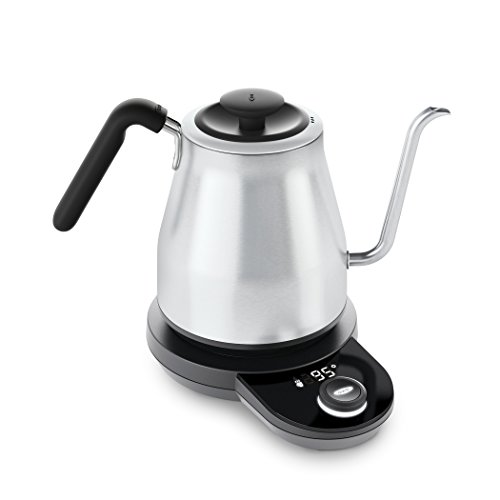
OXO Brew Adjustable Temperature Gooseneck Kettle
A single dial and a clear display keep the interface refreshingly simple, suiting a household where not everyone wants to learn a menu. Good pour control comes from the spout, and the handle stays comfortable when the kettle is full. Fine one degree granularity from the top pick is the one thing missing here.
Pros
- Simple controls anyone can use
- Comfortable handle when full
- Reliable hold function
Cons
- Less granular temperature setting
- Larger footprint than compact kettles

Bonavita Variable Temperature Gooseneck Kettle
Bonavita built its reputation on a very steady pouring stream, exactly what a pour over needs from the first bloom to the last pass. Variable temperature and a hold function cover the technical side reliably. Styling stays plain, and the build reads as functional rather than beautiful.
Pros
- Very steady stream throughout the pour
- Reliable temperature holding
- Straightforward to operate
Cons
- Plain appearance compared with rivals
- Handle balance is unremarkable when full

Brewista Artisan Electric Gooseneck Kettle
A built in brew timer and fine temperature control target people who follow a recipe rather than eyeball it. The narrow spout gives good control for slow pours. More menu navigation comes with those extra features than a simple dial kettle requires.
Pros
- Built in timer suits recipe brewing
- Fine temperature granularity
- Narrow spout gives good slow pour control
Cons
- More menu navigation than simple kettles
- Smaller capacity than most here

Hario V60 Buono Drip Kettle
This classic stovetop gooseneck carries the spout shape that made the style popular in the first place, and no base clutters the counter. Gas and most electric hobs work fine, though induction compatibility depends on the specific model. A thermometer becomes necessary since there is no built in temperature control.
Pros
- No base taking up counter space
- Classic spout shape with good control
- Nothing electronic to fail
Cons
- No temperature control or hold
- Handle can get hot on gas hobs

Kalita Wave Stainless Steel Pour Over Kettle
An unusually narrow spout gives the slowest, most controlled stream of anything in this group, suited to precise brewing methods. Modest capacity means it heats quickly on the stove. That same narrow spout makes filling anything other than a brewer genuinely tedious.
Pros
- Finest stream control in this group
- Compact and quick to heat
- Durable stainless construction
Cons
- Too slow for general kitchen use
- No temperature measurement built in
How they compare
| # | Model | Type | Best for | Score | Price |
|---|---|---|---|---|---|
| 1 | Fellow Stagg EKG Electric Kettle | Electric with variable temperature | Best overall | 9.4 | Check price |
| 2 | COSORI Electric Gooseneck Kettle | Electric with preset temperatures | Best value | 9.2 | Check price |
| 3 | OXO Brew Adjustable Temperature Gooseneck Kettle | Electric with adjustable temperature | Best for ease of use | 9.0 | Check price |
| 4 | Bonavita Variable Temperature Gooseneck Kettle | Electric with variable temperature | Best for consistent brewing | 8.8 | Check price |
| 5 | Brewista Artisan Electric Gooseneck Kettle | Electric with variable temperature | Best for brew timing | 8.6 | Check price |
| 6 | Hario V60 Buono Drip Kettle | Stovetop stainless steel | Best stovetop option | 8.3 | Check price |
| 7 | Kalita Wave Stainless Steel Pour Over Kettle | Stovetop stainless steel | Best for slow pouring | 8.0 | Check price |
Frequently asked questions
Do I really need a gooseneck kettle for pour over?
Brewing works without one, but the control it gives over flow rate and placement makes a noticeable difference to evenness of extraction. Owners report it as the single most useful upgrade after a decent grinder. French press or drip machines gain little from the shape.
What temperature should coffee be brewed at?
Common guidance sits a little below boiling, roughly the low to mid nineties in Celsius. Lighter roasts generally suit the higher end and darker roasts the lower. Set a temperature, taste the result, then adjust rather than chasing one fixed number.
Are electric gooseneck kettles worth it over stovetop?
A set temperature and hold function justify the extra cost for anyone who wants it, since a stovetop kettle needs a separate thermometer and constant attention. Stovetop models cost less, take no counter space and have nothing electronic to break. Counter space and desired precision usually decide the choice.
Can gooseneck kettles be used for tea?
Yes, and variable temperature models suit tea particularly well, since green and white teas are ruined by boiling water. The narrow spout also makes filling small teapots and gaiwans easier. Any electric model with temperature settings covers both drinks.
Why does my kettle temperature reading seem wrong?
Most kettles measure at the base or the wall rather than in the middle of the water, so readings can differ from a thermometer by a few degrees. Limescale on the element worsens the gap. Consistency matters more than exact accuracy, so calibrate a recipe to the specific kettle.
How often should a gooseneck kettle be descaled?
Every month or two in a hard water area, and less often with soft water. Descale as soon as white deposits appear inside. A vinegar and water solution or a proprietary descaler works, followed by a thorough rinse and a discarded first boil.
What capacity should I buy?
Around six tenths of a litre suits one or two cups and pours very controllably. A full litre covers a small group but grows heavier to hold steady when full. Choose the smaller size when pour control matters more than volume.
Will a stovetop gooseneck work on induction?
Only if the base is magnetic and the listing states induction compatibility. Many stainless kettles work and some do not. Check the specification, since a non magnetic kettle simply will not heat on an induction hob.
Our pick
Fellow Stagg EKG is the kettle to buy when pour control and temperature accuracy are the whole point of the purchase, and its balanced handle is what makes slow pouring comfortable. COSORI Electric Gooseneck Kettle gets most of the way there for a lot less. Hario V60 Buono remains the sensible stovetop option when counter space is the real constraint.
Dana Whitfield
Dana spent eight years buying and merchandising for a regional kitchenware retailer before moving into editorial work. She has handled thousands of SKUs across cookware, small appliances and kitchen organization, and focuses on the practical differences that matter once a product is actually in daily use.