Play Mats That Grow From Tummy Time to Toddler Play
Lovevery’s The Play Gym leads this list for its stage-based toys that change as a baby’s skills develop. The Fisher-Price Deluxe Kick ‘n Play Piano Gym suits newborn tummy time specifically, while the Toddlekind Prettier Playmat fits families wanting a cushioned foam floor mat instead of a fabric gym.
Lovevery’s The Play Gym leads this list because its attached toys are organized by developmental stage, so the same mat keeps offering age-appropriate challenges as a baby grows rather than becoming outdated within weeks. Families wanting a simple cushioned floor surface without attached toys may prefer a foam tile mat instead, which covers more floor area at a lower price.
We compared published cushioning thickness, portability, stage-based features and floor coverage across each mat based on the listings and owner feedback rather than running our own safety testing.
What matters most
What to weigh before choosing a play mat Cushioning thickness matters for tummy time directly on hard floors, where a thin mat offers less comfort than foam tiles or a padded gym base. Floor coverage decides whether the mat suits a crawling baby who needs room to move or a newborn who stays in one small spot. Attached toys, whether fixed or stage-based, add engagement but also add cost over a simple foam surface. Portability matters for families who want tummy time away from home, not just in one fixed room.
Activity gyms versus foam tile mats Fabric activity gyms like the Skip Hop Silver Lining Cloud and Fisher-Price Kick ‘n Play suit early tummy time with hanging toys overhead. Foam tile mats like the Toddlekind Prettier Playmat cover more floor space and support crawling and early walking better than a soft fabric surface. Many families eventually use both, starting with a gym for newborn months and adding foam tiles once a baby starts crawling.
Stage-based versus fixed-toy designs Lovevery’s The Play Gym changes its toy offering as a baby reaches new developmental stages, keeping the same mat relevant for longer. Fixed-toy gyms like the Skip Hop or Infantino models offer the same toys throughout, which works fine but may lose a baby’s interest sooner. Budget often decides between the two, since stage-based systems cost more than a fixed-toy gym of similar size.
Portability for travel and small spaces A foldable mat like the Gathre Mini Mat fits into a diaper bag for tummy time at a relative’s house or outdoors. A twist-and-fold gym like the Infantino Pond Pals model collapses for storage in a small apartment without permanent play space. Foam tile mats like the Toddlekind or Little Dove options are less portable but can be partially disassembled by removing individual tiles if floor space is limited.
Our top picks

Lovevery The Play Gym
Attached toys are grouped by developmental stage, from early visual contrast cards for newborns to grasping toys for older infants, so the same mat stays relevant for months rather than weeks. A padded base provides cushioning for tummy time directly on hard floors. The higher price reflects the curated toy set compared to a basic foam or fabric mat.
Pros
- Stage-based toys stay relevant across several months of growth
- Padded base cushions tummy time on hard floors
- Visual contrast elements suit newborn vision development
Cons
- Higher price than a basic foam tile or fabric mat
- Smaller floor coverage than a wall-to-wall foam tile set

Skip Hop Silver Lining Cloud Activity Gym
A fabric mat with an arching frame holds hanging toys at a lower price than curated stage-based systems. The soft fabric surface cushions tummy time without the firmer padding of a foam tile mat. Toys attach in fixed positions rather than rotating through developmental stages.
Pros
- Lower price than premium stage-based activity gyms
- Arching frame holds toys within easy reach for tummy time
- Soft fabric surface is machine washable
Cons
- Toys stay fixed rather than rotating through developmental stages
- Less cushioning than a dedicated foam floor mat
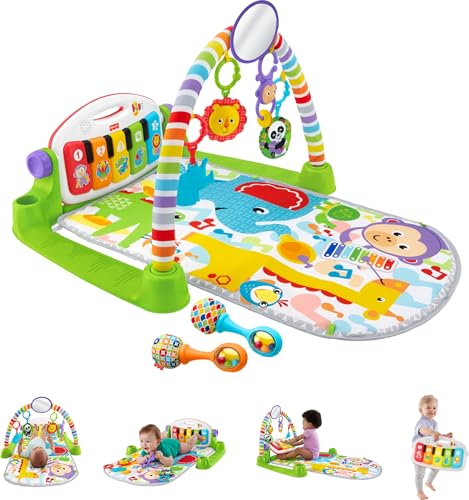
Fisher-Price Deluxe Kick ‘n Play Piano Gym
A piano panel at the foot end responds to kicks with sound and light, giving a newborn an early cause-and-effect activity during tummy time or back play. The mat includes a small arch with hanging toys similar to a standard activity gym. The piano panel requires batteries, adding a maintenance step a simple fabric mat does not have.
Pros
- Kick-activated piano introduces early cause-and-effect play
- Combines a standard hanging-toy arch with the piano feature
- Familiar, widely available brand for replacement parts
Cons
- Piano panel requires batteries and occasional replacement
- Toys do not rotate through developmental stages like a curated gym

Gathre Mini Mat
A compact leather mat rolls or folds flat, fitting into a diaper bag for tummy time away from home. The wipeable surface cleans up spills and drool faster than a fabric mat that needs washing. Its smaller size and lack of cushioning make it a secondary mat rather than a full at-home play surface.
Pros
- Folds flat and fits easily into a diaper bag
- Wipeable surface cleans faster than fabric
- Compact size suits travel or outdoor use
Cons
- Thinner cushioning than a dedicated foam floor mat
- Smaller size limits it to a secondary, not primary, play mat

Toddlekind Prettier Playmat
Interlocking foam tiles cover a larger floor area than a fabric activity gym, giving a crawling or early-walking baby more cushioned room to move. The firmer foam supports standing and furniture cruising better than a soft fabric surface. It does not include attached toys, so it pairs best with separate toys rather than built-in ones.
Pros
- Interlocking tiles cover more floor space than a fabric mat
- Firmer foam supports crawling and standing better than soft fabric
- Tiles can be rearranged or expanded as needed
Cons
- No attached toys, unlike a fabric activity gym
- Higher price than a basic foam mat without the tile design

Infantino Pond Pals Twist and Fold Activity Gym
A twist-and-fold frame collapses into a flat, compact shape for storage between uses, which suits small apartments without room for a permanently set-up gym. Hanging toys and a fabric mat cover the standard activity gym features. The twist mechanism takes a bit more effort to fold than simply pushing a basic arch flat.
Pros
- Twist-and-fold design collapses into a compact storage shape
- Standard hanging toys cover tummy time basics
- Suits small apartments without permanent gym space
Cons
- Twist mechanism takes more effort to fold than a simple push-flat arch
- Toys stay fixed rather than rotating through developmental stages

Little Dove Baby Play Mat
Basic interlocking foam tiles cover floor space at a price below premium puzzle-tile mats, giving a simple cushioned surface for a baby learning to crawl. The tiles lack the reversible or printed designs some premium foam mats include. It covers the core cushioning function without any attached toys or extra features.
Pros
- Lower price than premium foam tile mats
- Interlocking tiles still cover a useful floor area
- Simple design works in any room without matching decor
Cons
- Lacks the reversible or printed designs of premium foam mats
- No attached toys or developmental features included
Side by side
| # | Model | Toy System | Best for | Score | Price |
|---|---|---|---|---|---|
| 1 | Lovevery The Play Gym | Stage-based, changes with development | Best Overall | 9.2 | Check price |
| 2 | Skip Hop Silver Lining Cloud Activity Gym | Arching frame with hanging toys | Best Budget Activity Gym | 8.6 | Check price |
| 3 | Fisher-Price Deluxe Kick ‘n Play Piano Gym | Kick-activated piano panel | Best for Newborn Tummy Time | 8.5 | Check price |
| 4 | Gathre Mini Mat | Wipeable leather surface | Best Portable and Travel Mat | 8.4 | Check price |
| 5 | Toddlekind Prettier Playmat | Interlocking foam tiles | Best Foam Puzzle-Tile Mat | 8.7 | Check price |
| 6 | Infantino Pond Pals Twist and Fold Activity Gym | Twist-and-fold compact storage | Best Foldable and Compact Storage | 8.2 | Check price |
| 7 | Little Dove Baby Play Mat | Basic interlocking foam tiles | Best Budget Foam Tiles | 8.0 | Check price |
Questions worth asking
What age is a baby play mat good for?
Most activity gyms suit newborns through early sitting, while foam tile mats like the Toddlekind model extend usefulness into crawling and early walking.
Is a foam tile mat better than a fabric activity gym?
They serve different purposes, with foam tiles covering more floor space for crawling and fabric gyms offering hanging toys for tummy time.
Do stage-based play mats cost more than regular ones?
Yes, stage-based systems like Lovevery’s The Play Gym generally cost more than a fixed-toy gym like the Skip Hop or Infantino options.
Can a play mat be used for travel?
Foldable options like the Gathre Mini Mat are designed specifically to fit in a diaper bag for tummy time away from home.
How much floor space does a foam tile mat need?
Coverage varies by set size, though interlocking tiles like the Toddlekind or Little Dove mats can be arranged to fit different room sizes.
Do play mats need batteries?
Not all do. Basic fabric gyms and foam tile mats need no power, while interactive features like the Fisher-Price piano panel require batteries.
Is a thicker play mat always better for a baby?
Thicker cushioning helps on hard floors, though a thinner travel mat like the Gathre Mini Mat is a reasonable tradeoff for portability.
Can two play mat styles be used together?
Yes, many families start with a fabric activity gym for tummy time and add foam tiles once a baby begins crawling for more floor coverage.
The verdict
Families wanting one mat to grow with their baby’s development should choose Lovevery’s The Play Gym despite its higher price. Those on a tighter budget who still want a proper activity gym should pick the Skip Hop Silver Lining Cloud instead. Once a baby starts crawling, families should add the Toddlekind Prettier Playmat rather than relying on a fabric gym built mainly for tummy time.
Rachel Simmons
Rachel previously worked in child-product retail and brings a practical, detail-first eye to gear reviews, focusing on safety standards, ease of use and the fine print that matters most for new caregivers.