Which Automatic Litter Box Actually Controls Odor?
Whisker’s Litter-Robot 4 sifts most reliably and pairs weight sensing with a laser for cat detection. Multi cat homes gain from Casa Leo’s Leo’s Loo Too and its larger waste drawer. PetSafe ScoopFree Smart is the simplest entry, using crystal trays instead of clumping clay.
Whisker’s Litter-Robot 4 is the automatic litter box that gets the fundamentals right most consistently. Globe sifting works, the sensors are redundant, and the app reports weight and usage rather than just nagging. Casa Leo’s Leo’s Loo Too suits multi cat homes, and the PetSafe ScoopFree Smart is the easiest starting point.
Trusting a machine around a cat is the hard part. Detection has to be reliable when a second cat wanders in mid cycle, drawers need to hold enough between empties, and litter compatibility quietly decides your running costs. We compared sensor types, stated capacities, litter requirements and app functions across seven current models, alongside what owners report about odor and long term reliability.
The best picks, ranked

Whisker Litter-Robot 4
A rotating globe sifts clumps into a sealed carbon filtered drawer below, leaving fresh litter behind. Weight plates and a laser work together to detect a cat, which is the redundancy that matters when a second cat approaches mid cycle. Whisker’s app logs weight trends and drawer level, and owners report a clear drop in daily odor.
Pros
- Consistent sifting with sealed waste storage
- Redundant weight and laser cat detection
- Weight tracking flags changes in litter habits
Cons
- Large footprint needs a dedicated corner
- Clumping clay only, no tofu or crystal litter

Casa Leo Leo’s Loo Too
Wide entry and a deep waste drawer suit households where three or four cats share one box. Triple sensors plus an anti pinch design halt the drum whenever a cat is detected near the opening. A built in fan and carbon filter run between cycles, and the larger drawer stretches the gap between manual empties.
Pros
- Drawer capacity absorbs several cats
- Three sensors reduce false starts
- Fan and carbon filter manage odor between cycles
Cons
- Bulky and heavy to reposition
- App connection drops for some owners

PetSafe ScoopFree Smart Self-Cleaning Litter Box
A rake sweeps waste into a covered compartment at one end of a disposable crystal tray. Crystals dehydrate solids and absorb urine, which is why this design controls odor without clumping clay. Swapping the whole tray takes seconds and avoids any contact with waste, though trays are a recurring purchase.
Pros
- Simplest route into automated litter care
- Crystals suppress odor without clumping
- Tray swap involves no scooping at all
Cons
- Trays must be replaced regularly
- Open design gives shy cats little privacy
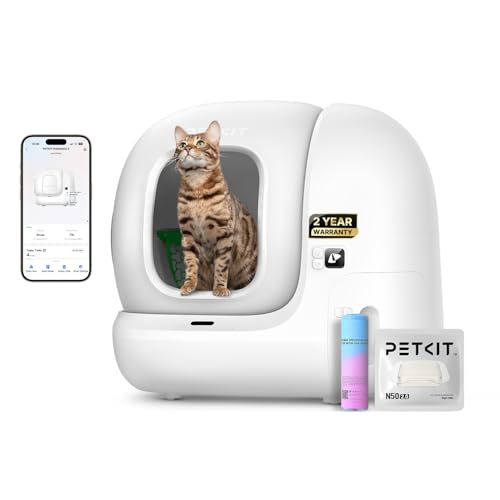
PETKIT Pura Max Self-Cleaning Cat Litter Box
Scheduling, per cat weight logs and visit histories all live in the PETKIT app, which goes further than most rivals on data. Infrared beams and weight sensing check for a cat before each rotation begins. Tofu and clumping clay both work, and an optional deodorizer module clips on for households with several cats.
Pros
- Deep scheduling and per visit logging
- Accepts tofu as well as clumping clay
- Optional deodorizer module for busy homes
Cons
- Initial setup takes patience
- Deodorizer refills are an ongoing purchase

Neakasa M1 Open-Top Self-Cleaning Litter Box
Skipping the enclosed drum entirely, this one uses an open tray that sifts clumps down into a compartment beneath. Cats that refuse to climb into a globe often accept the low, airy entry without any coaxing. Weight and radar sensing handle detection, and the cycle runs quietly enough not to startle a nervous cat.
Pros
- Open layout suits cats wary of enclosures
- Low step over height helps kittens and seniors
- Quiet cycle avoids startling nervous cats
Cons
- Open top contains odor less well
- Smaller waste capacity than drum designs

Whisker Litter-Robot 3 Connect
Years of service reports back the globe sifting concept that the newer model refined. Whisker’s app is mature here, with cycle alerts and drawer notifications that work reliably. A single weight sensor handles detection rather than the laser array on the 4, and the mechanism runs noticeably louder.
Pros
- Long service record from many owners
- Mature app with dependable notifications
- Same sealed drawer approach as the newer model
Cons
- Louder cycle than the Litter-Robot 4
- Single weight sensor rather than redundant detection
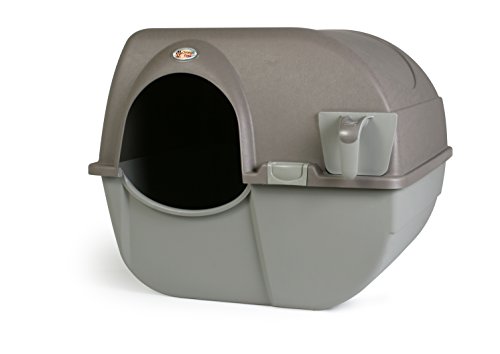
Omega Paw Roll’n Clean Self-Cleaning Litter Box
No motor, no app and no power cord: rolling the box onto its side drops clumps into a pull out tray, then rolling it back leaves clean litter. Nothing can fail electronically, and a power cut changes nothing. Clumping litter is essential, and the tray needs enough depth for clumps to separate cleanly.
Pros
- No electricity, refills or firmware involved
- Nothing mechanical that can jam or break
- Removes the scoop without any sensors to trust
Cons
- Still needs a manual roll every day or two
- Clumps stick when the litter bed runs shallow
Side by side
| # | Model | Type | Best for | Score | Price |
|---|---|---|---|---|---|
| 1 | Whisker Litter-Robot 4 | Rotating globe | Best overall | 9.4 | Check price |
| 2 | Casa Leo Leo’s Loo Too | Rotating drum | Best for multiple cats | 9.2 | Check price |
| 3 | PetSafe ScoopFree Smart Self-Cleaning Litter Box | Rake mechanism | Best value | 9.0 | Check price |
| 4 | PETKIT Pura Max Self-Cleaning Cat Litter Box | Rotating drum | Best app control | 8.8 | Check price |
| 5 | Neakasa M1 Open-Top Self-Cleaning Litter Box | Open sifting tray | Best open top design | 8.6 | Check price |
| 6 | Whisker Litter-Robot 3 Connect | Rotating globe | Best proven design | 8.3 | Check price |
| 7 | Omega Paw Roll’n Clean Self-Cleaning Litter Box | Manual roll and sift | Best non electric | 8.0 | Check price |
What matters most
How automatic litter boxes work Three mechanisms cover almost every model sold. Rotating designs turn a globe or drum so gravity drops clumps through a sieve into a sealed drawer, which is what the Litter-Robot and Leo’s Loo Too do. Raking models pull a comb across a shallow bed, sweeping waste into a covered compartment at one end. Manual sifting boxes like the Omega Paw use the same physics with no electronics at all, powered by you tipping them over. Each approach trades convenience against complexity, and complexity is what eventually fails.
What to look for in cat detection sensors Sensor design is the specification worth studying hardest. Weight plates register a cat standing inside, infrared beams and radar catch one approaching, and the better boxes combine at least two so a single failure does not start a cycle. Redundancy matters most in multi cat homes, where one cat can walk in seconds after another leaves. Kittens weigh little enough to slip under a weight only threshold, which is a real argument for infrared or radar alongside it. Introduce any new box slowly and watch the first several cycles.
Choosing an automatic litter box for a multi cat home More cats means faster drawer fill and more frequent emptying, so drawer volume becomes the practical limit rather than the cleaning mechanism. Casa Leo’s Leo’s Loo Too and similar large drum designs stretch that interval furthest. Interior room matters too. Your largest cat needs space to turn around fully, or shy cats simply refuse the box and go elsewhere. Vets and shelters commonly advise one box per cat plus one spare, and an automatic box does not suspend that guidance in a large household.
Litter types and what you keep paying for Match the litter to the mechanism, because the wrong choice jams sifting hardware. Rotating globes and drums generally require clumping clay, and some like the PETKIT Pura Max also accept tofu litter. Raking models such as the ScoopFree Smart run on proprietary crystal trays instead. Work out the recurring side before buying: disposable trays, carbon filters, waste liners and deodorizer refills all add up over a year. A box using standard clumping clay and generic liners often costs less to run than a cheaper unit tied to branded consumables.
Questions worth asking
Are automatic litter boxes safe for cats?
Reputable models use weight plates, infrared or radar to detect a cat and pause the cycle. Choose one with at least two sensor types, introduce it gradually beside the old box, and supervise the first several cycles with kittens or timid cats.
Do self-cleaning litter boxes actually reduce odor?
Yes, because waste moves into a sealed drawer or absorbent tray minutes after use rather than sitting exposed. Carbon filters and fans help further. Emptying the drawer on schedule still does more for odor than any filter.
Will my cat use an automatic litter box?
Most cats adapt within a week or two when the new box sits beside the old one at first. Cats that dislike enclosed spaces often accept an open design like the Neakasa M1 far more readily than a globe.
How often do you empty an automatic litter box?
Drawer size and cat count decide it. A single cat home often runs about a week between drawer changes, while three or four cats need emptying every few days. Larger drawers stretch that interval.
What litter works in an automatic litter box?
Rotating globes and drums generally need clumping clay, some units accept tofu litter, and raking models use crystal trays. Check the manual before switching, since the wrong litter can jam the sifting mechanism.
Are automatic litter boxes worth the money?
They earn their keep if scooping is the chore you skip or you travel regularly. Owners who want the scooping gone without electronics can get most of the benefit from a manual sifting box like the Omega Paw.
Can one automatic litter box serve multiple cats?
It can, provided you pick a large drawer and redundant sensors, as on Casa Leo’s Leo’s Loo Too. The one box per cat plus one guidance still applies in bigger households, automatic or not.
Do automatic litter boxes need Wi-Fi?
No. Cleaning cycles run locally whether or not the box is connected. Wi-Fi adds remote monitoring, usage history and drawer alerts, and non connected options work fine if you would rather skip the app.
Which automatic litter box is best for a nervous cat?
An open top design with a low entry and a quiet cycle, such as the Neakasa M1, asks far less of a cautious cat than a tall enclosed globe. Keep the old box available during the transition.
How much space does an automatic litter box need?
Most drum and globe models occupy considerably more floor area than a tray, and need clearance behind for the drawer to slide out. Measure the corner you have in mind, including height, before ordering.
The bottom line
Whisker’s Litter-Robot 4 is the automatic litter box to shortlist first, thanks to dependable globe sifting, redundant cat detection and genuinely useful weight logging. Multi cat households should look at Casa Leo’s Leo’s Loo Too for drawer capacity, while the PetSafe ScoopFree Smart offers the gentlest introduction. Anyone wary of electronics can strip the problem back to the manual Omega Paw Roll’n Clean.
Olivia Hartley
Olivia spent several years working at an animal shelter and a pet-supply retailer before joining the editorial team. She researches pet gear with an emphasis on safety, comfort and the fine print that owners often miss.

