Which Aquarium Magnet Cleaner Wipes Glass Without a Mess?
Mag-Float 360 Floating Magnet Cleaner takes the top spot because the inner half surfaces instead of dropping into the substrate. Flipper Standard 2 in 1 switches to a stainless blade without wet sleeves. Nano tanks are better matched to the Tunze Care Magnet Nano 0220.020.
Mag-Float 360 Floating Magnet Cleaner is the safest choice for a typical glass aquarium, since a separated inner half floats up rather than landing in the sand. Flipper Standard 2 in 1 earns its place where coralline has taken hold. Nano keepers should skip both and fit the Tunze Care Magnet Nano instead.
Buying a magnet cleaner is a matching exercise, which is exactly where it goes wrong. A magnet rated for quarter inch glass slips constantly on a half inch pane, while an oversized block drags hard on thin glass and makes trapped grit dangerous. We compared stated thickness ratings, float behaviour, pad and blade materials, and owner reports on scratching and rust after a year in service.
How to choose
Measure your glass before comparing anything else Maximum glass thickness is the specification that decides whether a magnet cleaner works at all. Measure the top rim rather than guessing from tank volume, since two aquariums of the same capacity often use different panes. Used past its rating, a magnet slips constantly and feels weak. Used far below its rating, it drags hard and makes any trapped grit more dangerous.
Why floating models are worth the premium When the halves part, a sinking inner block lands in the substrate. Retrieving it means rolling a sleeve up, disturbing the sand bed and clouding the water column. Floating designs surface instead. It reads like a small convenience until it happens during a Sunday clean on a tall tank.
Cleaning an acrylic tank without scratching it Steel blades and firm scrubbing faces that are safe on glass mark acrylic permanently. Choose a cleaner sold with an acrylic safe pad or a plastic blade, and read the packaging rather than assuming. Even on glass, one grain of sand under the pad leaves a visible arc, so lift the magnet clear of the substrate line before each pass.
Match the tool to the algae you actually have Soft green film wipes off with felt or foam. Coralline in a reef tank is calcified and needs a blade to shift. Diatom dust responds to almost anything. Buying a bladed cleaner for a freshwater community tank adds risk without benefit, while a plain pad on a mature reef means burnishing hard deposits forever.
The best picks, ranked

Mag-Float 360 Floating Magnet Cleaner
Separate the halves and the inner block rises to the surface rather than sinking into the substrate. Felt clears film algae without much pressure against the pane. Sealed plastic surrounds the magnet, so there is no exposed metal to corrode in a marine tank.
Pros
- Floating inner half saves wet sleeves
- Sealed body suits saltwater use
- Sizes cover thin glass to thick panes
Cons
- Felt picks up sand and can drag it
- Polishes hardened coralline rather than removing it

Flipper Standard 2 in 1 Magnetic Aquarium Cleaner
Rolling the outer magnet flips the inner half from a soft pad to a stainless blade, all without a hand entering the water. Coralline patches that felt only burnishes come away in one pass. Replacement blades cost little and swap in seconds.
Pros
- Switches to a blade without getting wet
- Blades are cheap and replaceable
- Removes coralline that pads leave behind
Cons
- Inner half sinks if the halves separate
- Steel blade must never touch acrylic
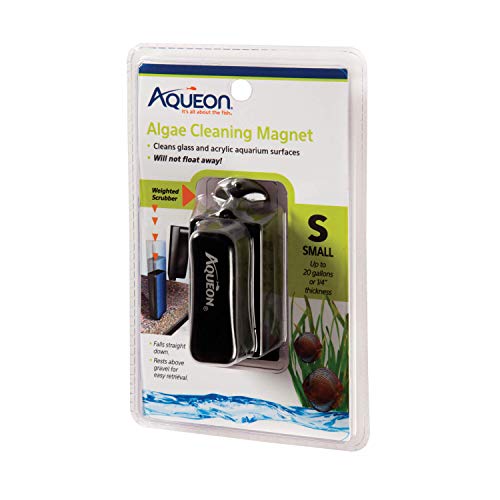
Aqueon Algae Cleaning Magnet
Two pieces, one scrubbing pad, and sizes matched to common tank ranges. Weekly film algae on a freshwater community tank rarely needs more than this. Owners report it holds firmly as long as you stay inside the stated glass rating.
Pros
- Widely stocked and easy to size
- Non abrasive pad suits acrylic
- Outer grip is comfortable to push
Cons
- No blade for hardened deposits
- Drops into the gravel if it detaches

Tunze Care Magnet Nano 0220.020
Sized for pico and nano glass, where a full block is both unwieldy and too strong for thin panes. The cleaning face releases trapped grains instead of grinding them along the pane. Tanks under roughly 20 gallons are its natural home.
Pros
- Strength matched to thin nano glass
- Cleaning face releases trapped sand
- Small enough to reach tight corners
Cons
- Too weak for standard thickness glass
- Small face covers a pane slowly
Fluval 2 in 1 Algae Magnet Cleaner
One face carries a soft pad and the other a firmer scrub, covering routine film and stubborn spots without owning two tools. A contoured outer grip stays comfortable through a long session. Firm scrubbing surfaces belong on glass only, never acrylic.
Pros
- Two cleaning surfaces in one body
- Contoured grip suits long sessions
- Holds well across mid thickness glass
Cons
- Firm face will scratch acrylic
- Bulkier than nano tools in corners

Jasonwell Aquarium Glass Cleaner Magnet Brush
A handle attachment extends reach to the lower panes of a deep tank without leaning over the rim. The scrubbing face handles routine film, and a small scraper covers spot work. Based on specifications it targets mid range glass thicknesses.
Pros
- Floats free if the halves separate
- Handle reaches the bottom of deep tanks
- Scraper included for spot cleaning
Cons
- Hold weakens near the rated maximum
- Handle attachment flexes under pressure
Kedsum Aquarium Magnetic Cleaner Brush
Light enough to push one handed across a pane, this clears fresh film before it hardens. Floating construction keeps it out of the gravel when the halves part. Owners report it belongs on thinner glass and routine maintenance rather than restoration work.
Pros
- Moves easily with one hand
- Floats rather than dropping into gravel
- Gentle enough for frequent passes
Cons
- Slips on glass past 3/8 inch
- Little effect on hardened deposits
Side by side
| # | Model | Glass rating | Best for | Score | Price |
|---|---|---|---|---|---|
| 1 | Mag-Float 360 Floating Magnet Cleaner | Up to around 3/4 inch | Best overall | 9.4 | Check price |
| 2 | Flipper Standard 2 in 1 Magnetic Aquarium Cleaner | Up to around 1/2 inch | Best for coralline algae | 9.2 | Check price |
| 3 | Aqueon Algae Cleaning Magnet | Varies by size, up to 3/8 inch | Best budget | 9.0 | Check price |
| 4 | Tunze Care Magnet Nano 0220.020 | Thin glass up to around 1/4 inch | Best for nano tanks | 8.8 | Check price |
| 5 | Fluval 2 in 1 Algae Magnet Cleaner | Up to around 1/2 inch | Best for mixed algae | 8.6 | Check price |
| 6 | Jasonwell Aquarium Glass Cleaner Magnet Brush | Up to around 1/2 inch | Best for tall tanks | 8.3 | Check price |
| 7 | Kedsum Aquarium Magnetic Cleaner Brush | Up to around 3/8 inch | Best for weekly upkeep | 8.0 | Check price |
Common questions
How do I know which magnet cleaner size to buy?
Match the stated glass rating to your panes, then size up only if your glass sits at the top of a band. Most brands publish three or four sizes that differ mainly in magnet strength.
Will a magnet cleaner scratch my tank?
The magnet does not, but grit caught under the pad does. Keep the cleaner above the substrate line, rinse the pad after every session, and check it for embedded sand before the next one.
Can I leave the cleaner in the tank between uses?
Many keepers park it in a corner, which keeps the pad wet and saves handling. A permanently submerged pad becomes an algae surface itself, and exposed metal corrodes fast in saltwater, so favour fully sealed bodies.
Do magnet cleaners work in saltwater and reef tanks?
Yes, provided the housing is sealed with no exposed steel. Reef tanks grow coralline that pads only polish, so keep a flip out blade or a separate scraper alongside.
Why does my magnet cleaner keep falling off?
Usually a thickness mismatch, or algae on the pad reducing contact. Confirm the rating, clean the pad, and move steadily rather than fast. Sudden direction changes break the hold more than pressure does.
Are magnet cleaners better than a scraper on a handle?
For weekly cleaning, yes, because hands stay out of the water and oils stay out of the tank. Long handled scrapers still win for restoring a badly neglected pane, where direct force and clear sight lines matter.
How often should I clean aquarium glass?
Weekly suits most stocked tanks and takes less effort than a monthly battle. Frequent light passes need less pressure, which lowers scratch risk. Algae returning within a day points at lighting or nutrients rather than the tool.
Do magnet cleaners lose strength over time?
The magnets hold their strength for years at aquarium temperatures. Pads glaze, blade edges dull and housings can let water in. Replace pads when they stop biting and retire any cleaner showing rust staining.
What is the best magnet cleaner for a nano tank?
A compact model rated for thin glass, such as the Tunze Care Magnet Nano. Full size blocks are too strong for a nano pane and too large to work around hardscape.
The bottom line
Mag-Float 360 Floating Magnet Cleaner is the pick for most glass aquariums, because a floating inner half turns a recurring annoyance into a non event. Reef keepers fighting coralline should choose Flipper Standard 2 in 1 for its flip out blade. Nano tanks need the smaller, gentler Tunze Care Magnet Nano instead of either.
Olivia Hartley
Olivia spent several years working at an animal shelter and a pet-supply retailer before joining the editorial team. She researches pet gear with an emphasis on safety, comfort and the fine print that owners often miss.