Indoor Aquarium Lights for Live Plants and Better Color
Fluval Plant 3.0 leads for indoor planted tanks, pairing genuine output with per channel scheduling and sunrise ramping. Finnex Planted Plus 24/7 CC runs a full day cycle without any external timer. NICREW ClassicLED Plus covers anubias and java fern for much less.
Fluval Plant 3.0 is the fixture to choose for a demanding indoor planted tank, because output and control arrive together. Finnex Planted Plus 24/7 CC automates dawn to moonlight straight out of the box. Low light tanks with anubias, java fern and cryptocoryne do fine under NICREW ClassicLED Plus.
Lighting choices go wrong because brightness figures describe what your eye sees, not what plants use at substrate depth. Surplus light in a living room tank turns into algae rather than growth. We compared spectrum coverage, published output figures, dimming and timer options, bracket hardware and housing material, then weighed owner reports on algae and plant response.
The best picks, ranked

Fluval Plant 3.0 LED Aquarium Light
Few consumer fixtures combine enough output for carpeting plants with the control needed to hold algae back. Bluetooth scheduling covers per channel colour, sunrise and sunset ramps, cloud effects and a full weekly programme. An extruded aluminium body doubles as the heatsink, and adjustable brackets span rimmed and rimless tanks.
Pros
- Output reaches demanding carpeting plants
- Per channel scheduling down to the minute
- Aluminium body sheds heat well
Cons
- App pairing takes patience on first setup
- Easy to overdrive a low tech tank into algae

Finnex Planted Plus 24/7 CC LED
Dawn colours shift into midday intensity, then dusk and a low moonlight period, all without an external timer. Custom mode on the CC version lets each channel be set manually when the preset does not suit. Output covers low to medium light plants and the housing sits low on a rimmed tank.
Pros
- Complete day cycle with no timer needed
- Custom mode overrides the preset
- Slim housing suits a living room tank
Cons
- Remote is small and easily misplaced
- Output falls short for high light species

NICREW ClassicLED Plus Aquarium Light
Enough usable light reaches the substrate for anubias, java fern, cryptocoryne and mosses. Extendable brackets slide to fit varied tank widths, and two brightness levels cover most photoperiods. No timer is built in, so plan on an outlet timer to keep the day length consistent.
Pros
- Covers undemanding plants reliably
- Brackets adjust across tank widths
- Slim aluminium bar sits close to the rim
Cons
- No built in timer
- Not enough output for carpet plants

Current USA Satellite Freshwater LED Plus
A wireless remote mixes each colour channel freely, so a warm planted look or a cooler display look is a few presses away. Cloud cover and lightning effects run on demand. Output sits in the low to medium band, which suits community tanks with easy plants.
Pros
- Wide colour adjustment range
- Timing presets built into the remote
- Slim body suits open top tanks
Cons
- Moderate output limits plant choice
- Most functions need the remote in hand
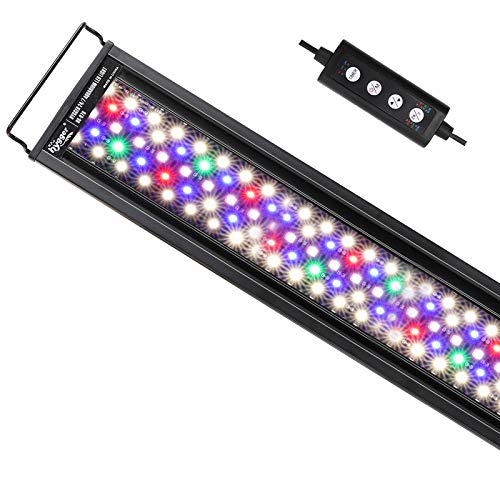
Hygger Full Spectrum Aquarium Light
Timer and dimming come built in at an entry level outlay, removing the need for a separate outlet timer. Mode presets cover white, blue and mixed spectra. Plastic housing sheds heat less effectively than aluminium, which shortens diode life in a warm room.
Pros
- Timer included without extra hardware
- Several spectrum modes to switch between
- Dimmable across the whole range
Cons
- Plastic body sheds heat poorly
- Timer resets after a power cut

Aqueon OptiBright Plus LED Fixture
Colour rendition rather than plant growth drives this fixture, and fish colours read well under the mix. A remote handles dimming and a simple colour blend. Modest plants hold their own beneath it, but demanding species need more.
Pros
- Flattering colour rendition on fish
- Docking legs fit standard rims neatly
- Straightforward remote control
Cons
- Limited output for plant growth
- No scheduling built in
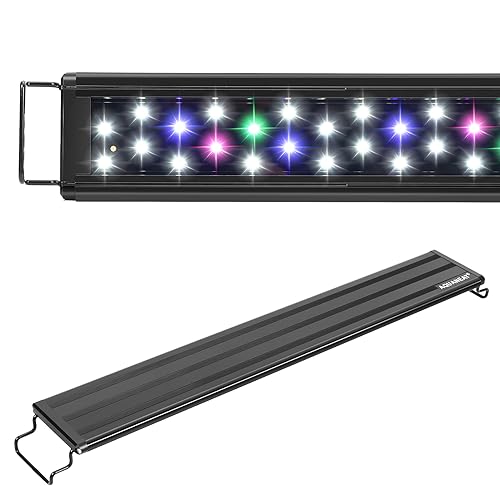
AQUANEAT LED Aquarium Light
Clip and bracket fittings suit desktop tanks where a full size fixture would dominate the setup. Modest output matches the shallow depth of a nano aquarium. Quarantine and grow out tanks are another sensible use, since control is limited to on and off.
Pros
- Sized correctly for nano tanks
- Clip fitting suits rimless nano glass
- Simple to install in minutes
Cons
- No dimming or timer
- Output fades badly past 18 inches depth
How they stack up
| # | Model | Spectrum | Best for | Score | Price |
|---|---|---|---|---|---|
| 1 | Fluval Plant 3.0 LED Aquarium Light | Full spectrum with per channel control | Best overall | 9.4 | Check price |
| 2 | Finnex Planted Plus 24/7 CC LED | Full spectrum with red and blue emphasis | Best automated day cycle | 9.2 | Check price |
| 3 | NICREW ClassicLED Plus Aquarium Light | White with blue accent | Best value | 9.0 | Check price |
| 4 | Current USA Satellite Freshwater LED Plus | Adjustable RGB plus white | Best for colour tuning | 8.8 | Check price |
| 5 | Hygger Full Spectrum Aquarium Light | Full spectrum with mode presets | Best budget with a timer | 8.6 | Check price |
| 6 | Aqueon OptiBright Plus LED Fixture | White, blue and RGB accent | Best for community display tanks | 8.3 | Check price |
| 7 | AQUANEAT LED Aquarium Light | White and blue | Best for nano tanks | 8.0 | Check price |
Before you buy
Match light output to the plants, not the tank Plants sort into low, medium and high light groups, and that grouping is what you shop against. Anubias, java fern, most cryptocoryne and mosses thrive under modest output and suffer under too much. Carpeting species and red stem plants need considerably more, plus carbon dioxide to keep pace. Fitting a powerful fixture over a low tech tank is the most reliable route to an algae problem.
Why photoperiod matters more than brightness Consistent day length keeps a planted tank stable. Six to eight hours suits a new setup, extended slowly once plants look healthy and algae stays flat. Switching a light manually produces wildly uneven days, which favours algae over plants. Either buy a fixture with a timer or put a cheap outlet timer behind it, then leave the schedule alone for several weeks.
Spectrum, colour rendition and how the tank looks indoors Plants use light across the spectrum with peaks in red and blue. A fixture heavy in blue makes a freshwater tank look sterile and encourages certain algae. Adjustable channels let you balance growth against how the tank reads in a lounge. Extra red brings out fish colour and plant tones, while heavy blue belongs over a marine display.
Fixture build, heat and mounting brackets Aluminium bodies dissipate heat better and outlast plastic ones, which matters because heat shortens diode life. Check the mounting method against your tank, since rimless glass needs different brackets from a rimmed frame and a hood restricts what fits at all. Look for splash resistance rather than full waterproofing, and keep the adapter above water level with a drip loop in the cable.
Good to know
How many hours a day should an aquarium light run?
Six to eight hours suits a planted tank. Extend gradually only while plants look healthy and algae stays flat. Longer days never compensate for a fixture that lacks output.
Will a stronger light grow plants faster?
Only while nutrients and carbon dioxide keep pace. Once light exceeds what plants can use, the surplus feeds algae. Matching output to your plant list beats maximising it.
Do fish need light at night?
No. A genuine dark period lets fish rest. Moonlight modes exist for viewing rather than for the fish, so running them all night is best avoided.
Why am I getting algae after upgrading the light?
Output or day length now exceeds what the plants can use. Shorten the photoperiod first, then dim the fixture if it supports it, and leave the tank alone for a few weeks.
Can I use a household LED strip over a tank?
Domestic strips are not built for the humidity above an aquarium and rarely carry a spectrum plants use. Aquarium fixtures add splash resistance, appropriate spectra and brackets sized for tank rims.
What is the difference between lumens and PAR?
Lumens describe brightness as human eyes perceive it. PAR measures light plants can photosynthesise with at a given depth. For planted tanks, PAR at substrate level is the informative figure.
Do I need a light with a timer built in?
Not strictly, since an outlet timer achieves the same consistency. Built in timers are tidier and often add sunrise and sunset ramping, which softens the startle response when a light snaps on.
Will an aquarium light heat the water?
Modern LED fixtures add very little compared with old fluorescent and metal halide gear. A nano tank under a closed hood can pick up a degree, so check temperatures during the first few days after fitting.
Which aquarium light is best for a low tech tank?
One with modest output and a timer, such as the NICREW ClassicLED Plus paired with an outlet timer. Restraint matters more than power when plants are undemanding.
The verdict
Fluval Plant 3.0 is the fixture to buy when plants are the point, since output and fine control arrive in the same housing. Finnex Planted Plus 24/7 CC suits anyone who wants a full day cycle with nothing to configure. Low light tanks with hardy species are served perfectly well by NICREW ClassicLED Plus and an outlet timer.
Olivia Hartley
Olivia spent several years working at an animal shelter and a pet-supply retailer before joining the editorial team. She researches pet gear with an emphasis on safety, comfort and the fine print that owners often miss.


