Which Aquarium Heater Keeps an Indoor Tank Stable?
Eheim Jager TruTemp leads because its dial recalibrates against a reference thermometer instead of locking in a factory offset. Cobalt Aquatics Neo-Therm answers the breakage problem with a thermoplastic body. Fluval E Series shows the actual water reading on the front panel.
Eheim Jager TruTemp is the heater to fit in a normally heated room, since the dial can be corrected against a thermometer you trust. Cobalt Aquatics Neo-Therm swaps glass for thermoplastic where large fish or children are nearby. Fluval E Series adds a readable display and a drift warning.
Indoor tanks are harder to hold steady than they look, because the heater only bridges the gap between room air and target water. A bedroom that falls several degrees overnight demands more capacity than a warm lounge. We compared housing materials, published accuracy figures, calibration options and cutout behaviour, then weighed owner reports of long term drift.
The best picks, ranked

Eheim Jager TruTemp Aquarium Heater
Laboratory glass surrounds the element, and the collar unlocks so the dial can be reset to match a reference thermometer. That single feature turns a factory offset into a solvable problem. Run dry protection cuts power when the water level falls below the tube.
Pros
- Dial resets to match a real thermometer
- Wattage options cover nano to large tanks
- Run dry cutout protects the element
Cons
- Glass tube breaks if knocked hard
- Needs enough depth for full submersion

Cobalt Aquatics Neo-Therm Heater
Thermoplastic replaces glass in a flat body barely thicker than a phone. An LED strip shows the set point and the current reading side by side. Electronic control handles the cycling, though the calibration is fixed at the factory.
Pros
- No glass to crack in a busy tank
- Flat profile tucks behind hardscape
- Set point and actual reading both visible
Cons
- Calibration cannot be adjusted by the owner
- Suction cups need periodic replacement

Fluval E Series Electronic Heater
A slotted guard surrounds the element so bottom dwellers cannot rest against hot glass. Colour coded LCD on the front reads water temperature from outside the tank. Should the reading drift beyond the set band, the display flags it before fish show stress.
Pros
- Guard prevents direct contact burns
- Readable from across the room
- Alerts when temperature drifts
Cons
- Wider than a bare glass tube
- Guard slots collect debris and need rinsing
Aqueon Pro Adjustable Heater
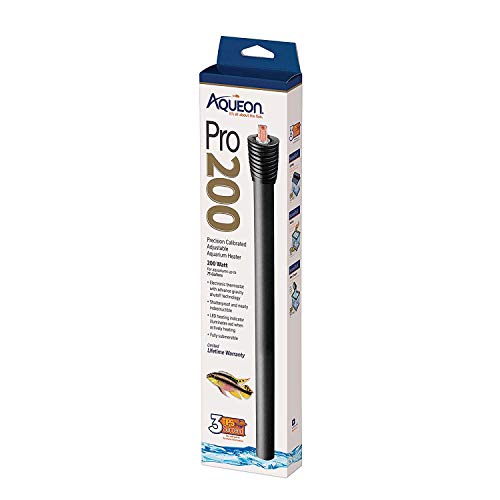
An aluminium element sits inside a shatter resistant composite shell, which puts breakage risk in the same bracket as electronic models. Control is a plain dial with an LED that lights while drawing power. Owners report the printed markings are approximate, so pair it with a separate thermometer.
Pros
- Break resistant without electronics
- LED confirms the element is cycling
- Mounts horizontally or vertically
Cons
- Dial markings are approximate
- No numeric temperature readout

Hygger Titanium Aquarium Heater
Titanium tubing carries the element while all electronics live in a controller outside the cabinet. Target temperature sets in single degree steps and the display shows the probe reading. Metal shrugs off the knocks that end a glass heater in a boisterous tank.
Pros
- Titanium tube resists impact and corrosion
- Adjustments made without wet hands
- Single degree control steps
Cons
- Separate probe adds a second cable
- Controller needs a dry mounting spot

Tetra HT Submersible Aquarium Heater
Preset to a tropical target with no dial at all, this suits a first betta or a shrimp tank. A two colour light shows heating or holding at a glance. Species needing a specific figure rule it out entirely.
Pros
- Nothing to knock out of adjustment
- Status light readable at a glance
- Short body fits shallow nano tanks
Cons
- Fixed set point suits few species
- Wattage too low for larger volumes
Orlushy Submersible Aquarium Heater
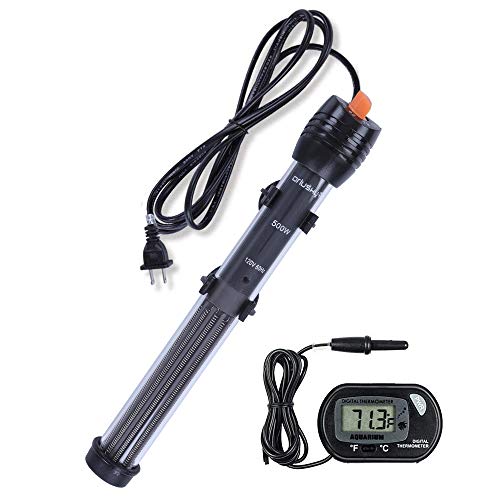
Quartz glass and an external adjustment dial cover the basics for a stable indoor room. Setting the target does not mean reaching into the water, which is unusual at this level. Owners report factory calibration varies between units, so verify with a thermometer during the first week.
Pros
- Dial sits outside the water
- Wide wattage range available
- Simple to install and replace
Cons
- Factory calibration varies between units
- Glass body needs careful handling
How they compare
| # | Model | Housing | Best for | Score | Price |
|---|---|---|---|---|---|
| 1 | Eheim Jager TruTemp Aquarium Heater | Laboratory glass | Best overall | 9.4 | Check price |
| 2 | Cobalt Aquatics Neo-Therm Heater | Shatterproof thermoplastic | Best for breakage resistance | 9.2 | Check price |
| 3 | Fluval E Series Electronic Heater | Guarded glass core | Best temperature display | 9.0 | Check price |
| 4 | Aqueon Pro Adjustable Heater | Shatter resistant composite | Best value | 8.8 | Check price |
| 5 | Hygger Titanium Aquarium Heater | Titanium tube | Best for large volumes | 8.6 | Check price |
| 6 | Tetra HT Submersible Aquarium Heater | Sealed plastic body | Best for small tanks | 8.3 | Check price |
| 7 | Orlushy Submersible Aquarium Heater | Quartz glass | Best budget | 8.0 | Check price |
What to look for
How to size heater wattage for an indoor room Roughly three to five watts per gallon is the usual starting figure. Room temperature matters just as much as tank volume, because the heater only makes up the difference. A tank in a heated lounge sits at the low end of that range. One in a cool spare bedroom or a converted garage needs the high end, or the wattage split across two units.
Why two smaller heaters beat one large one Splitting the required wattage across two heaters covers both failure modes. Should one fail off, the other holds the tank survivable until you notice. Should one stick on, half the wattage cannot cook the volume quickly. Placing them at opposite ends also evens out warm and cool zones in a long tank.
Glass, composite or titanium: which body suits your tank? Glass tubes control accurately and cost least, but a broken heater in a live tank is both a shock hazard and a cleanup. Composite shells remove that risk and suit tanks with cichlids, turtles or curious children. Titanium is the toughest of the three and pairs with an external controller, at the cost of an extra probe cable.
Can you trust the dial on an aquarium heater? Every dial carries some offset, and it widens over years of service. Keep an independent thermometer at the opposite end of the tank from the heater. Set the dial to whatever produces the reading you want rather than the number printed on the collar. Check it during routine maintenance, not only when fish look unwell.
Questions worth asking
What wattage aquarium heater do I need indoors?
Start at three to five watts per gallon, then adjust for how cool the room gets overnight. A consistently warm room sits at the low end. A cold room justifies the high end or two heaters sharing the load.
Should I use one heater or two?
Two smaller units is safer for anything past a small tank. Coverage improves along the length, and a single failure stops being an emergency.
Do aquarium heaters have to be fully submerged?
Almost every modern heater is fully submersible and should be, since the thermostat needs to read water rather than air. A few older designs carry a maximum immersion line printed on the tube.
Where should the heater sit in the tank?
Near the filter outflow or another source of steady movement, so heated water circulates instead of pooling. A heater in a dead corner reads its own pocket and leaves the far end cold.
How accurate are aquarium heater dials?
Less accurate than the printed numbers suggest. Treat the dial as a starting point, confirm with a separate thermometer, and adjust from there. Recalibratable models such as the Eheim Jager make that correction permanent.
Can an aquarium heater overheat a tank?
Yes, if the thermostat sticks closed. Splitting wattage across two heaters limits how far the temperature can climb, and models with an over temperature cutout add a second layer.
How long do aquarium heaters last?
Several years is typical for a quality unit. They remain consumable equipment rather than fixtures, so many keepers replace them on a schedule instead of waiting for a failure with fish in the tank.
Do I need to unplug the heater during a water change?
Yes, whenever the level will drop below the tube. Run dry protection tolerates exposure better, but unplugging removes the risk. Let the glass cool before lifting it out.
Is a shatterproof heater worth it for an indoor tank?
It is if the tank holds cichlids, turtles or plecos, or sits somewhere children reach. In a quiet planted tank, glass remains accurate and perfectly safe.
The bottom line
Eheim Jager TruTemp stays the sensible default for an indoor freshwater tank, because a correctable dial fixes the problem that matters most. Where breakage is a real concern, Cobalt Aquatics Neo-Therm delivers similar stability in a thermoplastic body. Fluval E Series justifies its bulk with a readable display and drift alerts, and any of the three works better alongside a separate thermometer.
Olivia Hartley
Olivia spent several years working at an animal shelter and a pet-supply retailer before joining the editorial team. She researches pet gear with an emphasis on safety, comfort and the fine print that owners often miss.