Which Air Pump Handles Large Pet Tanks Best?
Tetra Whisper AP300 covers aquariums to roughly 300 gallons with a damped chamber that keeps it livable. Fluval Q2 holds pressure in tall tanks through two independently valved outlets. Active Aqua AAPA45L pushes 45 liters per minute across eight outlets for fish rooms.
Tetra Whisper AP300 is the workhorse most large tank keepers settle on, rated to around 300 gallons. Fluval Q2 holds output at depth better than its size suggests, with per-outlet flow control. Active Aqua AAPA45L delivers 45 liters per minute across eight outlets, which replaces a rack of small pumps.
Gallon ratings assume a shallow tank and one coarse air stone. Reality adds water depth, long airline runs, gang valves, sponge filters and fine pore stones, and each of those subtracts real output. Back pressure, not volume, is what stalls a pump at the substrate. We compared published output figures, depth and pressure claims, outlet counts, damping design, and what owners report about noise and diaphragm life under continuous running.
The shortlist, ranked

Tetra Whisper AP300 Air Pump
Rated to roughly 300 gallons, this drives several sponge filters at depth without stepping up to a linear piston pump. A damped internal chamber and rubber feet keep the running note lower than the output suggests. Its single outlet splits easily with a manifold. Footprint is large enough to need planned cabinet space.
Pros
- Holds output against deep water pressure
- Quieter than most pumps in its power class
- Rebuild kits are widely available
Cons
- Takes substantial cabinet footprint
- Needs a check valve on any below-rim placement

Fluval Q2 Air Pump
Twin outlets carry independent valves, so a sponge filter and an airstone can run at different rates from one unit. Rated to roughly 160 gallons, it keeps pushing in tall aquariums where cheaper pumps stall. A suspended motor mount transfers very little vibration into a wooden cabinet.
Pros
- Maintains output at depth
- Per-outlet flow control on both lines
- Very low vibration transfer to furniture
Cons
- 160 gallon rating trails the piston pumps here
- Replacement parts are harder to source

Active Aqua Air Pump AAPA45L
Eight outlets and 45 liters per minute make this a rack pump rather than a display tank accessory. Fish rooms and stock tank setups use one to replace four or five hobby units. A metal housing on rubber feet is built for continuous duty. It is not designed to hide in a living room cabinet.
Pros
- Eight outlets feed a whole rack
- 45 litres per minute of total volume
- Metal housing rated for continuous duty
Cons
- Clearly audible in a living space
- Far more pump than one display tank needs

EcoPlus Commercial Air Pump 5
Sealed commercial construction handles pond depth and the long airline runs that come with outdoor installs. Round-the-clock aeration is the design brief, and owners report years of service between diaphragm changes. Noise levels mean most pond builds house it in a vented box.
Pros
- Pushes through pond depth and long tubing runs
- Built for continuous outdoor duty
- Serviceable rather than disposable
Cons
- Loud enough to want a housing box
- Heavy and awkward to reposition
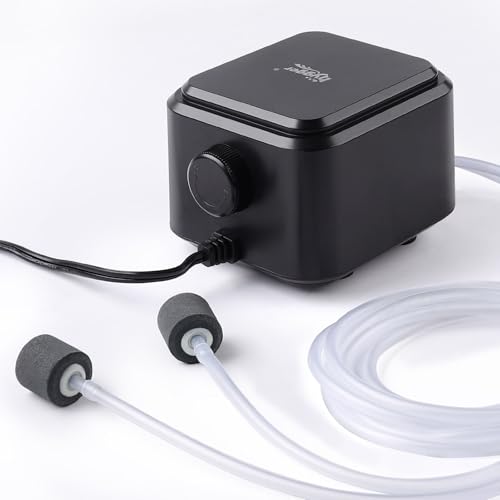
hygger Quiet Aquarium Air Pump
Two outlets plus an adjustable output dial cover most tanks around the hundred gallon mark. A rubber suspended motor keeps vibration off the stand, and owners report it stays quiet months into use. Airline and stones come in the box. Output falls away noticeably once water depth climbs.
Pros
- Output dial prevents over-aerating
- Stays quiet at moderate settings
- Airline and air stones supplied
Cons
- Output drops in very deep tanks
- Plastic body feels less durable than metal rivals

VIVOSUN Commercial Air Pump
Built for hydroponic reservoirs, which makes it equally suited to grow-out tanks and livestock troughs. Multiple valve-controlled outlets spread air across many stones at once. Total volume is the selling point, not refinement, so plan on a garage, basement or outbuilding rather than a living room.
Pros
- Very high total air volume
- Spreads output across many airstones
- Metal housing survives utility spaces
Cons
- Noisy without vibration isolation
- No fine control over total output

Tetra Whisper AP150 Air Pump
Smaller sibling to the AP300, rated to roughly 150 gallons and using the same damping approach. One large tank with a sponge filter or two sits comfortably inside that range. Parts interchange with the bigger model, which helps when a diaphragm hardens. Several deep water stones will outrun it.
Pros
- Solid output for its size and cost
- Runs quietly thanks to the damped chamber
- Shares service parts with the AP300
Cons
- Struggles with several deep water stones
- Single outlet needs a splitter for multiple devices
Compared at a glance
| # | Model | Rated for | Best for | Score | Price |
|---|---|---|---|---|---|
| 1 | Tetra Whisper AP300 Air Pump | Up to about 300 gallons | Best overall | 9.4 | Check price |
| 2 | Fluval Q2 Air Pump | Up to about 160 gallons | Best for deep tanks | 9.2 | Check price |
| 3 | Active Aqua Air Pump AAPA45L | Eight | Best for many outlets | 9.0 | Check price |
| 4 | EcoPlus Commercial Air Pump 5 | Ponds and large reservoirs | Best for ponds | 8.7 | Check price |
| 5 | hygger Quiet Aquarium Air Pump | Large freshwater and marine tanks | Best value | 8.5 | Check price |
| 6 | VIVOSUN Commercial Air Pump | Multiple, valve controlled | Best for stock tanks | 8.2 | Check price |
| 7 | Tetra Whisper AP150 Air Pump | Up to about 150 gallons | Best budget | 8.0 | Check price |
How to pick the right one
How to size an air pump for a large setup Start with tank volume, then adjust for everything the rating ignores. Water depth, airline length, fittings and stone pore size all add back pressure. Count the devices each pump must feed. Confirm rebuild kits exist, since a pump running twenty-four hours a day will need a diaphragm before it needs replacing. Only then compare noise claims.
Why volume rating and pressure are different numbers A gallon rating assumes shallow water and a coarse airstone. Pressure is what pushes air down two or three feet of water and through a fine pore diffuser. A pump rated for a large tank can still fail to bubble at the bottom of a tall one. For tanks deeper than about two feet, or any pond, choose models that state depth or pressure explicitly.
How many outlets do you actually need? Every sponge filter, airstone, air-driven skimmer and undergravel lift consumes output. Splitting one outlet six ways with gang valves rarely balances, because the line with least resistance takes most of the air. Native outlets with individual valves give far better control, which is why multi-outlet pumps like the Active Aqua AAPA45L dominate fish rooms.
Noise control and check valves on large systems Vibration through a cabinet, not motor sound, is what people hear. A folded towel, rubber mat or foam block under the pump usually beats upgrading the model. Hanging the pump from a hook removes hard contact entirely. Fit a one-way check valve on every line, since a pump below the water line will siphon a tank onto the floor during an outage. Loop the airline above the rim as a second defense.
Good to know
How do I know if my large tank needs more aeration?
Fish holding near the surface and gulping, sluggish behavior early in the morning, and a heavy surface film all point to low dissolved oxygen. Warm water and heavy stocking make it worse, since warm water holds less oxygen.
Can an air pump be too strong for a big tank?
It can create more current and surface churn than some species tolerate, and heavy agitation drives carbon dioxide out of a planted tank. Dial an adjustable pump back rather than buying an undersized one.
Should the pump sit above or below the tank?
Above the water line is safest, since it removes any back siphon risk. If it must sit below, fit a check valve on every line and route the airline up over the rim first.
How often do air pump diaphragms need replacing?
Owners report roughly one to two years of continuous running on hobby pumps, and less on commercial units worked hard. Falling output with no visible leak is the usual sign, and rebuild kits are inexpensive for major brands.
Do air pumps actually oxygenate water?
Mostly indirectly. Bubbles transfer a little oxygen themselves, but the larger effect is the surface disturbance they create, which is where gas exchange happens. A pump aimed to break the surface can outperform a deeper diffuser.
Can I run a pond with an aquarium air pump?
Only a very small pond. Depth and long tubing runs create far more back pressure than aquarium pumps are built for, which is exactly why commercial units such as the EcoPlus exist.
Will a battery backup keep my air pump running?
Some pumps include built-in backup, and separate battery models cover outages. For a heavily stocked large tank a backup is worth having, since oxygen crashes fastest in warm, crowded water.
Why did my air pump get louder over time?
Usually a hardened diaphragm, a loose rubber foot, or the housing having shifted so it touches the cabinet. Check the mounting first, then replace the diaphragm if output has also dropped.
Which air pump is best for a fish room with many tanks?
Active Aqua AAPA45L, since eight outlets and 45 liters per minute feed an entire rack from one unit. VIVOSUN Commercial is the alternative when reservoirs and grow-out tanks are the load.
Tetra Whisper AP300 vs AP150: which do I need?
AP300 is rated to roughly 300 gallons and handles several deep sponge filters. AP150 covers about 150 gallons and suits one large tank with one or two filters, sharing the same service parts.
Our take
Tetra Whisper AP300 is the sensible default for a single large display aquarium, with pressure for depth and a running note quiet enough for a living room. Fluval Q2 is the better pick for tall tanks where noise matters most. Aerating a fish room, stock tank or pond calls for the Active Aqua AAPA45L, given somewhere isolated to sit.
Olivia Hartley
Olivia spent several years working at an animal shelter and a pet-supply retailer before joining the editorial team. She researches pet gear with an emphasis on safety, comfort and the fine print that owners often miss.