Air Pumps Compared for Pools, Tires, and Sports Gear
Tetra Whisper AP150 tops this list, feeding tanks near 150 gallons while keeping vibration off the shelf. Fluval Q2 holds pressure in deep aquariums where smaller pumps fade. Marina 200 covers a single mid sized tank and accepts a replacement diaphragm instead of going in the bin.
Buy the Tetra Whisper AP150 if you need real output without a buzz in the room. Deep tanks are better served by the Fluval Q2, which keeps pressure where budget pumps stall. Marina 200 handles one mid sized aquarium and costs far less.
Two things decide whether an air pump works out, and neither appears on the box: output once water pressure pushes back, and how much noise reaches the room. A pump rated for a large tank can stall at twenty four inches of depth. A pump silent on foam can drone through a cabinet door. We compared rated output against depth, vibration behaviour, outlet count and adjustment, and whether the diaphragm can be replaced, then weighed owner reports of pumps fading after a year.
What matters most
What size air pump do you need for your tank? Start from tank volume, then correct for depth. Every inch of water above the airstone pushes back against the pump, so a tall tank is harder work than a shallow one of equal gallons. Past roughly eighteen inches of depth, size up a step. Running several devices from one pump has the same effect, since each stone or sponge filter takes a share. Weak bubbles at the stone are the classic sign of an undersized unit.
How do you make an aquarium air pump quieter? Resonance, not the motor, causes most complaints. A small vibration entering a wooden cabinet turns the whole cabinet into a speaker. Stand the pump on a folded towel, foam or a mouse mat, or hang it from a hook so nothing rigid touches it. Check that the airline is not tapping the tank rim. Quiet rated models such as the Hygger help through internal suspension, but the surface underneath still matters more than the badge.
Do you need a check valve on an air pump? Yes, whenever the pump sits at or below the water line. Cut the power and water can siphon backwards down the airline, emptying part of the tank onto the floor and ruining the pump. One way check valves cost almost nothing and push on in seconds. Mount them close to the tank, and loop the line above the rim as a second barrier. Replace airline once it yellows, because stiff tubing splits at the barbs.
How long does an air pump diaphragm last? Rubber diaphragms are consumables. Most harden over one to three years, and the symptom is gradually weaker bubbles rather than sudden silence. Established brands sell rebuild kits with a fresh diaphragm and valve flaps, and fitting one takes a screwdriver and ten minutes. Unbranded pumps are usually disposable instead. That distinction matters when a pump runs around the clock, so check parts availability before buying.
The top picks, ranked

Tetra Whisper AP150 Aquarium Air Pump
Tetra suspends the motor inside a dampening chamber, which is why a pump rated near 150 gallons stays subdued in a living room. Enough pressure remains at depth to drive several sponge filters or a long air bar. Its body is bulky, so plan a cabinet shelf rather than a corner of the stand.
Pros
- High output without a harsh buzz
- Keeps working as water depth increases
- Suspension design stops shelf resonance
Cons
- Too large for a small stand
- Wasted capacity on a single nano tank

Fluval Q2 Aquarium Air Pump
A swing arm and dual chamber layout hold output steady as depth increases, which is exactly where cheaper pumps quietly give up. Two outlets adjust independently, so a sponge filter and a bubble wall can share the unit. Barbs arrive stiff, so warm the airline before first fitting.
Pros
- Keeps pressure in tall aquariums
- Separate valve control on each line
- Rebuild parts sold separately
Cons
- Costs more than most hobby pumps
- Stiff barbs make the first tubing fit awkward
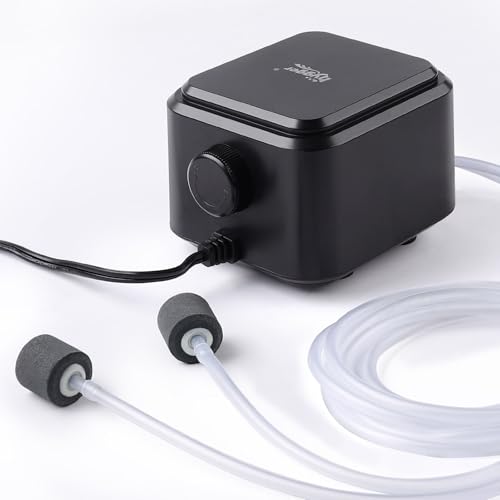
Hygger Quiet Aquarium Air Pump
Rubber feet and a soft internal mount stop most vibration reaching the surface underneath. A dial tunes a sponge filter down to a slow bubble instead of a rolling boil. Peak output sits below the big Tetra and Fluval units, so match it to a modest tank.
Pros
- Genuinely quiet on a bedroom shelf
- Dial sets the bubble rate precisely
- Rubber feet cut shelf resonance
Cons
- Lower peak output than the large pumps
- At minimum setting it can stall a deep sponge filter

Marina 200 Aquarium Air Pump
Marina strips the feature list down to a dampening chamber and steady output for a mid sized tank. Nothing adjusts, which suits anyone who would rather set it and forget it. Replacement diaphragms exist, so a weak pump can be rebuilt years later.
Pros
- Dependable output for a modest outlay
- Quiet enough for a living room
- Rebuildable rather than disposable
Cons
- No output adjustment
- Single outlet needs a splitter for two devices
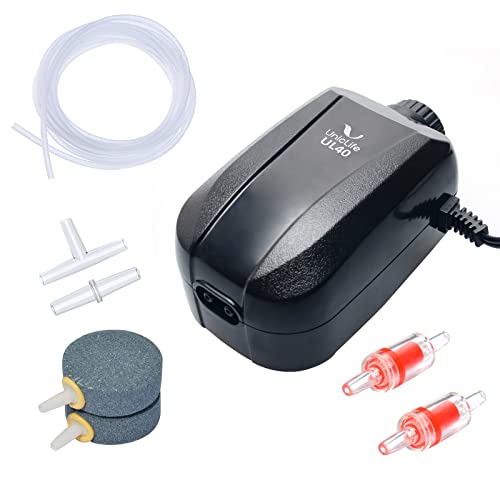
Uniclife Aquarium Air Pump with Dual Outlets
Two separately adjustable outlets feed a display tank and a quarantine setup from one socket. Valves let you starve one line without cutting the other. Materials feel plainer than the branded pumps, and it sits audibly louder than the dedicated quiet models.
Pros
- Runs two tanks from one plug
- Each outlet adjusts on its own
- Usually ships with tubing and check valves
Cons
- Louder than the dedicated quiet pumps
- Plainer build than branded alternatives

Aqueon Aquarium Air Pump
Aqueon labels each model by tank capacity, which removes the guesswork behind vague output claims. Performance holds steady for the rated size, and the housing behaves on a padded surface. Smaller models carry one fixed outlet, so buy the size that matches the tank rather than planning to dial it back.
Pros
- Capacity labelling takes the guesswork out
- Consistent output at the rated tank size
- Stocked widely for quick replacement
Cons
- No output adjustment
- Needs a mat to avoid buzzing on hard surfaces

Pawfly Aquarium Air Pump
Pawfly aims this at betta tanks, shrimp bowls and hospital setups that need a gentle bubble stream and nothing more. Its body hides behind the aquarium and draws very little power. Output stays modest, so a large sponge filter or a deep tank is out of reach.
Pros
- Cheap enough to keep as a spare
- Small enough to hide behind the aquarium
- Gentle output suits bettas and shrimp
Cons
- Not enough pressure for deep or large tanks
- Audible hum in a silent room
Side by side
| # | Model | Rated for | Best for | Score | Price |
|---|---|---|---|---|---|
| 1 | Tetra Whisper AP150 Aquarium Air Pump | Tanks up to about 150 gallons | Best overall | 9.4 | Check price |
| 2 | Fluval Q2 Aquarium Air Pump | Two with independent control | Best for deep tanks | 9.2 | Check price |
| 3 | Hygger Quiet Aquarium Air Pump | Adjustable output dial | Best for quiet rooms | 9.0 | Check price |
| 4 | Marina 200 Aquarium Air Pump | Mid sized aquariums | Best value | 8.8 | Check price |
| 5 | Uniclife Aquarium Air Pump with Dual Outlets | Two, individually adjustable | Best for multiple tanks | 8.6 | Check price |
| 6 | Aqueon Aquarium Air Pump | Rated clearly by tank capacity | Best for easy sizing | 8.3 | Check price |
| 7 | Pawfly Aquarium Air Pump | Nano and small tanks | Best budget | 8.0 | Check price |
Frequently asked questions
Does every aquarium need an air pump?
No. Tanks whose filter ripples the surface already exchange enough gas. Pumps earn their place with sponge filters, heavy stocking, warm water that holds less oxygen, medication that lowers oxygen, and any tank where you want visible bubble movement.
What size air pump do I need for a 55 gallon tank?
Match the rating to the volume first, then step up if the tank is taller than about eighteen inches or you are running more than one air device. A pump like the Tetra Whisper AP150 leaves headroom for both.
How do I quieten a buzzing air pump?
Isolate it from hard surfaces using foam, a folded towel or a hook. Confirm the airline is not vibrating against glass. If noise appeared recently, check the airstone, because a clogged stone makes the pump work audibly harder.
Do I need a check valve?
Only if the pump sits at or below the water line, which covers most cabinet installations. Without one, a power cut turns the airline into a siphon. Fit one per line and keep it close to the tank.
Can one pump run two tanks?
Yes, using a dual outlet pump such as the Uniclife or a gang valve, provided output covers both. Fit a check valve on each line. Shared airline is a theoretical disease path, so a separate pump is safer for quarantine.
Why has my air pump got weaker over time?
A hardened diaphragm and worn valve flaps reduce output gradually. Rebuild kits from established brands restore it cheaply. Check the obvious first, though: a clogged stone or a kinked airline produces identical symptoms.
Do air pumps add oxygen to the water?
Indirectly. Bubbles themselves transfer little gas. What they do is drive circulation and break the surface, and surface agitation is where exchange happens. That is why pumps help most in still, poorly circulated tanks.
Should an air pump run all the time?
Generally yes, especially where a sponge filter depends on it. Switching off overnight can drop oxygen in a stocked tank. Power draw is tiny, so continuous running costs very little.
Is a dual outlet pump better than two single pumps?
Two pumps give redundancy and isolate tanks from each other. One dual outlet unit saves a socket and space. Choose two pumps when a quarantine tank is involved, and one when both tanks are display setups in the same room.
Final word
Tetra Whisper AP150 is the pump to buy when you want serious output that still behaves in a living room, with headroom for several sponge filters. Choose the Fluval Q2 where water depth is the obstacle, since it holds pressure as smaller units fade. For one mid sized aquarium, Marina 200 does the job and rebuilds cheaply when the diaphragm hardens.
Olivia Hartley
Olivia spent several years working at an animal shelter and a pet-supply retailer before joining the editorial team. She researches pet gear with an emphasis on safety, comfort and the fine print that owners often miss.


