Action Cameras That Hold Up When Things Get Rough
The GoPro HERO13 Black is the best overall action camera, combining class leading stabilization with a modular mounting system. The DJI Osmo Action 5 Pro suits low light shooting with its larger sensor, and the Akaso Brave 8 covers casual use on a budget.
The GoPro HERO13 Black is the best overall action camera, because its HyperSmooth stabilization and magnetic mod system handle the widest range of fast moving activities without a gimbal or extra accessories. It costs more than most competitors here, so anyone filming mostly casual, slower paced activity can get similar everyday results from a cheaper camera.
We compared stabilization quality, sensor size and low light performance, waterproof rating without a case, battery life and screen design using manufacturer specifications and owner feedback from retail listings.
What matters most
Stabilization: The Spec That Matters Most for Action Footage Electronic image stabilization smooths out the bumps and shakes of running, biking or skiing, and the difference between a basic system and a refined one like GoPro’s HyperSmooth shows clearly in fast motion. Budget cameras like the Akaso Brave 8 and Campark X35 include stabilization, but it visibly struggles compared to the GoPro HERO13 Black or DJI Osmo Action 5 Pro at higher speeds. Anyone filming genuinely fast activity should prioritize stabilization quality over resolution.
Sensor Size and Why It Matters More Than Megapixels A larger sensor, like the 1/1.3 inch chip in the DJI Osmo Action 5 Pro, gathers more light than the smaller sensors in budget action cameras, which shows up as cleaner footage in shade, dusk or indoor settings. Resolution numbers like 4K or 5.3K describe how many pixels are captured, not how well the camera handles difficult lighting. Buyers who mostly shoot bright daylight outdoors will notice sensor size less than someone filming dawn surf sessions or indoor sports.
Standard Action Cameras Versus 360 Degree Capture A standard action camera like the GoPro HERO13 Black records exactly what the lens points at, requiring the camera to be aimed correctly in the moment. A 360 camera like the Insta360 X4 captures the full sphere around it, letting an editor choose the framing afterward, which helps when the action’s direction is unpredictable. That flexibility comes with extra editing time to reframe 360 footage into a standard video format.
When a Budget Action Camera Is the Right Call Cameras like the Akaso Brave 8, SJCAM SJ11 and Campark X35 cost meaningfully less than GoPro or DJI while still recording usable 4K footage for casual use. They make sense as a backup camera, a first camera for a kid, or for anyone unsure whether they will stick with action sports filming long term. Serious or frequent use in fast conditions still favors the stronger stabilization and sensors in premium models.
Our top picks

GoPro HERO13 Black
The HERO13 Black records 5.3K video with HyperSmooth stabilization that handles running, biking or skiing footage without a gimbal. Magnetic mod mounts let it attach interchangeable lenses and accessories without the fiddly screw mounts older models used.
Pros
- Best in class stabilization for handheld action footage
- Magnetic mod system swaps lenses and accessories quickly
- Dual screens aid framing from the front and rear
Cons
- Battery life shortens noticeably at the highest resolution settings
- Costs more than most competitors here

DJI Osmo Action 5 Pro
The Osmo Action 5 Pro uses a larger 1/1.3 inch sensor with dual native ISO, holding detail in dim conditions noticeably better than smaller sensor action cameras. Battery life also runs longer per charge than most competitors.
Pros
- Larger sensor improves low light and dynamic range
- Longer battery life than most action cameras here
- Waterproof without a case to a deeper rating
Cons
- App and ecosystem are less mature than GoPro’s
- Fewer third party mounting accessories available
Insta360 Ace Pro 2
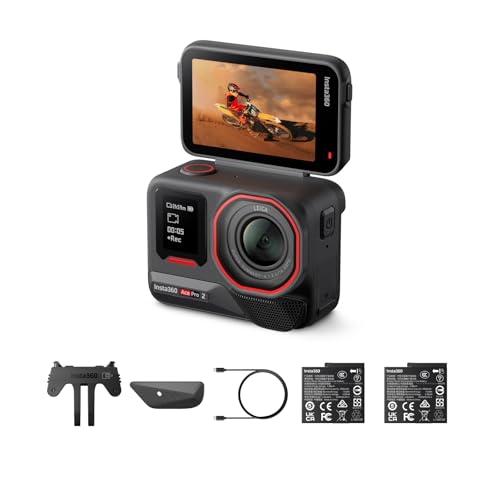
The Ace Pro 2 flips its touchscreen forward for easy framing while vlogging, and its Leica co-engineered sensor targets stronger color accuracy than typical action camera sensors. A removable battery adds flexibility for longer shooting days.
Pros
- Flip touchscreen simplifies front facing vlogging shots
- Removable battery allows quick swaps for long days
- Color science tuned with Leica aims for more natural tones
Cons
- Flip screen mechanism adds moving parts versus fixed screens
- Fewer accessories available than the GoPro ecosystem

Insta360 X4
The X4 captures a full 360 degree sphere using two lenses, letting you reframe and choose an angle after recording instead of aiming the camera in the moment. That makes it useful for action where you cannot predict exactly where the subject will go.
Pros
- Captures everything around the camera, not just what it’s aimed at
- Reframing after the fact fixes unpredictable framing mistakes
- High resolution 360 capture holds detail when cropping to a flat view
Cons
- 360 footage requires extra editing time to reframe into standard video
- Stitch line between lenses can show in certain lighting

Akaso Brave 8
The Brave 8 brings a touchscreen and basic electronic stabilization to a price well below GoPro or DJI, suited to casual users who want decent action footage without the premium cost. It still manages 4K recording for everyday clips.
Pros
- Lower cost than premium action camera brands
- Touchscreen simplifies settings and framing
- Decent stabilization for the price point
Cons
- Stabilization is noticeably less smooth than GoPro or DJI at speed
- Lower light performance trails pricier sensors

SJCAM SJ11
The SJ11 copies the modular lens concept popularized by premium brands at a lower price, letting owners swap between a standard lens and a wide angle module. It targets buyers who want some of GoPro’s flexibility without the matching cost.
Pros
- Modular lens swapping at a fraction of premium brand pricing
- Rear touchscreen aids basic framing and menu navigation
- Reasonable build quality for its price tier
Cons
- Stabilization lags behind GoPro and DJI in fast motion
- Lens module selection is smaller than premium ecosystems

Campark X35
The X35 covers the basics for anyone trying action cameras for the first time or buying a backup unit for a kid’s bike rides. It skips advanced stabilization and sensor size in favor of a low entry price.
Pros
- Lowest cost entry point into action cameras in this group
- Simple controls suit first time users or kids
- Comes with a reasonable mounting accessory kit
Cons
- Stabilization struggles noticeably with fast movement
- Non-touch screen makes menu navigation slower
How they stack up
| # | Model | Max Video | Best for | Score | Price |
|---|---|---|---|---|---|
| 1 | GoPro HERO13 Black | 5.3K at 60fps | Best Overall | 9.5 | Check price |
| 2 | DJI Osmo Action 5 Pro | 4K at 120fps | Best for Low Light | 9.2 | Check price |
| 3 | Insta360 Ace Pro 2 | 4K at 120fps | Best for Flip Screen and Vlogging | 8.9 | Check price |
| 4 | Insta360 X4 | 8K 360 degree capture | Best for 360 Degree Footage | 8.7 | Check price |
| 5 | Akaso Brave 8 | 4K at 30fps | Best Budget Pick | 8.3 | Check price |
| 6 | SJCAM SJ11 | 4K at 30fps | Best for Interchangeable Lenses at Lower Cost | 8.1 | Check price |
| 7 | Campark X35 | 4K at 30fps, interpolated | Best for a Simple Backup or Beginner Camera | 7.8 | Check price |
Good to know
Do I need 5.3K resolution for action camera footage?
Most online viewing and even large screen playback looks great at 4K. 5.3K mainly helps if you plan to crop or stabilize heavily in editing and still keep a sharp 4K final output.
How deep can action cameras go underwater without a case?
Depths in this comparison range from about 30 to 66 feet without an additional case. Diving beyond those depths requires a separate waterproof housing rated for deeper use.
What is the benefit of a 360 degree action camera over a standard one?
A 360 camera captures everything around it, so you can choose the best angle after filming instead of having to aim the camera correctly in the moment, which helps for unpredictable action.
Do cheaper action cameras handle fast motion well?
Budget cameras include basic stabilization but tend to show more visible shake and warping during fast motion compared to premium models with more advanced processing.
Can action cameras replace a vlogging camera?
Models with a front facing flip screen, like the Insta360 Ace Pro 2, work reasonably well for vlogging, though dedicated vlogging cameras generally offer better autofocus and audio options.
How long does an action camera battery last while recording 4K?
Battery life varies from about 70 to 180 minutes depending on resolution, frame rate and model, with larger sensor cameras like the DJI Osmo Action 5 Pro generally lasting longer.
Do action cameras need a memory card, and what type?
Yes, all of these cameras require a separate microSD card, and higher resolution recording like 4K or 5.3K needs a faster rated card to avoid dropped frames.
Are modular lens systems worth the extra cost on an action camera?
They add flexibility to switch between a standard and wide angle view without buying a second camera, which benefits people who shoot varied content, but casual users may never swap lenses often enough to justify the cost.
Final word
The GoPro HERO13 Black is the strongest overall pick, since its stabilization and modular accessory system handle the widest range of action sports without major compromises. Anyone shooting mostly in low light or at dawn and dusk should choose the DJI Osmo Action 5 Pro instead, since its larger sensor holds detail better in dim conditions. Casual users or anyone buying a first or backup camera can get solid 4K footage for less with the Akaso Brave 8.
Marcus Chen
Marcus covered consumer electronics for enthusiast tech publications for six years before joining ChoiceCrest. He specializes in translating manufacturer spec sheets into plain-language buying advice, with a focus on audio, computing accessories and smart-home gear.