Why Do Trekking Poles Reduce Knee Strain on Downhill Hikes?
Trekking poles reduce knee strain on downhill hikes because they let your arms and shoulders absorb part of the impact force that would otherwise land entirely on your knees with each downhill step. Research on hiking biomechanics has measured meaningful reductions in compressive force on the knees when poles are used correctly on descents, which is a real mechanical effect, not just a perceived comfort benefit.
Why descents are so much harder on knees than climbs
Going downhill, each step involves controlling and absorbing your body weight’s momentum as gravity accelerates you forward, which generates significantly higher impact forces through the knee joint than the muscular effort of climbing uphill does. This is the main reason hikers who feel fine on the way up often feel real knee discomfort on the way down, especially on long or steep descents.
How poles actually redistribute that load
Planting a pole ahead of each downhill step and pressing weight into it through your arm transfers a portion of your body weight’s impact into the pole and your upper body, instead of all of it landing on the leading knee as it absorbs the step. Over hundreds or thousands of steps on a long descent, that repeated small reduction per step adds up to meaningfully less cumulative joint stress.
Why technique matters as much as having poles at all
Poles only help if used actively, planting them ahead of your downhill foot and genuinely pushing weight into them, rather than carrying them loosely without real load transfer. Hikers who use poles passively, mostly for balance rather than active weight-bearing on descents, get less of the knee-sparing benefit than those who deliberately lean into them on each downhill step.
How pole length and adjustment affect the benefit
Poles are typically lengthened somewhat for descents compared to flat or uphill walking, since a longer pole reaches the ground properly at the steeper downhill angle and lets you plant it ahead of your body for effective load transfer. A pole left at a flat-ground length on a steep descent forces an awkward reach that reduces how effectively it can actually take weight off the knee.
Why this matters more on longer hikes than short ones
The knee-sparing effect of poles is cumulative, so a short, gentle downhill walk may not show much practical difference, while a long multi-mile descent, especially with a loaded pack, is where the accumulated reduction in joint impact becomes noticeably felt, both during the hike and in recovery the next day.

Black Diamond Trail Trekking Poles
A widely used adjustable aluminum trekking pole with quick-lock length adjustment, commonly used to lengthen poles for descents as described above.
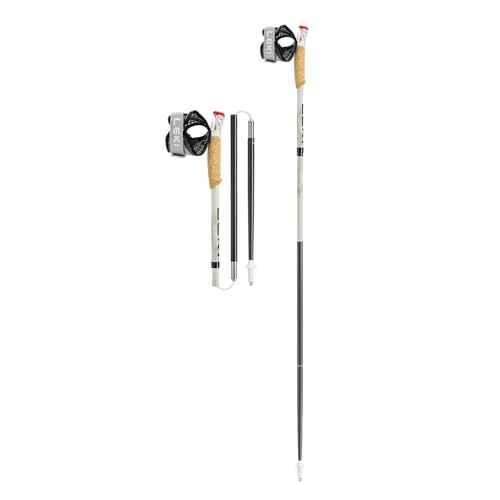
Leki Micro Vario Carbon Trekking Poles
A lighter carbon folding trekking pole favored by hikers who want reduced swing weight on long descents without sacrificing the load-bearing function poles provide.
Common questions
Do trekking poles help on uphill sections too, or just downhill?
They help on both, but differently, on uphill sections poles assist with propulsion and balance, while on downhill sections their main benefit is absorbing impact force that would otherwise load the knees directly.
How much should I lengthen my trekking poles for a downhill descent?
A common guideline is to lengthen poles a few inches beyond their flat-ground setting for descents, enough that the pole reaches the ground comfortably when planted slightly ahead of your body on the steeper angle.
Can using trekking poles incorrectly actually make knee strain worse?
Using poles passively without real weight transfer provides little benefit, and in rare cases poor technique, like planting poles too far forward and awkwardly, can throw off your natural gait, though this is less common than simply not getting the full benefit poles can offer.
Do I need two poles, or does one pole help with knee strain too?
Two poles generally provide more consistent and balanced load transfer on both sides with each alternating step, though a single pole still offers some benefit and is sometimes preferred for simpler terrain or when one hand needs to stay free.
Are trekking poles only useful for people with existing knee problems?
No, the mechanical benefit of reduced knee impact applies to healthy knees too, since it is about distributing a repeated physical load more broadly rather than treating an existing injury specifically.
Does pole material, like carbon versus aluminum, affect how well they reduce knee strain?
The core load-transfer mechanism works the same regardless of material, though lighter carbon poles reduce arm fatigue over a long hike, which can indirectly help you maintain good weight-bearing technique for longer compared to tiring out with heavier poles.
Can trekking poles help with ankle stability on downhill terrain as well as knees?
Yes, by providing additional points of contact and balance support, poles can help reduce the chance of an ankle roll on uneven downhill terrain, in addition to their direct effect on knee loading.
Do trekking poles add extra energy cost to a hike even though they reduce knee strain?
Using poles does increase overall energy expenditure somewhat since your arms are doing more work, which is generally considered a reasonable tradeoff for the reduced joint impact, especially on long descents.
Is there research actually showing trekking poles reduce knee force, or is this mostly anecdotal?
There is published biomechanical research measuring reduced compressive force on the knee joint during pole-assisted descents compared to hiking without poles, so the effect has genuine measured support beyond just hiker testimonials.
Should trekking pole tips be different for dirt trails versus rocky or paved terrain?
Rubber tip covers are often recommended for harder surfaces like rock or pavement to reduce slipping and noise, while the bare carbide tips underneath grip dirt and softer trail surfaces better without a cover.
Will trekking poles help on a downhill hike with a heavy backpack?
Yes, and arguably the benefit is more noticeable with a loaded pack, since the added pack weight increases the impact force each downhill step generates, which poles help redistribute more of.
Do trekking poles wear out or need maintenance over time?
Tips wear down with extended rocky terrain use and are usually replaceable, and locking mechanisms on adjustable poles can loosen over time and occasionally need tightening or cleaning to keep the pole length secure.
Can trekking poles cause shoulder or wrist strain if used heavily on long descents?
It is possible with poor technique or on very long, steep descents, since the arms and shoulders are absorbing load that the knees otherwise would, so building up pole-use endurance gradually can help avoid new strain simply shifting location rather than being reduced overall.
Do wrist straps on trekking poles actually matter for reducing knee strain?
Properly adjusted wrist straps let you push weight into the pole through your hand and wrist rather than relying purely on grip strength, which makes the load transfer more efficient and sustainable over a long descent than gripping the pole tightly without using the strap.
Is it better to plant both poles together or alternate them with each step on a descent?
Alternating poles with each opposite step, matching a natural walking rhythm, is generally the more common and sustainable technique, while planting both together is sometimes used on especially steep or technical sections for extra stability at the cost of a slower pace.
Do trekking poles help reduce knee strain on flat trail sections too, or only on descents?
The knee-sparing benefit is most pronounced on descents where impact force is highest, while on flat ground poles mainly assist with balance and overall pacing rather than meaningfully reducing joint load, since flat walking does not generate the same impact forces.
Can using poles on descents help prevent long-term knee problems, not just reduce strain on a single hike?
Reducing cumulative impact load over many hikes is generally considered protective for joint health over time, though poles are one factor among several, including body weight, pack load, and overall hiking frequency, that influence long-term knee wear.
Our take
This is one of the rare hiking gear claims with real measured backing behind it, not just marketing language. The benefit depends on actually using the poles actively on the way down, not just carrying them for the climb.
Sierra Daniels
Sierra's background is in landscape design and nursery retail. She focuses on lawn and garden equipment, outdoor furniture and gear durability, weighing published specs against how materials actually hold up outside.
You might also need

Minikey Solar Bird Feeder Camera: Is the AI Bird ID Worth the Subscription?

Refresh Sports Glider Ray Pool Torpedo: A Good Pick for Underwater Pool Play?

Sweet Home Collection Patio Chair Cushions: Enough Padding for Daily Outdoor Use?
