Why Does a Socket Wrench Click When You Reach Full Torque?
The click is a manufactured mechanical signal, not just torque giving way. Inside a click type torque wrench, a calibrated spring holds a ball or cam against a pivoting lever, and once the applied torque overcomes the spring’s preset tension, the lever snaps slightly out of position, producing an audible and often tactile click right at the value you dialed in.
What’s physically happening inside the wrench
A spring pushes a ball or roller against a pivoting cam near the wrench head. As you apply torque, the resistance builds until it overcomes the spring tension you set on the dial, at which point the cam releases suddenly and knocks against the housing, producing the click and a small give in the handle.
Why you should stop immediately at the click
The mechanism only signals that the threshold has been reached, it does not physically stop you from continuing to turn. Keep applying force past the click and you will overtighten the fastener, which can stretch bolts, strip threads, or crush a gasket depending on the application.
Why the click can feel different at different torque settings
At higher spring tension settings, the release is sharper and more abrupt, easy to feel and hear. At low settings, the spring tension is lighter, so the click is softer and easier to miss in a noisy shop or when wearing gloves.
Why torque wrenches drift out of calibration
Storing a click type wrench at a torque setting under spring tension for long periods, or dropping it, can weaken or shift the internal spring over time, which causes the click to happen earlier or later than the value shown on the dial.
Click type vs beam type vs digital
Beam wrenches use a flexing beam and a pointer rather than a sound based release, so they have no snapping mechanism to wear out and rarely drift out of calibration. Digital wrenches use an electronic strain gauge and give a numeric reading plus an audible or vibrating alert, often more precise but dependent on battery power.
Best practice to protect accuracy
Store a click type wrench at its lowest setting rather than mid or high torque, have it recalibrated periodically if it sees regular use, and apply a steady, smooth pull rather than a sharp jerk, since jerking the handle can trigger a false early click.
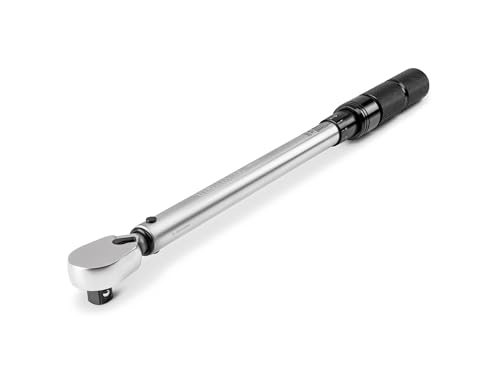
TEKTON 24335 1/2 Inch Drive Click Torque Wrench
A commonly used click type torque wrench with a dual range scale, popular for automotive and general mechanical work.

CRAFTSMAN CMMT99434 1/2 Inch Drive Torque Wrench
A mid range click type wrench aimed at home mechanics doing routine wheel, suspension, and engine bolt torquing.
Frequently asked questions
Should I stop turning the instant I hear the click?
Yes, continuing past the click applies torque beyond your set value, which can overtighten the fastener even though the wrench will not physically prevent you from turning further.
Why does my torque wrench click twice?
A double click often happens when the handle keeps moving slightly after the first release due to momentum or a jerky pull, which can trigger a second faint click that does not represent additional set torque.
Can a torque wrench lose accuracy over time?
Yes, especially click type wrenches, since the internal spring can weaken or shift from repeated use, long term storage under tension, or being dropped.
How often should a torque wrench be recalibrated?
A commonly recommended interval for frequent professional use is about once a year or every few thousand uses, while occasional home use may only need a check every few years.
Is it bad to store a click type torque wrench at a high setting?
Yes, leaving the spring compressed at a high torque setting for long periods between uses is one of the more common causes of calibration drift, so most manufacturers recommend returning it to the lowest setting after use.
Why does the click feel softer at low torque settings?
Lower settings mean less spring tension overall, so the mechanical release is gentler and produces a quieter, less pronounced click compared to a high torque setting.
Can a digital torque wrench replace a click type one for home use?
It can, and often gives a clearer numeric readout, but it depends on battery power and tends to cost more, so many home users still find a click type wrench perfectly adequate.
Does temperature affect torque wrench accuracy?
Extreme cold can slightly stiffen the internal spring and lubricants, which may shift the effective click point a small amount, though normal indoor temperature ranges have little practical effect.
Why do mechanics use different torque wrenches for different jobs?
Smaller fasteners need finer torque resolution than a large wrench can provide accurately, so a shop often keeps a smaller range wrench for delicate work and a larger one for suspension or wheel bolts.
Is a beam type torque wrench less accurate than a click type?
Not necessarily. Beam wrenches are mechanically simple and tend to hold calibration well over time, though they require watching the pointer during the pull rather than just listening for a click, which some users find less convenient.
What happens if I overtighten past the click?
Depending on the fastener and application, overtightening can stretch or snap a bolt, strip threads, crush a gasket, or warp a component like a brake rotor or cylinder head, all of which defeat the purpose of torquing in the first place.
Can dropping a torque wrench throw off its calibration?
Yes, a hard drop can bend internal components or shift the spring’s resting position, which is one of the most common real world causes of a wrench clicking at the wrong value.
Do cheap torque wrenches click at the correct value?
Quality varies a lot at the low end, and some budget wrenches click several percent off their marked value even when new, which matters more for critical fasteners than for general use.
How do I know if my torque wrench needs servicing?
If it feels gritty, clicks inconsistently at the same setting, or you have reason to doubt a critical torque job, having it checked against a calibrated reference is the only reliable way to confirm accuracy.
Why do some mechanics use a torque multiplier instead of extending reach?
A torque multiplier uses internal gearing to amplify input force accurately, which preserves calibrated torque output, whereas simply adding a pipe or cheater bar to extend a wrench’s reach throws off the torque reading entirely.
Can humidity inside a wrench housing cause rust that affects the click?
Yes, moisture trapped inside the housing can corrode the internal spring and cam mechanism over time, which is part of why storing a torque wrench in a dry case matters for long term accuracy.
Is it okay to use a torque wrench as a breaker bar?
No, using a torque wrench to break loose an overtightened or seized fastener can permanently damage its internal calibration mechanism, so a separate breaker bar should be used for that step instead.
Do aircraft or motorsport applications use different torque wrench standards?
Yes, those fields often require tighter calibration tolerances and more frequent recertification than typical home or general automotive use, reflecting the higher consequence of an incorrect torque value.
Can a torque wrench be used in reverse for loosening accurately?
Most click type torque wrenches are designed to measure torque only in the tightening direction, and using them to loosen fasteners does not give an accurate reading and can stress the mechanism unnecessarily.
Why does torque spec differ between dry and lubricated bolts?
Lubrication reduces friction between threads, which means less of the applied torque is lost to friction and more translates into actual clamping force, so specs often distinguish between dry and lubricated conditions.
Is torque-to-yield different from a regular torque spec?
Yes, torque to yield fasteners are designed to stretch slightly into their yield point during installation and typically require a specific angle of additional rotation after reaching a base torque value, rather than torque alone.
Final word
The click exists specifically so you do not have to guess, but it only works if you respect it the instant you hear it and take care of the wrench between uses. Treat the click as a stop sign, not a suggestion, and store the tool properly, and it will keep telling the truth for years.
Jake Monroe
Jake worked as a residential contractor for over a decade before shifting to full-time writing. He evaluates power tools, hand tools and workshop gear through the lens of someone who has actually used them on job sites, not just read the box.


