Why Does a Patio Umbrella Need a Heavier Base in Windy Areas?
An open patio umbrella acts like a sail, catching wind across its entire canopy area and converting that into a tipping force at the base. A heavier base counters that force by lowering the umbrella’s center of gravity and resisting the leverage the pole creates, and because wind force increases roughly with the square of wind speed, even a moderate gust can generate far more tipping force than the umbrella’s own weight alone can resist.
Why an open canopy catches so much wind force
A patio umbrella’s canopy is essentially a large flat or slightly domed surface held up on a long pole, and wind pushing against that surface creates a sideways force multiplied by the length of the pole acting as a lever arm. A 9-foot umbrella has significantly more canopy surface area than a 7-foot one, so the wind force it catches, and the tipping leverage that force creates at the base, both increase substantially with size.
The physics of why base weight matters so much
The base has to generate enough resisting torque to counteract the tipping torque the wind creates through the pole. Because the pole acts as a long lever, even a base that feels heavy when lifted by hand can be insufficient once wind catches a large canopy, which is why manufacturers specify minimum base weights tied to umbrella size rather than a single universal number.
Why gust speed matters more than steady wind
Wind force does not increase in a simple straight line with speed, it increases roughly with the square of the speed, so a gust twice as fast as a steady breeze creates roughly four times the force on the canopy. This is why an umbrella that seems stable in a calm afternoon can suddenly tip over the moment a stronger, brief gust comes through.
Why a lightweight base fails even with a heavy umbrella frame
The umbrella pole and canopy frame’s own weight does very little to resist tipping, since that weight sits mostly above the pivot point rather than low and wide like a proper base does. A heavy frame on a light base is still prone to tipping, because the base is what provides the wide, low resistance against the lever-arm force, not the umbrella structure itself.
Why wind-rated or vented canopies help but do not replace base weight
Some umbrellas include vents or small openings in the canopy designed to let a portion of wind pass through rather than catching it fully, which reduces peak force in gusty conditions. This genuinely helps, but it reduces rather than eliminates the force on the base, so even a vented canopy still needs an appropriately weighted base for its size.
How exposure and location change the real-world requirement
An umbrella on an open, elevated deck or near a coastline experiences stronger and more frequent gusts than one tucked against a house wall or fenced yard that blocks wind, meaning the same umbrella size may need a meaningfully heavier base in an exposed location than the manufacturer’s general minimum suggests.
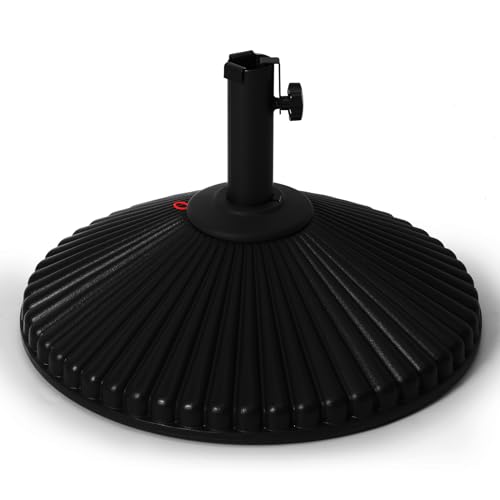
Abba Patio Fillable Umbrella Base Stand
A fillable resin base designed to be weighted with sand or water, commonly used to add substantial ballast under market and cantilever umbrellas in windier spots.

Classic Accessories Patio Umbrella Base Weight Plate
A solid cast concrete-filled weight plate often added as supplemental ballast under an existing lighter base for larger umbrellas facing exposed wind conditions.
Questions worth asking
How much does umbrella base weight need to increase for a larger canopy?
Manufacturers generally recommend scaling base weight up meaningfully with canopy diameter, since a larger canopy catches disproportionately more wind force, though the exact figure varies by umbrella design and manufacturer guidance.
Why does my umbrella tip over even with a base that feels heavy?
The base may still be undersized relative to the umbrella’s canopy area and the pole’s leverage, since wind force on a large canopy can exceed what a moderately heavy base was designed to resist, especially in gusty conditions.
Does filling a hollow base with sand or water make a real difference?
Yes, fillable bases are specifically designed to add substantial weight cheaply, and a fully filled base performs far better against wind than the same base left empty or only partially filled.
Is a cantilever umbrella more prone to tipping than a center-pole umbrella?
Often yes, since a cantilever design places the canopy’s weight and wind exposure off to one side rather than centered directly over the base, requiring an even heavier or specifically designed base to resist tipping.
Should I close my patio umbrella when it is windy?
Yes, closing the canopy removes nearly all the surface area wind can push against, which is the most effective way to prevent tipping or damage during gusty conditions, regardless of how heavy the base is.
Does umbrella pole height affect how much base weight is needed?
Yes, a taller pole increases the leverage the wind force exerts at the base, meaning taller umbrellas generally need proportionally more base weight than shorter ones with the same canopy size.
Can a vented umbrella canopy use a lighter base than a solid one?
A vented canopy reduces peak wind force somewhat, potentially allowing a slightly lighter base in moderate conditions, but it does not eliminate the need for adequate ballast, especially in genuinely windy or exposed locations.
Why do some umbrella bases use sand while others use water?
Sand generally provides more weight per unit of volume than water, making it the better choice for maximum ballast, while water-filled bases are lighter to transport and fill but offer somewhat less total weight for the same base size.
Is it safe to anchor a patio umbrella base to the ground instead of using weight?
Yes, where possible, a securely anchored or in-ground mounted base resists wind more reliably than a freestanding weighted base, since it eliminates reliance on weight alone to prevent tipping.
Does umbrella material affect how much wind force the canopy catches?
Yes, heavier, less flexible fabrics tend to resist billowing and catch wind somewhat differently than lighter fabrics, though canopy size and shape generally have a bigger effect on total wind force than material alone.
Can strong wind actually break an umbrella rather than just tip it?
Yes, beyond a certain wind speed, the frame ribs or pole can bend or snap under the force even if the base holds, which is part of why closing the umbrella in genuinely strong wind is safer than relying on base weight alone.
How do I know if my current base is heavy enough for my umbrella?
Checking the umbrella manufacturer’s recommended minimum base weight for that specific canopy size, and increasing it further for an exposed or consistently windy location, is the most reliable way to judge adequacy.
Does a wider base footprint help even without added weight?
Yes, a wider base footprint increases the resisting torque even at the same weight, since the stabilizing force acts over a larger radius, which is why base shape and diameter matter alongside raw weight.
Can I use multiple weight plates stacked for extra stability?
Yes, many base weight plates are designed to stack, letting you add incremental weight as needed for a larger umbrella or windier location without replacing the entire base assembly.
Does umbrella tilt function change how much base weight is needed?
A tilted umbrella shifts the canopy’s wind-catching surface off-center relative to the pole, which can increase tipping leverage in certain wind directions, so tilting models often benefit from slightly more base weight than fully upright ones.
Can a table with an umbrella hole through it substitute for a separate base?
Only if the table itself is heavy and stable enough on its own, since a lightweight table with an umbrella hole provides little real resistance to wind compared to a dedicated weighted base.
Is it normal for umbrella bases to come without any weight included?
Yes, many bases are sold empty specifically so buyers can choose sand, water, or gravel fill depending on how much weight their specific umbrella size and location actually require.
Our take
Base weight is not an arbitrary spec, it is the counterweight to real physics happening in the canopy above it. Matching base weight to canopy size and local wind exposure, rather than assuming any heavy-looking base is enough, is what actually keeps a patio umbrella upright through a gusty afternoon.
Sierra Daniels
Sierra's background is in landscape design and nursery retail. She focuses on lawn and garden equipment, outdoor furniture and gear durability, weighing published specs against how materials actually hold up outside.
You might also need

Why Does Bird Bath Water Turn Green So Fast?
How Does a Rain Gauge’s Placement Affect How Accurate the Reading Is?

Smart Stackable Planters for Vertical Gardens and Small Patios