Why Does a Jigsaw Blade Wander on Thicker Material?
A jigsaw blade wanders on thick stock mainly because it is a thin, flexible strip supported only near the top by the shoe and guide roller, so as material thickness increases, the unsupported tip has more room to flex and twist off the marked line before it fully clears the far side of the cut. Orbital action, a dull blade, or feeding too fast all make this underlying flex problem worse.
The blade is a thin, flexible strip, not a rigid disc
Unlike a circular saw’s rigid spinning disc, a jigsaw blade is a narrow strip of steel held only at the top by the clamp and guide roller. Any sideways resistance from the material can flex or twist that unsupported length, and the effect becomes more pronounced the deeper the blade has to travel through thicker stock.
Orbital action can make wander worse on thick cuts
Many jigsaws offer an orbital setting that moves the blade slightly forward and back in addition to up and down, which helps clear chips and speeds up cutting in thin material but can increase wander and leave rougher edges on thicker stock where precise line-following matters more.
Blade selection matters more than most people expect
A wider, thicker-bodied blade resists lateral flex far better than a thin scroll-style blade, and the correct tooth count for the material being cut also matters. A worn or dull blade has to be pushed harder to cut, and that extra pressure directly increases the sideways load that causes wander.
Feed rate and material support are user-controlled factors
Pushing the saw too fast forces the blade to flex around resistance rather than cut cleanly through it, and failing to properly support or clamp the material lets it vibrate or flex under the shoe, adding motion the blade then has to fight on top of its own flex.
Why some jigsaws handle thick material better than others
A guide roller positioned closer to the blade’s cutting tip supports more of the blade’s unsupported length, and a saw that lets you switch off orbital action for a straight pendulum-free setting generally wanders less on thick, straight cuts than a basic fixed-orbital model.

Bosch JS470E Top-Handle Jigsaw
A well-regarded corded jigsaw with adjustable orbital settings and a guide roller positioned close to the blade, relevant to the wander-reduction factors above.
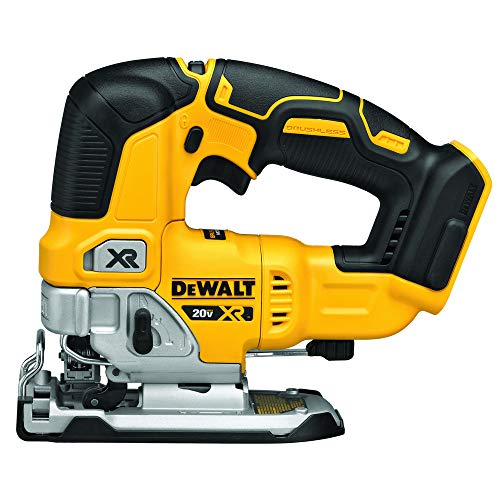
DeWalt DCS334B 20V MAX Cordless Jigsaw
A cordless jigsaw with variable speed and orbital action settings, commonly used for both curved and straight cuts in varying material thicknesses.
Good to know
Does turning off the orbital setting help with wander on thick cuts?
Often yes, a straight, non-orbital setting trades some cutting speed for a straighter cut path, which generally helps control wander on thicker material.
Why does a brand-new blade still wander on thick plywood?
Plywood alternates layers of varying hardness, so even a sharp blade can deflect slightly moving from a harder layer into a softer one, independent of the blade’s own condition.
Can a wider jigsaw blade actually cut straighter on thick stock?
Yes, a wider blade body resists the sideways twisting force far better than a thin scroll blade, though it sacrifices the ability to follow tight curves.
Is it normal for the bottom face of the cut to angle even when the top looks straight?
Yes, that is a classic sign of blade flex, since the unsupported tip of the blade lags slightly behind the top of the stroke on thicker material.
Does feed speed matter more than blade quality for wander?
Both matter, but pushing too fast is often the single biggest contributor, since it forces the blade into the material faster than it can cleanly shear through it.
Can a dull blade actually cause more wander than a sharp one?
Yes, a dull blade needs more forward pressure to cut at all, and that extra pressure increases the sideways flex responsible for wander.
Why do curved cuts seem to wander less than long straight cuts?
Shorter, gradual direction changes let the operator correct drift continuously, while a long straight cut gives flex more distance to accumulate before it becomes visually obvious.
Does clamping the material down reduce blade wander?
Yes, a securely clamped workpiece removes vibration and flex from the material itself, leaving the blade’s own rigidity as the main remaining variable.
Can a jigsaw ever cut as straight as a circular saw on thick boards?
Not reliably. A jigsaw’s thin reciprocating blade is fundamentally more flexible than a circular saw’s rigid disc, so for long straight cuts in thick material a circular saw with a guide is the better tool.
Why does the guide roller’s position matter for wander?
A guide roller positioned close to the blade’s cutting edge supports more of the blade’s length, reducing how much unsupported blade is free to flex during a deep cut.
Can an edge guide or straightedge reduce wander on long straight cuts?
Yes, clamping a straightedge or using an edge guide helps keep the shoe tracking straight, which reduces, though does not fully eliminate, flex-driven wander.
Is wander worse when cutting metal with a jigsaw compared to wood?
Typically yes, since metal cutting calls for a slower feed rate and finer-tooth blade, and the added resistance from harder material increases flex if the feed rate is not slowed accordingly.
Does blade shank style, like T-shank versus U-shank, affect wander?
Not directly, blade thickness and body width determine rigidity, though a more securely clamped T-shank blade can indirectly reduce wander caused by slight slip in the clamp itself.
Does blade length matter for wander on thick material?
Yes, a longer blade has more total unsupported length between the clamp and the tip, so it generally flexes more than a shorter blade rated for the same material thickness.
Can the orbital setting be adjusted mid-cut if wander starts happening?
Most jigsaws only let the orbital setting be changed while the saw is off or idle, so it is better to choose the right setting before starting a long cut rather than adjusting partway through.
Does the base plate itself contribute to wander?
A flexing or warped base plate can introduce some inconsistency of its own, though this matters far less in practice than the blade’s own flex during a deep cut.
Does using a scrolling-style blade on thick material make wander worse?
Yes, scrolling blades are intentionally thin and narrow to allow tight curves, which makes them far more prone to flexing and wandering on thick, straight cuts than a wider general-purpose blade.
Does tooth direction, like reverse-tooth versus standard, affect wander?
Not primarily, tooth direction mainly affects which stroke does the cutting and the surface finish on the top or bottom face, while wander is driven mostly by blade width and rigidity rather than tooth orientation.
Can starting from a pre-drilled hole reduce wander on thick material?
It can help begin the cut cleanly without forcing the blade sideways at the very start, though it does not change how much the blade flexes once it is well into a thick, long cut.
Is it normal for a jigsaw to struggle more on hardwood than softwood of the same thickness?
Yes, denser hardwood resists the blade more at the same feed rate, which increases the forward pressure needed and, in turn, the sideways flex that causes wander.
Final word
Wander on thick material is mostly physics, not operator error alone, since a thin blade supported at only one end will always flex more as it travels deeper. Choosing a wider blade, slowing the feed rate, and switching off orbital action for straight cuts addresses the parts of the problem that are actually within the user’s control.
Jake Monroe
Jake worked as a residential contractor for over a decade before shifting to full-time writing. He evaluates power tools, hand tools and workshop gear through the lens of someone who has actually used them on job sites, not just read the box.

