Why Do Golf Push Carts Need Specific Wheel Types for Different Terrain?
Golf push cart wheels need specific sizing and tread because fairways, rough, wet grass, cart paths and sand all put very different demands on traction, rollability and stability. A wheel built mainly for smooth cart paths can sink, slip, or struggle in exactly the conditions a golf course regularly presents on a normal round.
Why wheel diameter affects rollability on grass
Larger diameter wheels, common on three wheel push carts, roll over uneven turf, divots and light rough more easily than small wheels, which tend to catch on terrain and require more pushing effort.
Why tread pattern matters on wet or soft ground
Wheels with grooved or textured tread resist sinking and slipping on dewy morning grass or soft rough, while a smooth, hard wheel that works fine on pavement can slide or dig in on wet turf.
Foam filled versus air filled tires
Foam filled wheels never go flat and need no maintenance, but can feel slightly less smooth rolling. Air filled tires roll more smoothly over bumps but need occasional reinflation and are more susceptible to punctures from thorns or sharp debris.
Why some carts use three wheels instead of four
A three wheel design with a single front wheel improves maneuverability and stability on sloped or uneven fairways compared to a four wheel layout that can struggle to track evenly across sidehill terrain.
How wheel width relates to sinking on soft terrain
Wider wheels spread weight over more surface area, reducing how deeply the cart sinks into soft or wet turf, similar in principle to how a wider tire reduces sinking in loose sand.
Why cart path only rules exist on wet days
Many courses require carts stay on cart paths specifically after rain because narrower, harder wheels can tear up soft, saturated turf more than wider, treaded wheels would, which is as much about course maintenance as it is about wheel design.

Clicgear Model 4.0 Golf Push Cart
A three wheel push cart with foam filled tires built for rolling over varied course terrain without needing air checks.
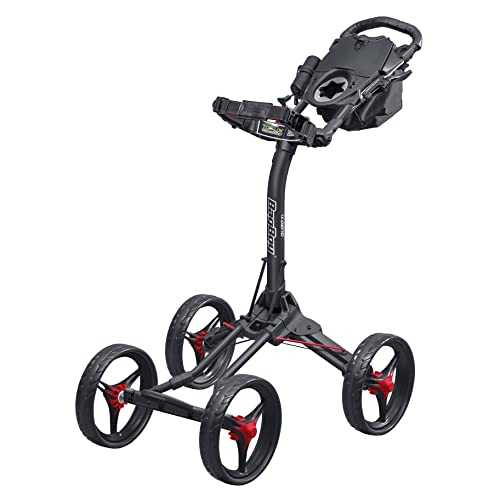
Bag Boy Quad XL Push Cart
A four wheel push cart designed for stability with a wider wheelbase footprint.
Questions worth asking
Do all golf push carts use the same size wheels?
No, wheel diameter and width vary by model and are often chosen specifically to balance rollability, stability and storage footprint.
Are foam filled push cart tires better than air filled ones?
Foam filled tires need no maintenance and never go flat, while air filled tires generally roll a bit smoother over bumps but require occasional air checks.
Can push cart wheels get damaged on cart paths?
Hard, smooth wheels designed more for turf can wear down faster on abrasive concrete cart paths than wheels designed for mixed terrain use.
Why does my push cart wheel sink into soft fairway grass?
Narrow or smooth wheels concentrate weight into a smaller contact area, which is more likely to sink into soft or wet turf than a wider, treaded wheel would.
Do three wheel push carts handle slopes better than four wheel carts?
Generally yes, a three wheel design with a steerable front wheel tends to track more predictably across sidehill slopes than some four wheel designs.
Can you replace the wheels on a golf push cart?
Many popular push cart models sell replacement wheels separately, since wheels are typically the first part to wear out on a heavily used cart.
Why do some push cart wheels have deep tread and others are nearly smooth?
Deep tread is built for grip on grass, rough and wet conditions, while smoother wheels are often meant more for pavement or storage convenience rather than turf performance.
Do push cart wheels affect how heavy the cart feels to push?
Wheel quality and bearing smoothness affect rolling resistance meaningfully, and a cart with poor bearings can feel noticeably harder to push even on flat ground.
Is a bigger wheel always better for a golf push cart?
Not necessarily, bigger wheels generally roll over terrain more easily but can add bulk and weight to the folded cart, which matters for storage and transport.
Can push cart wheels leave marks on greens or tee boxes?
Courses generally ask carts to stay off greens and certain tee areas regardless of wheel type, since wheeled pressure on short, delicate turf can leave an impression.
Why do some push carts have a locking front wheel option?
A lockable front wheel helps the cart track straight on flat ground or downhill, while unlocking it allows tighter turning when maneuvering around obstacles.
Do push cart tires go flat the same way bike tires do?
Air filled push cart tires can get punctures similarly to bike tires, which is one reason many golfers prefer foam filled tires for worry free use.
Can cold weather affect push cart tire pressure?
Yes, air filled tires can lose a small amount of pressure in cold temperatures, similar to how car tires fluctuate seasonally, so checking pressure before a round in cold weather is reasonable.
Do heavier golfers or bags need wider push cart wheels?
A wider wheel base can help distribute more total weight, cart plus bag, over more surface area, which somewhat reduces sinking on soft terrain under a heavier total load.
Do golf push cart wheels differ between recreational and tournament level carts?
Higher end carts marketed toward frequent or competitive players often use more refined wheel and bearing designs, though the basic principles of tread, fill type and diameter apply across price points.
Can push cart wheels be swapped between different cart brands?
Generally no, wheels are typically sized and mounted specifically for each manufacturer’s frame design, so cross brand compatibility isn’t common.
Does wheel bearing quality matter as much as the wheel material itself?
Yes, smooth, well sealed bearings reduce rolling resistance significantly, and a quality wheel with poor bearings can still feel sluggish to push.
Is it worth buying a push cart with off road specific wheels for a course with a lot of rough terrain?
If a course regularly involves wet, uneven, or heavily rough terrain, wheels built for that kind of surface can noticeably reduce pushing effort compared to standard wheels.
Can sand specifically cause different wear than grass on push cart wheels?
Sand can be more abrasive on wheel surfaces and bearings over time compared to grass, which is a consideration for golfers who frequently play courses with extensive sand features.
Do three wheel carts fold differently because of their wheel configuration?
Yes, the single front wheel design on most three wheel carts often allows a more compact folded profile than some four wheel designs, partly due to the wheel layout itself.
Does wheel size affect how a push cart handles going up or down hills?
Larger wheels generally provide more stable rolling control on slopes, while smaller wheels can feel more prone to catching or losing traction on steep or uneven hill sections.
Does wheel choice affect how a push cart performs on artificial turf driving ranges?
Synthetic surfaces generally offer more consistent footing than natural turf, so wheel choice matters somewhat less there compared to variable natural course conditions.
Can mismatched wheel wear on one side of a cart cause steering issues?
Yes, uneven wear between wheels can cause a cart to pull slightly to one side, which is usually a sign it’s time to inspect or replace the more worn wheel.
Do push cart wheels need lubrication like a bicycle chain?
Most sealed bearing wheels don’t require regular lubrication, though keeping the axle area free of dirt and grass clippings helps maintain smooth rolling over time.
Is there a noticeable performance difference between budget and premium push cart wheels on the same terrain?
Yes, premium wheels often use better bearings and tread compounds that roll more smoothly and resist wear longer than budget equivalents, even on identical terrain.
The bottom line
The wheel is doing more work than most golfers give it credit for. A cart that feels great rolling across a parking lot can still bog down in wet rough with the wrong wheel type, which is why tread, fill type and wheel count matter more than how the frame folds.
Derek Holt
Derek has a background coaching recreational and amateur athletes and has worked the sales floor at specialty fitness retailers. He focuses on equipment durability, ergonomics and realistic use cases rather than marketing claims.


