Why Does a Ferret Cage Need Multiple Levels?
Ferrets are naturally burrowing, climbing animals with extremely high energy, and a single flat floor space, even a large one, doesn’t give them enough to actually do during their active hours. Multiple levels connected by ramps or tubes let a ferret climb, explore, and investigate vertically the way it would move through a den system in the wild, and that vertical complexity does more for reducing boredom and cage pacing than simply adding more floor level square footage would.
Ferret behavior in the wild versus a flat cage
Ferrets descend from polecats, tunnel and den dwelling animals with a constant drive to investigate new spaces. A bored ferret confined to a flat, unchanging floor tends to become destructive, chewing at cage bars or pacing the same path repeatedly, which is a sign the environment isn’t giving it enough to engage with.
Why levels beat floor space for the same footprint
Adding a second or third level through ramps, hammocks, and tubes multiplies the amount of territory a ferret can explore without needing a physically bigger cage. Climbing itself functions as enrichment, not just a way to get from one place to another, so the vertical movement is doing real behavioral work.
What actually goes on each level in a well set up cage
A hammock or sleeping level near the top gives a ferret a dark, enclosed place to rest, which matters since ferrets sleep roughly fourteen to eighteen hours a day and need that rest away from activity. Litter and food areas typically sit on a lower level, with a middle level often used for tunnels, tubes, and general play.
Safety considerations specific to multi-level cages
Ramp spacing and the risk of falls matter more in a multi-level setup than a flat one, and solid ramps are generally safer than wire mesh ramps, which can injure a ferret’s feet in the same way wire flooring causes problems for rabbits. Levels should also be checked for gaps a ferret could squeeze through and get stuck in.
Signs a ferret’s current cage setup isn’t working
Excessive bar biting, visible lethargy, or a ferret that consistently avoids the upper levels altogether are all signs worth investigating, since the last one in particular often points to a ramp that feels unsafe or inaccessible rather than the ferret simply preferring the ground floor.
Retrofitting an existing single-level cage with vertical add-ons
A cage that currently has only one level doesn’t necessarily need full replacement to gain the same benefits. Clip-on hammocks, stacked shelf kits, and connecting ramps sold separately can often be added to an existing cage frame, turning a flat single-level setup into a layered one without buying an entirely new enclosure. This is a reasonable middle step for owners who want to improve an existing cage before committing to a larger multi-level unit.
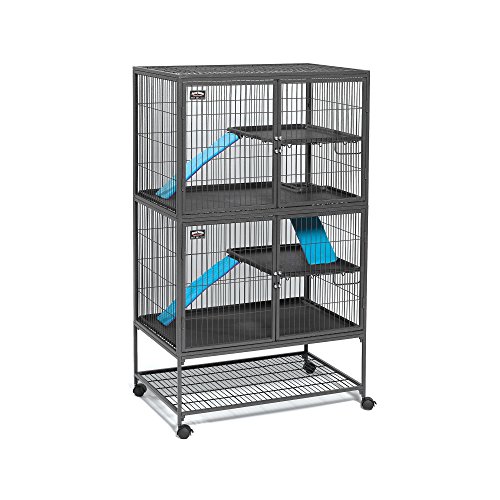
MidWest Ferret Nation 182 Two-Unit Cage
A well known multi-level ferret cage built with several connected shelves and ramps, widely used in the ferret-owning community specifically for its vertical layout.

Prevue Pet Products Ferret Mansion
A multi-level cage with ramps connecting several platforms, giving a ferret separate areas for sleeping, play, and litter use across different heights.
Good to know
How many levels does a ferret cage actually need?
There’s no strict number, but most well regarded ferret cages have at least two to three levels connected by ramps, giving separate areas for sleep, play, and litter use.
Can a single-level cage work if it’s large enough?
A very large single-level cage is better than a small one, but it still lacks the vertical climbing and exploring that a multi-level setup provides, which is a separate benefit from floor space alone.
Why do ferrets sleep so many hours a day?
It’s a normal trait of the species tied to their metabolism, and the long sleep periods are exactly why a quiet, enclosed hammock level away from daytime activity matters in cage design.
Are wire mesh ramps dangerous for ferrets?
They can be, since a ferret’s feet can get caught or strained in wire mesh ramps the same way rabbit feet can be injured by wire flooring, so solid ramps are the safer choice.
Do ferrets need supervised time outside the cage even with multiple levels?
Yes, a multi-level cage improves life inside the cage but doesn’t replace supervised free-roam time, which most ferret owners still provide daily regardless of cage quality.
Can two ferrets share the same multi-level cage?
Yes, ferrets are generally social and often do well housed together, though the cage should be sized up accordingly so there’s enough room and enough separate resting spots for more than one.
What’s the ideal height difference between levels?
It varies by cage design, but ramps should have a gentle enough slope that a ferret can climb comfortably without a steep drop risk if it misjudges a step.
Do ferrets actually prefer hammocks over flat resting shelves?
Many ferrets strongly prefer hammocks since the enclosed, swinging feel mimics a den, though some individuals are happy with a flat shelf as long as it’s covered or tucked away from open activity.
Is cage biting always a sign of boredom in ferrets?
It’s one common cause, but it can also signal the cage feels too small overall or that the ferret wants out for playtime, so it’s worth considering alongside the cage’s overall layout.
Can a DIY multi-level setup work as well as a commercial one?
Yes, as long as ramps are solid, spacing is safe, and levels are stable, a well built DIY setup can match a commercial cage’s functional benefits.
Do ferrets need ramps, or can they jump between levels?
Ramps are strongly preferred, since ferrets have relatively poor depth perception from height and jumping between levels raises injury risk compared to a gradual ramp.
How much floor space should each individual level have?
Each level should be large enough for the ferret to turn around, stretch out, and move comfortably, rather than being a narrow shelf that only fits a single resting position.
Can an older or arthritic ferret still use a multi-level cage?
Senior ferrets may need gentler ramp slopes or fewer total levels to navigate comfortably, so cage layout sometimes needs adjusting as a ferret ages.
Does adding tubes between levels help as much as ramps?
Tubes add an extra layer of tunnel-like enrichment that ramps alone don’t provide, since tunneling itself is a core ferret behavior, so many setups use both together.
Is it normal for a ferret to rearrange bedding across levels?
Yes, moving and stashing bedding material between levels is a common and harmless ferret behavior tied to their natural instinct to build and maintain a den space.
How do you introduce a ferret to a new multi-level cage?
Most ferrets investigate a new cage on their own once placed inside, though leaving ramps accessible and placing familiar bedding on a lower level first can help a nervous ferret build confidence before exploring higher platforms.
Can a multi-level cage help with litter training?
Yes, dedicating one level or corner consistently to a litter pan, separate from sleeping and play areas, tends to reinforce litter habits better than a single-level cage where everything is mixed together in one space.
Does cage material affect how safe the levels are?
Solid, non-slip platform material gives more secure footing than bare wire shelving, which matters specifically on upper levels where a slip carries a greater fall risk than the same slip would on the ground floor.
Where this leaves you
The vertical layout isn’t a luxury add-on, it’s closer to the minimum setup a naturally burrowing, high energy animal needs to stay mentally engaged in captivity. A bigger flat cage helps, but it’s solving a different problem than the one multiple connected levels actually solve. A thoughtfully laid out multi-level cage also makes supervised cleaning easier, since waste and bedding stay more contained to specific levels instead of spreading across one large undivided floor.
Olivia Hartley
Olivia spent several years working at an animal shelter and a pet-supply retailer before joining the editorial team. She researches pet gear with an emphasis on safety, comfort and the fine print that owners often miss.


