Is a Tire Pressure Monitoring System Worth It Over Manual Checks?
A tire pressure monitoring system is worth it for most drivers mainly because it catches pressure problems between the manual checks people actually remember to do, which in practice is far less often than tire manufacturers recommend. It is not a full replacement for manual checks though, since most systems only alert once pressure drops to a meaningfully low threshold, meaning a slow, gradual loss can go unflagged for a while even with a monitor installed.
What a TPMS actually catches that manual checks usually miss
Most drivers check tire pressure only occasionally, often prompted by a visual look at the tire rather than an actual gauge reading, and a tire can look basically normal while being noticeably underinflated. A TPMS continuously tracks actual pressure and alerts the driver automatically, closing the gap created by how infrequently most people do a real manual check.
Why a TPMS still has a real blind spot
Most systems, including the ones built into vehicles by federal mandate, are only required to alert once pressure drops to roughly 25 percent below the vehicle’s recommended level, which means a tire can already be meaningfully underinflated before any warning appears. A driver relying entirely on the dashboard light rather than occasional manual checks can miss a slower, smaller pressure loss that still affects handling and fuel economy.
The difference between a direct and indirect TPMS
A direct system uses an actual pressure sensor inside each wheel and reports real pressure values, while an indirect system infers possible underinflation from differences in wheel rotation speed detected by the anti-lock brake sensors, without measuring actual pressure at all. Indirect systems are generally less precise and slower to catch a gradual, even pressure loss across all four tires, which is a real limitation worth knowing if your vehicle uses one.
Why aftermarket TPMS add-ons matter for trailers and RVs specifically
Vehicles without a factory TPMS, along with towed trailers and RVs that are not covered by a tow vehicle’s own system, can benefit significantly from an aftermarket TPMS, since a blown or severely underinflated trailer tire at highway speed is a serious and sometimes hard to notice hazard that a driver in the tow vehicle has little other way to detect in real time.
Where manual checks still matter even with a TPMS installed
A manual check with a dedicated gauge gives an exact number rather than just a general warning, which matters for fine tuning pressure to the exact specification on the door jamb sticker, adjusting for cold weather, or catching a slow loss before it reaches the threshold that triggers a dashboard alert.
What actually fails on a TPMS over time
Direct TPMS sensors run on small internal batteries that typically last around five to ten years, and a dead sensor battery means that wheel stops reporting entirely, sometimes without an obvious warning distinguishing a dead sensor from an actual pressure problem, which is why sensor age is worth tracking on an older vehicle.

TireMinder TM77 Tire Pressure Monitoring System
An aftermarket monitoring system commonly used on RVs and trailers that reports real pressure and temperature from each tire to a dashboard mounted display, filling the gap left by a tow vehicle’s own built-in system.

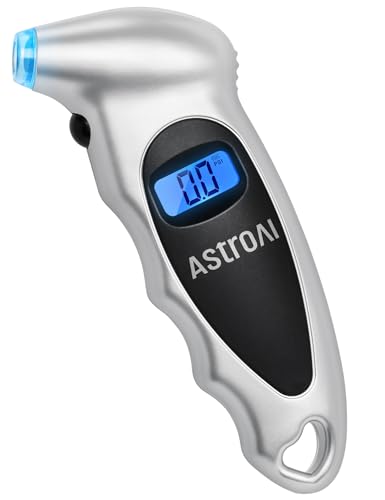
AstroAI Digital Tire Pressure Gauge
A basic handheld digital gauge that still matters for exact manual readings even on a vehicle already equipped with a built-in monitoring system.
Common questions
How accurate is a factory installed TPMS compared to a handheld gauge?
A properly functioning direct TPMS sensor is generally quite accurate, often within a pound or two of a quality handheld gauge, though it is designed to alert at a threshold rather than give the same precise, continuously visible number a manual gauge reading provides.
Why does the TPMS warning light sometimes come on and off by itself?
An intermittent light is often caused by normal temperature driven pressure fluctuation pushing a tire just above and below the warning threshold repeatedly, rather than a sensor malfunction, which is one reason an intermittent warning is still worth checking rather than dismissing.
Can a TPMS sensor fail without the dashboard showing an obvious error?
Yes, a dead sensor battery or a lost signal can sometimes trigger a generic system fault light rather than a clear low pressure warning, which can be mistaken for a pressure issue when the real problem is the sensor itself no longer reporting.
Is it legal to drive with the TPMS light on if the tires actually look fine?
It is legal to drive with the light on, but doing so means driving without the safety margin the system is meant to provide, and a dashboard warning should generally be treated as reason enough to check actual pressure with a gauge regardless of how the tire looks visually.
Do aftermarket TPMS sensors work as well as factory installed ones?
Quality aftermarket direct sensors can perform comparably to factory sensors, though compatibility and proper calibration with the vehicle’s specific system matter, and cheaper aftermarket kits vary more in reliability than factory installed systems typically do.
Does cold weather trigger false TPMS warnings even when tires are fine?
A sudden cold front can genuinely drop pressure enough to trigger a real warning rather than a false one, since the pressure drop itself is a real physical effect, not a sensor glitch, even though it may feel like an overreaction for a tire that was fine the day before.
How often should TPMS sensor batteries actually be checked or replaced?
Most TPMS sensor batteries are sealed and not independently replaceable, lasting roughly five to ten years before the whole sensor unit typically needs replacement, so there is no routine battery check the way there would be with a household device.
Does a TPMS help with anything besides just low pressure, like a slow leak location?
No, a standard TPMS only reports pressure level, not the location or cause of a leak, so finding an actual puncture or valve stem problem still requires a physical inspection once the system has flagged which tire is low.
Can a spare tire have its own TPMS sensor too?
Some vehicles and aftermarket kits support an additional sensor for the spare tire, though many factory systems do not monitor the spare at all, which is worth checking specifically if the spare matters for your driving situation.
Is an indirect TPMS system noticeably worse in practice than a direct one?
In practice, yes, indirect systems are generally slower and less precise at detecting a gradual, even pressure loss across all tires, since they are inferring pressure from wheel speed differences rather than measuring it directly, which is a real practical limitation.
Do trailer-specific TPMS kits require professional installation?
Many trailer and RV TPMS kits are designed for straightforward do-it-yourself installation, typically screwing onto each valve stem without needing to break down the tire, though some setups benefit from a shop’s help pairing sensors to the display correctly.
Does resetting or recalibrating a TPMS after a tire rotation matter?
Yes, after a tire rotation the system may need to be told which sensor is now in which position, particularly on vehicles that display per wheel pressure readings, since a rotation without recalibration can show pressure data mapped to the wrong wheel location.
Can a TPMS prevent a tire blowout, or just warn after pressure is already low?
A TPMS only warns after pressure has already dropped to a meaningful degree, it does not prevent the drop itself, so its real value is catching the problem early enough to address it before it progresses to a blowout, not stopping pressure loss from happening.
Is it worth adding an aftermarket TPMS to a car that already has a basic factory system?
For a vehicle without trailer towing needs, an additional aftermarket system is usually unnecessary, but for anyone towing a trailer or RV not covered by the factory system, an aftermarket TPMS adds real coverage the factory system was never designed to provide.
Our take
A TPMS earns its keep by catching what inconsistent manual habits miss, but its threshold based warning is not a substitute for an actual gauge reading when precision matters. The two are complementary, not competing, tools.
Tony Russo
Tony trained as an automotive technician and spent years in service and parts retail before moving into writing. He focuses on garage tools, car care products and accessories from a hands-on maintenance perspective.