Is a Rotary Tool Really Versatile Enough to Replace Several Specialty Tools?
A rotary tool genuinely replaces several specialty tools for light to moderate work, since one handheld motor can cut, grind, sand, carve, polish, and engrave just by swapping bits and attachments. Where it falls short is on jobs that need sustained power, larger cutting diameters, or heavy material removal, since a rotary tool’s small motor and bit size were never designed to match a dedicated angle grinder, jigsaw, or bench grinder on those tasks. In practice, most owners end up using a rotary tool heavily for a handful of specific tasks it excels at, rather than as a true one-for-one replacement across every tool category it theoretically touches.
What makes rotary tools genuinely versatile
A single rotary tool handpiece accepts dozens of interchangeable bit types, from cutting wheels and grinding stones to sanding drums, wire brushes, polishing felts, and engraving tips, all driven by the same small high-speed motor. That bit-swapping system is what lets one tool realistically stand in for a mini grinder, a detail sander, an engraver, and a polisher depending on what attachment is installed. This bit-swapping convenience is also why rotary tools have become a common starter tool for hobbyists who are not yet sure which specific craft or repair task they will end up doing most often.
Where it genuinely competes with dedicated tools
For small, precise, or detail-oriented work, like cutting a small hole in drywall, deburring a metal edge, carving detail into wood or soap, or polishing jewelry, a rotary tool often does the job as well as or better than a larger dedicated tool simply because of its smaller size and higher control. The same high RPM that makes detail work possible also means a rotary tool bit spends less time in contact with material per pass, which actually helps control and precision on small, careful cuts.
Where it is not a real substitute
On tasks that need to remove a lot of material quickly, like cutting a large wood panel, grinding down a thick weld bead, or cutting through thick metal stock, a rotary tool’s small bit diameter and modest motor power make it noticeably slower and more prone to overheating than a tool actually built for that job. Trying to force a rotary tool through a job it is not suited for also tends to burn through bits and batteries far faster than using the right tool, which erases much of its cost advantage.
Corded vs cordless rotary tools change the versatility picture
Cordless rotary tools trade some sustained power and runtime for portability, which matters for tasks like detail carving but matters less for something like extended metal grinding where a corded model’s steadier power output and lack of battery drain tend to hold up better over a long session. For users who split time between detail work and heavier tasks, owning both a cordless rotary tool for portability and a corded model for sustained power is a common compromise rather than picking just one.
Bit and attachment quality matters as much as the tool itself
A rotary tool is only as versatile as the bits available for it, and cheap off-brand cutting wheels or sanding drums wear out or break far faster than name-brand accessories, which can make an otherwise capable tool feel underpowered or unreliable when the real issue is the consumable being used. Buying a small assortment of name-brand bits for the specific tasks you do most, rather than a huge generic multi-bit kit, usually produces better and more consistent results.
How much speed control actually matters
Variable speed models let the same tool handle both delicate engraving at low RPM and more aggressive cutting or grinding at high RPM, and that range is a big part of why higher-end rotary tools feel more versatile in practice than fixed-speed budget models. This is also why some higher-end rotary tools add electronic feedback that automatically maintains speed under load, which keeps cutting or grinding consistent even as resistance changes partway through a cut.
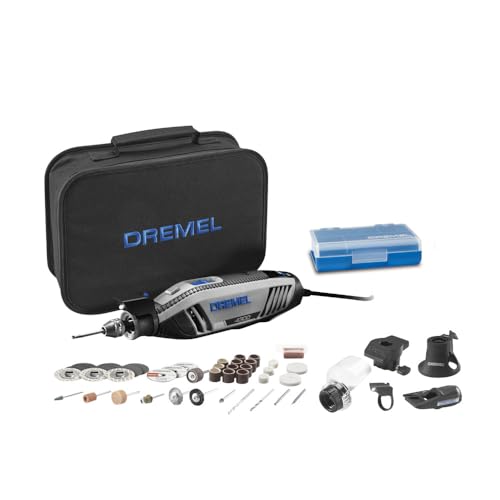
Dremel 4300 Rotary Tool
A corded, variable-speed rotary tool kit with a wide accessory range, built for users who want one tool to cover cutting, grinding, sanding and polishing tasks.

Dremel 8220 Cordless Rotary Tool
A battery-powered rotary tool aimed at portability for detail work away from an outlet, trading some sustained power for convenience.
Common questions
Can a rotary tool replace an angle grinder for metal work?
Only for light tasks like deburring or small cuts. For heavy grinding or cutting thick metal, an angle grinder’s larger wheel and motor power are a better fit.
Can a rotary tool cut through wood like a jigsaw?
It can make small or detail cuts, but it is much slower than a jigsaw on long straight cuts or thick material, since its cutting wheels are small in diameter.
Is a rotary tool good for engraving?
Yes, engraving is one of the tasks a rotary tool handles especially well, since its high speed and small tip size suit fine detail work.
Does a rotary tool overheat easily?
It can, especially on sustained heavy-duty tasks the motor was not designed for, since rotary tool motors are built for speed and precision rather than high torque under load.
Can you polish metal or stone with a rotary tool?
Yes, with a felt or buffing attachment and the right polishing compound, a rotary tool handles small-scale polishing jobs well.
Is a rotary tool worth buying if you already own a drill?
Often yes, since a drill and a rotary tool serve different purposes. A drill is built for driving and boring holes, while a rotary tool is built for fine shaping, cutting and finishing work.
Do rotary tool attachments fit across different brands?
Not always. Many brands use proprietary collet sizes or shank diameters, so it is worth checking compatibility before buying third-party bits.
Can a rotary tool handle tile or grout work?
With a diamond cutting bit, yes for small repairs, but larger tile jobs are usually faster and more consistent with a dedicated tile saw.
Is variable speed important on a rotary tool?
Yes, it lets the same tool run slow for delicate engraving and fast for cutting or grinding, which is a big part of what makes it feel versatile.
Does a cordless rotary tool lose much power compared to corded?
Somewhat, particularly during longer or more demanding tasks, since battery-powered motors typically cannot sustain peak output as long as a corded motor can.
Can a rotary tool sharpen other tools like drill bits or blades?
Yes, with the correct grinding stone attachment, light sharpening is a common rotary tool use, though precision sharpening jigs give more consistent results.
Is it safe to use a rotary tool freehand without a stand?
Yes for most light tasks, since rotary tools are designed for handheld control, though a stand improves precision for repetitive or straight cuts.
Do rotary tool bits wear out quickly?
Cutting and sanding bits wear faster than grinding stones, especially cheaper bits, and bit wear is one of the most common reasons a rotary tool seems to lose cutting power over time.
Can a rotary tool remove rust?
Yes, with a wire brush or abrasive wheel attachment, small-scale rust removal on tools or metal parts is a common and effective rotary tool task.
Is it worth buying a more expensive rotary tool over a budget one?
For frequent use, yes, since higher-end models typically offer better speed consistency under load, sturdier bearings, and compatibility with a wider range of name-brand bits than budget models.
The bottom line
A rotary tool earns its reputation for versatility on small, detailed, precise work, not on raw power. Treat it as the tool you reach for to finish, shape, and detail rather than the one you reach for to remove a lot of material fast, and it will genuinely cover several specialty jobs well. Judged honestly against the specific tasks it is built for, a rotary tool earns its versatility reputation task by task rather than as a blanket substitute for every other tool in the shop.
Jake Monroe
Jake worked as a residential contractor for over a decade before shifting to full-time writing. He evaluates power tools, hand tools and workshop gear through the lens of someone who has actually used them on job sites, not just read the box.