Is a Portable Gas Grill Actually Worth It Over a Charcoal Grill for Camping?
For most camping situations, a portable gas grill is worth it if convenience, quick cleanup, and predictable heat matter more than smoky flavor, since it lights instantly, has no ash to deal with, and can be adjusted on the fly. A charcoal grill still wins on direct searing heat and flavor, but it takes longer to light, needs ash disposal, and is more affected by wind and fuel availability at a remote site.
Setup and lighting speed
A portable gas grill connected to a small propane canister lights with a push-button igniter and reaches cooking temperature in a few minutes. Charcoal needs time to ash over, typically fifteen to twenty minutes with a chimney starter, before it is ready to cook on, which matters more on a trip where you are cooking multiple meals a day and want to minimize setup time each time.
Heat control and consistency
Gas grills let you turn a dial to raise or lower heat instantly and hold a steady temperature, which is useful for anything that needs even cooking like chicken or fish. Charcoal heat is less precise and drifts as coals burn down, requiring you to add fuel or move food to adjust, though that same unevenness is part of what gives charcoal-grilled food its characteristic flavor and char.
Fuel logistics while camping
Propane canisters are compact, do not need to dry out, and are unaffected by rain the way charcoal and lighter fluid can be. Charcoal needs to stay dry to light reliably and takes up more bulk relative to the heat it provides, which matters on trips where pack space or vehicle space is limited, like backpacking-adjacent car camping or canoe trips.
Cleanup and campsite impact
A gas grill produces no ash and generally just needs the grates wiped down, while charcoal leaves ash that needs to be fully cooled and packed out or disposed of properly, which matters at sites with fire restrictions or leave-no-trace rules. This is one of the more practical, less talked-about reasons campers increasingly lean toward portable gas models.
Where charcoal still has a real advantage
Charcoal reaches higher sustained searing temperatures once fully ashed over, and it imparts a smokier flavor that a clean-burning propane flame cannot replicate on its own. For someone who specifically wants that traditional grilled flavor as part of the camping experience, charcoal remains the better choice despite the extra setup time.
Fire restrictions change the calculation entirely
During dry seasons or in areas under active fire bans, charcoal and open flame cooking are often restricted or banned outright, while a contained propane grill with a shutoff valve is frequently still permitted. In those conditions, a portable gas grill is not just more convenient, it may be the only legal cooking option available at the site.

Weber Traveler Portable Gas Grill
A wheeled portable propane grill designed to fold down for transport, commonly used for car camping and tailgating where setup speed matters.
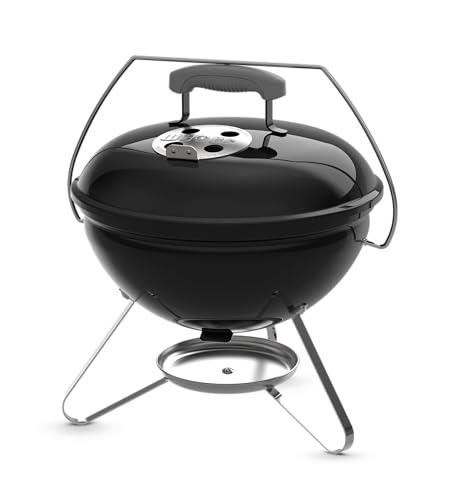
Weber Smokey Joe Charcoal Grill
A compact charcoal grill often chosen for camping trips where pack size matters but traditional charcoal flavor is still a priority.
Common questions
Is a portable gas grill faster to use than charcoal while camping?
Yes, a gas grill reaches cooking temperature in a few minutes with a push-button igniter, while charcoal typically needs fifteen to twenty minutes to ash over before it is ready to cook on.
Does food taste different cooked on gas versus charcoal while camping?
Yes, charcoal imparts a smokier flavor and char that a clean-burning propane flame does not replicate, which is the main flavor tradeoff campers weigh against gas grill convenience.
Are propane canisters safe to pack for a camping trip?
Yes, standard propane canisters are designed for transport and storage, though they should be kept upright, away from direct heat sources, and secured so they cannot roll or puncture during travel.
Can you use a portable gas grill during a fire ban?
Often yes, since many fire restrictions specifically target open flame and charcoal while permitting contained propane appliances with a shutoff valve, though rules vary by location and should be checked locally.
Is charcoal cheaper than propane for camping trips?
Per use, charcoal is often slightly cheaper, but propane canisters are reusable across many trips with no ash disposal cost, so the overall value depends on how often you camp and cook.
Does wind affect a gas grill less than a charcoal grill while camping?
Generally yes, a contained gas burner is less disrupted by wind than open charcoal coals, which can lose heat or burn unevenly when exposed to gusts at an exposed campsite.
How do you dispose of charcoal ash responsibly while camping?
Ash should be fully cooled, ideally doused with water, and either packed out or disposed of in a designated fire ring or ash receptacle rather than left scattered at the site.
Can a portable gas grill sear meat as well as charcoal?
Charcoal generally reaches higher sustained direct heat for searing, though higher-output portable gas grills can get close, especially models with a dedicated high-heat burner zone.
Is a portable gas grill heavier to pack than a charcoal grill of similar size?
It depends on the model, but a gas grill plus a propane canister is often comparable in weight to a charcoal grill plus a bag of charcoal, with gas typically taking up less bulk volume.
Do portable gas grills need much maintenance after a camping trip?
Minimal, mainly wiping down the grates and checking the propane connection for leaks, compared to charcoal grills which need the firebox emptied of ash and occasionally scraped clean.
Can you cook the same variety of foods on a portable gas grill as charcoal?
Mostly yes for everyday grilling like burgers, vegetables, and chicken, though some campers feel charcoal still has an edge for foods meant to pick up a smoky char.
Is it harder to find propane refills or charcoal while on a long camping trip?
Propane canisters are widely sold at gas stations and outdoor stores along most travel routes, while bagged charcoal is similarly common, so availability is usually comparable unless camping somewhere very remote.
Does a portable gas grill work well at high altitude camping?
Yes, propane burns consistently at most camping altitudes, though very high elevations can slightly reduce burner efficiency, an effect that also applies to charcoal combustion.
Are portable gas grills allowed on most public campgrounds?
Most developed campgrounds permit propane grills, and many prefer them over open charcoal fires specifically because of easier fire containment, though it is worth checking individual site rules before a trip.
How long does a single small propane canister last on a portable grill?
It depends on burner output and heat setting, but a standard one-pound canister typically provides one to two hours of moderate grilling, making it worth packing a spare for a multi-day trip.
Can you simmer or slow-cook food on a portable gas grill the way you would on charcoal?
Yes, and arguably more easily, since a gas grill’s adjustable low-heat setting holds a steady temperature for slow cooking without the fuel management that keeping charcoal at a low, consistent burn requires.
Do portable gas grills work well at higher elevations while camping?
Yes generally, propane burns reliably at most camping elevations, though very high altitude can slightly reduce burner efficiency, an effect that also impacts how well charcoal combusts at the same elevation.
Will a portable gas grill fit in a standard car trunk alongside other camping gear?
Most portable models are designed with folding legs or a compact footprint specifically for car camping, so they generally fit alongside a cooler and other gear, though larger cart-style models take up noticeably more space than tabletop versions.
The bottom line
For most camping trips, a portable gas grill earns its keep through speed, consistency, and easier cleanup, and it is often the only option allowed during fire restrictions. Charcoal still has a real edge in flavor and searing heat, so the right choice comes down to whether that flavor is worth the extra setup time and ash cleanup for the specific trip.
Sierra Daniels
Sierra's background is in landscape design and nursery retail. She focuses on lawn and garden equipment, outdoor furniture and gear durability, weighing published specs against how materials actually hold up outside.


