Is a Portable Air Compressor Enough to Properly Inflate Tires?
A good portable 12-volt air compressor is genuinely enough to inflate a car or light truck tire from flat to full pressure, including occasional full refills, as long as its rated airflow and duty cycle match the tire size being filled. Where portable compressors fall short is sustained, repeated use on large truck or RV tires, or filling multiple tires back to back quickly, since smaller units overheat and need rest periods that full-size shop compressors do not.
What actually determines whether a portable unit can do the job
The relevant spec is airflow, usually listed in CFM or liters per minute, matched against the tire’s volume and target pressure, not just the compressor’s wattage or marketing claims. A unit rated for small car tires will take noticeably longer, and may struggle, to bring a larger truck or SUV tire from flat to full compared to one rated with higher CFM output.
Why duty cycle matters as much as speed
Most portable compressors are built for intermittent use and will specify a duty cycle, meaning a recommended run time followed by a cooldown period, because the small motor and pump inside generate heat quickly under sustained load. Running one well past its rated duty cycle, like filling several tires back to back without pause, risks overheating the motor and shortening the unit’s lifespan.
What portable units are genuinely good for
Topping off tire pressure, handling a slow leak until a repair can be made, or fully inflating a single tire after a repair kit patch are all well within what a quality portable compressor handles reliably. This covers the large majority of situations most drivers actually encounter outside a shop setting.
Where portable units genuinely struggle
Large truck, RV, or trailer tires with high volume and high target pressure push smaller 12-volt compressors toward or past their rated capacity, often requiring long run times that bump against the duty cycle limit before reaching full pressure. For those tire sizes, a higher-output unit specifically rated for them, or a shop-grade compressor, is the more realistic tool.
Why built-in gauge accuracy matters more than people assume
A portable compressor’s built-in pressure gauge is convenient but often less accurate than a dedicated tire pressure gauge, and relying solely on it can leave a tire slightly over or under the intended pressure. Checking final pressure with a separate gauge after using a portable compressor is a reasonable habit for getting the number actually right.

VIAIR 400P Portable Compressor
A higher-output 12V compressor built with a sturdier duty cycle rating, often chosen for larger tires like trucks and SUVs.
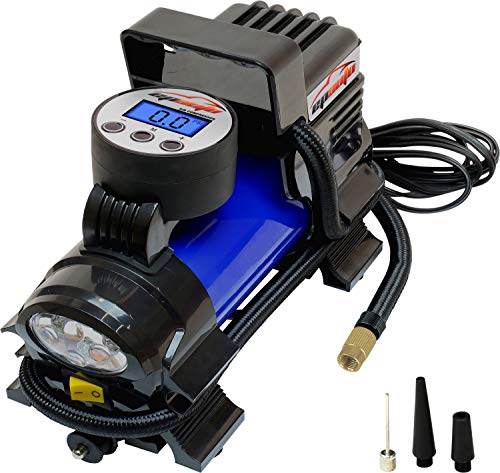
EPAuto 12V DC Portable Air Compressor Pump
A compact, lower-cost portable compressor suited to topping off car tires and handling occasional full inflation.
Good to know
How long should it take a portable compressor to fill a flat car tire?
This varies by compressor output and tire size, but a reasonably rated unit typically fills a standard car tire from flat to full in several minutes, while a weaker unit can take considerably longer.
Can a portable air compressor overheat if used too long?
Yes, most are rated for a specific duty cycle, and running one continuously well beyond that rating risks overheating the motor, which can shorten its lifespan or cause it to shut down mid-use.
Is CFM or PSI the more important spec when choosing a portable compressor for tires?
Both matter, but CFM, which measures airflow volume, determines how fast a tire fills, while PSI rating determines whether the unit can actually reach the tire’s target pressure at all.
Do portable compressors work on truck and RV tires, not just car tires?
Many entry-level units are undersized for the higher volume and pressure of truck and RV tires, so a compressor specifically rated for that higher capacity is a better match than a basic car-focused unit.
Does a portable compressor’s built-in gauge need to be checked against another gauge?
It is a reasonable precaution, since built-in gauges on budget units are sometimes less precise than a dedicated tire pressure gauge, and getting pressure exactly right matters for handling and tire wear.
Can a portable compressor run directly off a car’s cigarette lighter outlet reliably?
Yes, most are designed specifically for that power source, though higher-output units may draw enough current that the vehicle’s engine should be running during use to avoid draining the battery.
Is it worth buying a compressor with an automatic shutoff at a set pressure?
Yes, this feature prevents overinflation and lets the unit run unattended to the correct pressure, which is a meaningful convenience over manually watching a gauge and stopping it by hand.
Does cold weather affect how well a portable compressor fills a tire?
Cold air is denser, so the actual fill time and achievable pressure can shift slightly in very cold conditions, though most portable units still function adequately within normal winter temperature ranges.
Can a portable compressor be used to inflate things besides tires, like air mattresses or sports equipment?
Many portable compressors come with interchangeable nozzle attachments specifically for that purpose, though the pressure settings and valve types needed differ from a standard tire valve.
Is a battery-powered cordless compressor as capable as a plug-in 12V model?
Cordless models offer more convenience without needing a running vehicle, but they are often limited by battery capacity for sustained use, making them better suited to quick top-offs than multiple full inflations.
How do you know if a portable compressor is rated strong enough for a specific vehicle’s tires?
Comparing the compressor’s CFM and maximum PSI rating against the tire’s sidewall specifications for size and recommended pressure is the most reliable way to judge compatibility before relying on it.
Does using a portable compressor too often wear it out faster than occasional use?
Yes, like most small motors, frequent heavy use accelerates wear on the internal components compared to occasional light use, which is part of why duty cycle ratings exist in the first place.
Can a portable compressor fix a tire with a slow leak permanently?
No, a compressor only adds air; it does nothing to address whatever is causing the leak, so a tire that needs frequent refilling should still be inspected and repaired rather than relying on repeated inflation.
Is noise level a meaningful factor when choosing a portable compressor?
It can matter for comfort during use, since smaller, higher-RPM motors tend to run louder than larger, lower-RPM units, though noise level has no bearing on actual inflation performance.
Does a portable compressor need to be stored carefully to avoid damage?
Yes, protecting the hose, gauge, and power cord from being crushed or kinked in storage extends the unit’s working life more than most owners expect from a simple accessory.
Can a portable compressor be used to check tire pressure without adding air?
Most units let the hose connect and read current pressure before any air is added, functioning as a basic gauge, though a dedicated standalone gauge is usually faster for a quick check alone.
Does a portable compressor lose power as its source vehicle’s battery gets lower?
Yes, since the compressor draws directly from the vehicle’s electrical system, a weak or aging battery can cause reduced output or slower fill times compared to a healthy, fully charged battery.
Is it worth keeping a portable compressor in the trunk year-round rather than just for emergencies?
Yes, since tire pressure naturally drifts with temperature changes across seasons, having a compressor on hand for routine top-offs is just as useful as having one for an actual flat tire emergency.
The bottom line
For the realistic range of tasks most drivers face, topping off, handling a slow leak, or filling after a repair, a well-matched portable compressor is genuinely enough. The mismatch only shows up with large truck or RV tires or repeated back-to-back fills, where duty cycle limits turn a convenient tool into a slow and strained one.
Tony Russo
Tony trained as an automotive technician and spent years in service and parts retail before moving into writing. He focuses on garage tools, car care products and accessories from a hands-on maintenance perspective.


