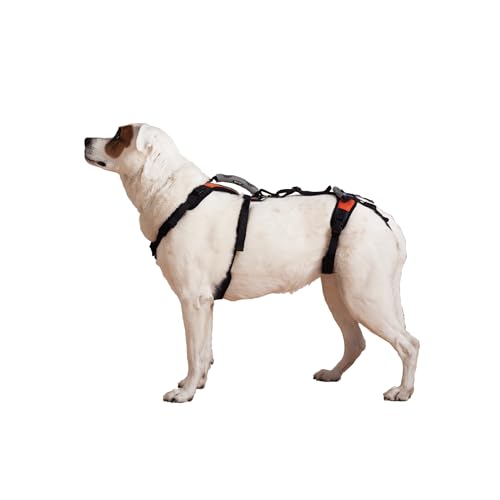
Is a Harness Better Than a Collar for Small Dogs?
For most small dogs, yes, a harness is the safer everyday choice because it spreads pulling force across the chest and shoulders instead of concentrating it on a narrow, collapsible airway. Toy and small breed dogs are disproportionately prone to tracheal collapse and neck disc issues, and any sudden leash pressure on a collar lands directly on that vulnerable area. A collar still has its place for holding an ID tag and for dogs who already walk calmly without pulling, but as the primary walking tool, a harness reduces the physical risk.
Why small breeds carry more risk
Toy and small breeds such as Yorkies, Chihuahuas, and Pomeranians have proportionally narrower tracheas with thinner, more flexible cartilage rings than larger dogs. That structure is already closer to its physical limit, so repeated pressure from a collar during normal walking, or one hard jerk when a dog lunges at something, can trigger coughing, gagging, or over years contribute to tracheal collapse in dogs who are already predisposed to it.
What a harness actually changes
A well fitted harness moves the point of pressure from the throat to the chest and shoulders, areas built to absorb force without affecting breathing. A front clip harness goes a step further by redirecting a pulling dog’s momentum sideways instead of letting the dog drive forward against a straight line of resistance, which is also why front clip harnesses are commonly recommended for leash training.
When a collar is still the right tool
A flat collar remains the standard place to attach an ID tag and rabies tag, and plenty of small dogs who walk politely on a loose leash never generate enough pulling force for a collar to be a meaningful risk. A martingale collar, which tightens slightly to prevent slipping out without choking, is also a reasonable option for narrow headed small breeds that can back out of a standard collar.
Where harnesses can go wrong instead
An ill fitting harness is not automatically safer just because it is a harness. Straps that sit too high can rub the armpits raw on long walks, and a harness sized too loosely gives an agile small dog room to back out of it entirely, which defeats the purpose during exactly the moment control matters most, like near traffic.
What most vets actually recommend
General veterinary guidance leans toward harnesses as the default for small and toy breeds, and strongly recommends them for any dog already diagnosed with tracheal collapse, a heart murmur, or glaucoma, since collar pressure can also spike eye pressure in dogs with certain eye conditions. For a healthy small dog with no diagnosed issues, the switch is more about reducing long term risk than fixing an existing problem.
Front clip versus back clip harnesses
A front clip harness gives more steering control over a dog that pulls, since the leash attachment at the chest turns the dog slightly when it surges forward. A back clip harness is simpler and more comfortable for dogs who already walk well, but offers less leverage if a dog decides to bolt after something.

PetSafe Easy Walk No-Pull Dog Harness
A widely used front clip harness sized down to fit toy and small breeds, built to redirect pulling force instead of letting it hit the throat.

Puppia Soft Dog Harness
A step-in mesh harness popular with small and toy breed owners for its wide, padded straps that avoid digging into the armpits.
Common questions
Can a small dog wear a harness all day without a problem?
Most small dogs tolerate a well fitted harness for normal daily wear, but it should still come off at home overnight so the coat and skin underneath can breathe and be checked for rubbing.
Why are toy breeds specifically prone to tracheal collapse?
Their tracheal cartilage rings are naturally thinner and more prone to weakening over time, and repeated pressure from a collar during pulling can speed that process in dogs already predisposed to it.
Does a harness stop a small dog from pulling completely?
No, a harness changes where the force lands rather than eliminating pulling itself, though a front clip design does make pulling less effective and easier to redirect during training.
How tight should a dog harness actually fit?
You should be able to fit two fingers snugly between the strap and the dog’s body, tight enough that the dog cannot back out of it but loose enough that it does not pinch or rub.
Is a martingale collar a safer middle ground than a flat collar?
For narrow headed small breeds prone to slipping their collar, yes, since it tightens just enough to prevent escape without applying the constant pressure of a standard collar.
Can switching from a collar to a harness help an existing cough?
It can reduce further irritation from pressure on the trachea, but an existing persistent cough should still be evaluated by a vet rather than assumed to be fixed by the switch alone.
Do harnesses ever cause shoulder or gait problems in small dogs?
A poorly fitted harness that restricts shoulder movement at the front straps can affect gait over time, which is why checking fit and watching how a dog moves in it matters more than the harness brand.
Why do some trainers still prefer collars for small dogs?
Some trainers use collars for precise, quick communication during structured obedience work, though for everyday walking most still default to a harness specifically for small and toy breeds.
What is the real difference between front-clip and back-clip harnesses?
A front clip attachment gives more steering leverage over a pulling dog by turning its direction, while a back clip is simpler and more comfortable for dogs who do not pull much.
Should puppies start out on a harness or a collar?
Many owners start small breed puppies on a harness from the beginning, since their tracheas are just as narrow as an adult’s relative to their size, and good habits form early.
Can a small dog still escape from a properly sized harness?
A correctly fitted harness with both a chest strap and belly strap is much harder to back out of than a collar, though no equipment is completely escape proof if a dog panics hard enough.
Is it fine to leave a flat collar on a small dog at home?
Yes, for holding ID tags a flat collar left on at home is fine, as long as it is not so tight that it rubs, and it is a separate decision from what to use for walking.
Do step-in harnesses fit small breeds better than overhead ones?
Step-in designs are often easier to put on calm, cooperative small dogs, while overhead designs can be faster for dogs who do not like paws being lifted, so it comes down to the individual dog’s tolerance.
How often should a harness be checked for wear and fit?
Check the stitching, buckles, and padding every few months, and recheck sizing any time a dog gains or loses weight, since even a half inch of slack changes how well it holds.
Does a small dog’s size alone determine whether it needs a harness?
Size is the main factor but not the only one, since a calm small dog that never pulls carries less risk on a collar than an energetic small dog that lunges at every squirrel.
Can a harness be used safely on a dog already diagnosed with tracheal collapse?
Yes, and it is usually the recommended choice in that situation specifically because it avoids putting any direct pressure on the trachea during walks.
Where this leaves you
A harness is the more conservative, lower risk default for small and toy breeds, and most of the exceptions come down to fit rather than the equipment category itself. A collar is not dangerous on its own, it just concentrates force somewhere a small dog’s body is least equipped to handle it, so the harness swap is a cheap, low effort way to remove that risk from the walk.
Olivia Hartley
Olivia spent several years working at an animal shelter and a pet-supply retailer before joining the editorial team. She researches pet gear with an emphasis on safety, comfort and the fine print that owners often miss.