Is a Cordless Reciprocating Saw Good for Demolition?
Yes, a cordless reciprocating saw is genuinely useful for light to medium demolition like cutting studs, PVC pipe, drywall and nail-embedded lumber. It falls short on heavy continuous demolition such as thick cast iron, dense concrete or all-day tear-out, where runtime and sustained power favor a corded model.
What a reciprocating saw actually does well in demolition
A reciprocating saw is a demolition tool by design. The back-and-forth blade stroke lets you plunge into a wall, cut through nails embedded in studs, slice PVC and copper pipe flush to a surface, and trim out window and door openings without needing a clean finish. Cordless versions free you from an outlet, which matters most when you are working in a gutted room, on a roof, or in a crawlspace where running an extension cord is its own hassle.
Where cordless models start to struggle
The honest limitation is energy density. A battery pack holds a finite amount of power, and reciprocating saws draw heavily under load, especially when the blade binds in dense material. Cutting through a few studs is fine. Cutting through forty studs, a cast iron drain stack, or a full day of subfloor removal will drain packs fast and may force you to rotate batteries or stop to recharge. Corded saws do not have that ceiling, which is why professional demolition crews often still reach for a corded model on big tear-outs.
Battery platform and voltage matter more than the label
Not all cordless reciprocating saws are equal. An 18V or 20V saw from a major platform with a high-capacity battery will cut faster and longer than a compact 12V model. If you already own batteries from a brand, staying in that system is usually the smartest move, since the saw is only as good as the packs you can feed it. Higher voltage and brushless motors generally translate to more sustained torque under load, which is exactly what demolition demands.
Blade choice changes the answer as much as the saw
A reciprocating saw is only as effective as the blade mounted in it. For demolition, a thick, coarse-tooth blade designed for nail-embedded wood cuts far faster and binds less than a fine-tooth metal blade. Using a worn or wrong blade is the most common reason people conclude a cordless saw is underpowered, when the real problem was the cutting edge. Keep a few dedicated demolition blades on hand and swap them before they dull.
When cordless is clearly the better call
For remodeling work inside an occupied home, overhead cutting, or jobs where setting up a cord is more work than the cut itself, cordless wins on convenience and safety. No cord to trip over, no寻找 an outlet, and no risk of cutting through your own power supply. For a homeowner tackling a bathroom gut or a deck removal, a cordless reciprocating saw is often the only saw needed.
When to rent or borrow a corded saw instead
If the job is a whole-house gut, a commercial demolition, or involves cutting dense cast iron or thick masonry, a corded reciprocating saw or a dedicated demolition hammer is the more honest tool. Cordless saws can do the work, but they will do it slower and with more battery swaps. Renting a corded saw for a weekend is often cheaper than buying extra batteries to get through the job.

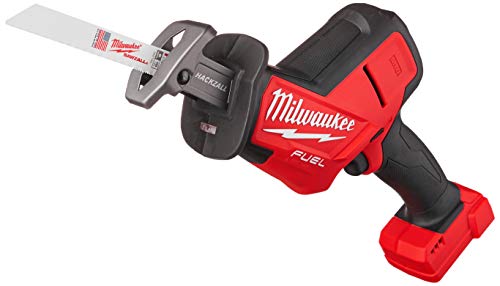
Milwaukee M18 FUEL Sawzall
A brushless 18V reciprocating saw known for strong sustained power and a vibration-reducing stroke, often used for remodeling and light demolition.
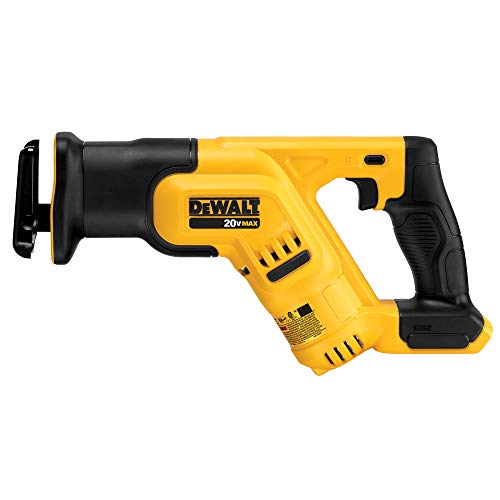
DEWALT 20V MAX Cordless Reciprocating Saw
A widely available 20V model with a compact body and tool-free blade change, suited to homeowner demolition and remodeling tasks.
Good to know
Can a cordless reciprocating saw cut through nails?
Yes, with the right blade. A demolition blade designed for nail-embedded wood will cut through nails, though hitting a dense nail cluster repeatedly will dull the blade faster and draw more battery power.
How long does a battery last when cutting demolition debris?
Runtime varies widely by battery capacity and material. A high-capacity pack might give 20 to 40 minutes of near-continuous cutting in wood, while dense material or binding cuts can drain it much faster.
Is a cordless reciprocating saw powerful enough to cut cast iron pipe?
It can cut cast iron with a proper metal-cutting blade, but it is slow going and drains batteries quickly. For a full cast iron stack removal, a corded saw or a dedicated snap cutter is usually more practical.
Do I need a brushless motor for demolition work?
A brushless motor generally delivers more sustained torque and better efficiency under load, which helps in demolition. It is not strictly required for occasional light work, but it is worth having for regular tear-out.
Can you cut drywall with a cordless reciprocating saw?
Yes, and it is a common demolition use. Use a short blade and a slow stroke to avoid tearing the paper face too far beyond the cut line.
Will a cordless reciprocating saw cut through a 2×4 stud quickly?
Yes, a sharp wood blade will cut a standard stud in seconds. The saw is well matched to framing lumber and similar dimensional wood.
What is the best blade for demolition with a reciprocating saw?
A thick, coarse-tooth blade labeled for nail-embedded wood is the usual choice. For pipe and metal, switch to a bi-metal blade with a finer tooth count.
Can a cordless reciprocating saw replace a circular saw for demolition?
No, they do different jobs. A circular saw makes straight, accurate cuts in sheet goods and lumber, while a reciprocating saw excels at plunge cuts, flush cuts and cutting installed material where a circular saw cannot reach.
Is it safe to use a cordless reciprocating saw overhead?
Yes, and cordless is often safer overhead because there is no cord to manage. Use eye protection and be aware of falling debris and blade binding.
How does voltage affect demolition performance?
Higher voltage platforms generally deliver more power and longer runtime under heavy load. An 18V or 20V saw will typically outperform a 12V compact model in sustained demolition cutting.
Can I use a cordless reciprocating saw to cut through a metal door frame?
Yes, with a bi-metal blade. It is slower than a dedicated metal-cutting saw, but it works for typical hollow metal frames and light steel.
Do cordless reciprocating saws vibrate a lot?
They can, especially under load. Better models include counterbalance or vibration-reduction features, which matter for control during long demolition sessions.
Is a cordless reciprocating saw good for deck demolition?
Yes, it is one of the better tools for cutting out deck boards, nails and joists. A cordless model lets you move around the deck without dragging a cord.
What battery size should I use for demolition cutting?
A high-capacity pack in the 4.0Ah to 6.0Ah range or larger is a reasonable starting point for sustained cutting, since it delivers more total energy before needing a swap.
Can a cordless reciprocating saw cut through concrete?
Only with a masonry blade and only for light work like cutting small openings or trimming block. For serious concrete demolition, a rotary hammer or demolition hammer is the correct tool.
Why does my cordless reciprocating saw keep stalling during demolition?
Stalling usually means the blade is dull, the material is binding the blade, or the battery is depleted. A sharp demolition blade and a steady, patient stroke reduce stalling significantly.
Is a cordless reciprocating saw worth buying for occasional home demolition?
For occasional work like removing a wall, cutting pipe or tearing out a bathroom, a cordless model is convenient and capable. For frequent heavy demolition, a corded saw is a better long-term investment.
Can you use a reciprocating saw to cut through a roof during demolition?
Yes, and cordless is often preferred on a roof because there is no cord to manage at height. Use a proper blade and take standard fall-protection precautions.
Where this leaves you
A cordless reciprocating saw is a legitimate demolition tool for the kind of tear-out most homeowners and remodelers actually do. It is not the equal of a corded saw on heavy, continuous work, but for cutting studs, pipe and decking without a cord, it earns its place in the kit.
Jake Monroe
Jake worked as a residential contractor for over a decade before shifting to full-time writing. He evaluates power tools, hand tools and workshop gear through the lens of someone who has actually used them on job sites, not just read the box.