Is a Cat Tunnel Toy Worth It for Indoor Cats?
For most indoor cats, a tunnel is worth it, but not as a standalone toy. It works best as part of a play circuit that includes a wand toy or laser, because the tunnel gives the cat a place to ambush and sprint toward. If your cat is a dedicated hider or a high-energy sprinter, a tunnel earns its floor space. If your cat ignores enclosed spaces and prefers open perches, it may just sit there.
What a tunnel actually gives an indoor cat
Indoor cats live in a flat, open environment with few places to stalk or hide. A tunnel adds a dark, enclosed run that mimics the burrows and brush piles cats use outdoors to ambush prey and to retreat when they feel exposed. That matters because indoor cats often lack both a sprint lane and a safe hiding spot, and a tunnel provides both in one object. It is not a substitute for vertical space like cat trees, but it fills a different need: horizontal cover and a chase path.
How tunnels fit into play and exercise
A tunnel is most useful when it is part of an active play session. Drag a wand toy along the floor and through the tunnel, and the cat gets a reason to sprint, pounce, and wait in ambush at the far end. That kind of stop-and-go chase is closer to real hunting behavior than batting at a toy in open space. For a cat that needs more exercise, a tunnel plus a wand toy can turn a small room into a circuit. On its own, a tunnel is a passive hiding spot, not an exercise tool.
When a tunnel is genuinely worth it
A tunnel tends to earn its place in a few specific situations. Shy or newly adopted cats often use a tunnel as a low-risk way to observe a room before coming out. High-energy young cats and bonded pairs use it for chase games. Multi-cat homes benefit because a tunnel gives a lower-status cat a way to move through a room without crossing open floor. If any of those describe your household, the tunnel is likely to get daily use.
When it may not be worth it
Some cats simply do not care about enclosed spaces. A confident cat that prefers high perches, window seats, or open beds may walk through a tunnel once and ignore it. Senior cats with arthritis or limited mobility may find the low, narrow opening awkward. And in a very small apartment, a tunnel takes up floor space that a cat tree or scratching post might use better. In those cases, the tunnel is not harmful, but it is not the best use of your space or budget.
What to look for in a cat tunnel
Look for a tunnel with a sturdy internal wire frame so it holds its shape instead of collapsing when the cat runs through it. A crinkle lining adds sound and texture that many cats find exciting, but it can be loud for nervous cats. Collapsible tunnels are easier to store, but check that the fabric and frame survive repeated folding. A tunnel with at least one side exit or a peek hole gives cats more play options than a simple straight tube. Size matters too: a tunnel that is too narrow can feel tight for a large cat.
How to get an indoor cat to actually use a tunnel
Do not just set the tunnel down and hope. Place it where the cat already likes to run, then toss a toy or treat through it to create a reason to enter. Feed a meal or place a favorite bed inside for a few days so the tunnel becomes a normal, safe part of the room. Once the cat is comfortable, use a wand toy to create a chase through and around the tunnel. Rotating the tunnel to a new spot every week or two also keeps it interesting, since cats habituate quickly to static objects.
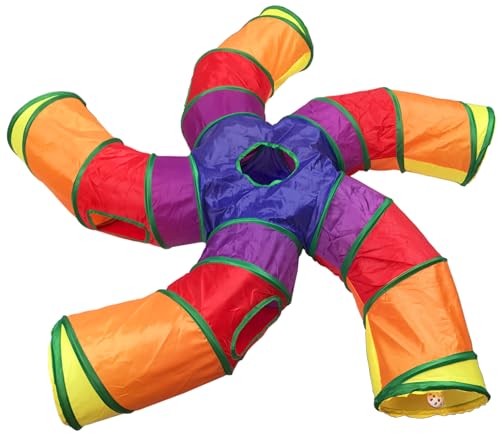
Pet Craft Supply Cat Tunnel
A collapsible nylon tunnel with a crinkle lining and a peephole, commonly used for indoor chase games and hiding.

Catit Senses 2.0 Play Circuit
A track-based play circuit with a tunnel section and moving ball, useful for cats that like to bat and chase rather than hide.
Frequently asked questions
Do indoor cats actually need a tunnel toy?
They do not need one, but many benefit from it. A tunnel adds a hiding spot and a sprint lane that most indoor homes lack, which supports natural stalk-and-chase behavior. Cats that prefer open space or high perches may not use one, so it is a useful addition rather than a requirement.
How do I know if my cat will like a tunnel?
Watch how your cat plays. Cats that hide under furniture, dart through doorways, or ambush toys from behind objects usually take to a tunnel quickly. Cats that ignore boxes and enclosed spaces may not. You can test interest cheaply by placing a cardboard box or paper bag on the floor for a few days.
Can a cat tunnel help a shy cat settle in?
Yes, often. A tunnel gives a shy or newly adopted cat a dark, enclosed place to observe a room from without feeling exposed. Place it near a wall in a quiet area and let the cat approach on its own. Do not force the cat into it.
Is a crinkle tunnel better than a plain fabric tunnel?
It depends on the cat. Many cats are drawn to the crinkle sound and texture because it feels and sounds like moving prey or dry leaves. Nervous or sound-sensitive cats may avoid it. A plain fabric tunnel is quieter and can be a better starting point for a timid cat.
How long do cat tunnels usually last?
A well-made tunnel with a wire frame and durable fabric can last a year or more with regular use. Cheaper tunnels often fail at the folding seams or the wire frame pokes through. Active cats that bite and bunny-kick the tunnel will wear it out faster.
Can a tunnel replace a cat tree?
No. A tunnel provides horizontal cover and a chase path, while a cat tree provides vertical space and perches. Indoor cats generally benefit from both, since climbing and hiding meet different needs. If you can only add one, choose based on whether your cat prefers height or cover.
Are cat tunnels safe for kittens?
Generally yes, and kittens often love them. Check that the tunnel has no loose threads, exposed wire ends, or small parts that could be chewed off. Supervise play until you know the kitten is not chewing on the fabric.
Do cat tunnels work for multiple cats?
Yes, and they can help in multi-cat homes. A tunnel gives a lower-status cat a way to move through a room without crossing open floor, and it creates a chase game that two cats can share. Watch for one cat guarding the tunnel and blocking the other.
Where should I put a cat tunnel in my home?
Place it along a wall in a room where your cat already spends time, ideally near a favorite running path or a window. Avoid blocking doorways. Rotating the tunnel to a new spot every week or two keeps it interesting, since cats lose interest in static objects.
Can I use a tunnel to help my cat lose weight?
A tunnel can support a weight loss plan by encouraging sprinting and pouncing during wand toy play, but it is not a solution on its own. Portion control and a vet-guided diet matter more. Use the tunnel to make active play sessions longer and more engaging.
Does a cat tunnel need to be collapsible?
Not necessarily, but collapsible tunnels are easier to store and to move around the house. If you plan to rotate the tunnel or put it away when guests visit, a collapsible model is more practical. Rigid tunnels tend to hold their shape better over time.
Why does my cat ignore the tunnel?
Some cats simply prefer open space or high perches. Others need a reason to enter, like a toy or treat tossed through it. Try placing a favorite bed or a meal inside for a few days, then use a wand toy to create a chase. If the cat still ignores it after two weeks, the tunnel may not suit that cat.
Can a cat tunnel be used outdoors?
Some are marketed for outdoor use, but most fabric tunnels are not weatherproof and will fade, mildew, or tear outdoors. If you want outdoor enrichment, look for a tunnel specifically designed for outdoor conditions, or keep the tunnel indoors and use a screened porch instead.
How do I clean a cat tunnel?
Most fabric tunnels can be vacuumed or shaken out, and many are spot clean only. Check the care label before washing. A tunnel that cannot be cleaned well will hold hair and dander, which matters in homes with allergies. Collapsible tunnels with removable covers are easier to keep clean.
Is a tunnel better than a cardboard box for indoor cats?
A cardboard box is free and many cats love it, but it collapses and gets dirty quickly. A tunnel offers a longer run, a defined chase path, and usually a more durable structure. Many cats enjoy both, and rotating between them keeps play interesting.
Can a tunnel help with scratching or biting problems?
It can help redirect energy. A cat that ambushes ankles or bites hands often lacks an appropriate outlet for stalk-and-pounce play. A tunnel plus a wand toy gives the cat a legal target. It is not a cure for all behavior issues, but it can reduce boredom-driven nipping.
Do senior cats use tunnels?
Some do, but senior cats with arthritis or limited mobility may find the low opening awkward. A tunnel with a wider diameter and a flat bottom is easier for older cats. If your senior cat avoids it, a low-sided bed or a heated mat may be a better fit.
What size tunnel is right for my cat?
Measure your cat’s width at the shoulders and choose a tunnel with a diameter a few inches wider. A tunnel that is too narrow can feel tight and discourage use, especially for large breeds. Most standard tunnels fit average adult cats, but large cats need a wider option.
The bottom line
A cat tunnel is worth it for most indoor cats, but it works best as part of a play routine rather than as a standalone purchase. If your cat likes to hide, sprint, and ambush, a tunnel earns its floor space. If your cat prefers high perches and open rooms, spend the money on a cat tree or a window perch instead.
Olivia Hartley
Olivia spent several years working at an animal shelter and a pet-supply retailer before joining the editorial team. She researches pet gear with an emphasis on safety, comfort and the fine print that owners often miss.


