Is a Benchtop Planer Necessary for DIY Projects?
A benchtop planer is not strictly necessary for most casual DIY work, but it becomes genuinely useful once a project needs boards of consistent, even thickness, something that is very difficult to achieve reliably by hand with a hand plane or sander alone. For simple builds using lumber as it comes from the store, skipping a planer entirely is a perfectly reasonable choice.
What a planer actually solves that other tools do not
A thickness planer removes material evenly across the full width and length of a board, bringing it to a precise, consistent thickness from one end to the other. Hand sanding or a hand plane can flatten a small area reasonably well, but maintaining that same evenness across a long board by hand is slow and genuinely hard to get right.
Projects where a planer makes a real difference
Furniture building, especially anything involving glued-up panels from multiple boards, benefits enormously from a planer since mismatched board thickness creates visible ridges at glue lines. Milling rough-cut lumber down to usable dimensions, or resurfacing warped or cupped boards, are also classic planer tasks that are impractical without one.
Projects where a planer adds little value
Simple builds using standard dimensional lumber straight from a home center, basic shelving, or projects where slight thickness variation will not be visible or structurally important, rarely benefit enough from a planer to justify buying or storing one just for that job.
The cost and storage tradeoff
Benchtop planers take up real bench or shelf space and come with an ongoing cost in replacement blades, since planer blades dull with use and need periodic sharpening or replacement. For someone doing one or two small projects a year, renting or borrowing a planer for that specific job is often more sensible than owning one.
Alternatives that cover some of the same ground
A hand plane paired with patience and a straightedge can flatten smaller boards acceptably for less demanding work, and some hardware stores or lumber yards offer surfacing services for a fee, which can substitute for owning a planer on an occasional project basis.
When the investment clearly pays off
Anyone building furniture regularly, working with rough-sawn lumber bought cheaper than pre-surfaced boards, or doing repeat woodworking projects where consistent thickness matters will generally find a benchtop planer pays for itself fairly quickly in both time saved and material cost avoided from buying pre-milled lumber.
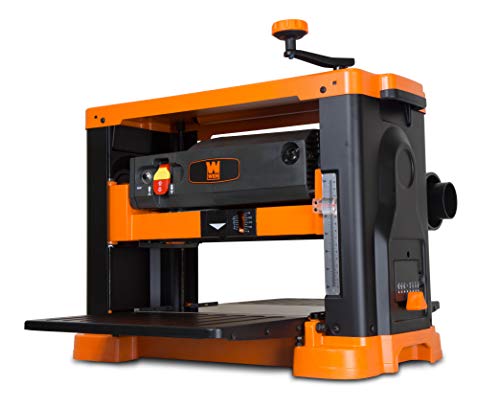
WEN 6552 Benchtop Thickness Planer
A budget-friendly benchtop thickness planer commonly used by hobbyist woodworkers for milling boards to consistent thickness.

DEWALT DW735X Thickness Planer
A 13-inch benchtop thickness planer frequently used by more serious hobbyists and small shops for furniture-grade milling work.
Frequently asked questions
What kinds of DIY projects actually need a benchtop planer?
Furniture building with glued-up panels, milling rough-sawn lumber, and resurfacing warped or cupped boards are the projects where a planer solves a problem that is genuinely hard to address another way.
Can you build basic furniture without ever owning a planer?
Yes, many simple builds using standard pre-surfaced lumber from a home center do not require a planer at all, since the boards already arrive at a consistent usable thickness.
Is it worth renting a planer instead of buying one for an occasional project?
Often yes, since rental costs for a single project are typically far less than the purchase price plus ongoing blade maintenance for a tool that might only get used once or twice a year.
Does a planer replace the need for a jointer?
No, a planer makes a board a consistent thickness but does not flatten a board that is already twisted or cupped on its own without a reference flat face, which is the specific job a jointer handles.
How much does a decent benchtop planer typically cost?
Prices vary widely by brand and capacity, with budget benchtop models sitting at the lower end of the power tool price range and higher-capacity models costing meaningfully more, though checking current listings is the only way to get an accurate number.
Do planer blades need regular maintenance?
Yes, planer blades dull with use, especially on resinous or knotty wood, and most benchtop models use replaceable or resharpenable blades that need periodic attention to keep cut quality clean.
Can a hand plane do the same job as a benchtop planer?
For small boards and less demanding projects, a hand plane with practice can get close, but maintaining consistent thickness across a longer board by hand is far more difficult and time-consuming than running it through a powered planer.
Is a benchtop planer loud or messy to use?
Yes to both, planers produce significant noise and generate a large volume of wood shavings quickly, so hearing protection and a shop vac or dust collection setup are worth having alongside the tool.
Does buying rough-sawn lumber and planing it yourself save money?
Often yes, since rough-sawn lumber is typically cheaper per board foot than pre-surfaced lumber, and the savings can offset the cost of a planer over several projects for anyone doing recurring woodworking.
Can a planer handle very wide boards?
Only up to its rated maximum width, which varies by model, so project boards wider than the planer’s capacity need to be ripped narrower first or run through in sections and glued back together.
Is a benchtop planer safe for a beginner to use?
With proper safety practices, including feeding boards correctly and keeping hands clear of the cutting area, yes, though reading the manual and understanding feed direction and kickback risk matters before first use.
Do all benchtop planers produce the same quality of cut?
No, cut quality varies by blade sharpness, feed rate control, and the number of cutting edges on the cutter head, with more expensive models generally producing a smoother finish requiring less sanding afterward.
Can a planer fix a board that is warped, not just the wrong thickness?
Only partially, since a planer follows the existing shape of the board’s bottom reference surface, so a significantly warped board usually needs flattening on a jointer or by hand first before planing to final thickness.
Is storage space a real concern with benchtop planers?
Yes, even benchtop models are bulky and heavy enough that storage and the ability to set them up on a stand or table when needed is a practical consideration before buying one for a small workshop.
Do professional woodworkers consider a planer essential?
Most who build furniture or do repeat milling work consider it one of the more essential stationary tools in a shop, though its necessity scales directly with how often rough or inconsistent lumber is part of the work.
Can a planer be shared or borrowed instead of purchased for a single project?
Yes, borrowing from a friend, a tool library, or a maker space is a practical option for a one-off need, since the tool sees infrequent enough use in that case that ownership offers little advantage.
Does feed rate on a planer affect the surface finish quality?
Yes, a slower feed rate generally produces a smoother cut with fewer visible mill marks than feeding a board through quickly, though it takes longer per pass to complete the job.
Is it common to need multiple passes through a planer to reach the final thickness?
Yes, removing a small amount of material per pass, often a fraction of an inch at a time, produces a cleaner result and puts less strain on the motor than trying to remove too much thickness in one pass.
The bottom line
A benchtop planer is a specialist tool that solves one problem extremely well, getting a board to a consistent thickness, and it is overkill for projects that never actually run into that problem. The honest test is whether a current or planned project involves rough lumber, glued-up panels, or warped boards, since that is where a planer stops being a nice-to-have and starts being the tool that makes the project possible. Short of that, the money is better spent elsewhere in the shop.
Jake Monroe
Jake worked as a residential contractor for over a decade before shifting to full-time writing. He evaluates power tools, hand tools and workshop gear through the lens of someone who has actually used them on job sites, not just read the box.