Is a Battery Charger Different From a Battery Maintainer for Long Term Storage?
Yes, they’re built for different jobs. A basic charger pushes a fixed or tapering current to bring a discharged battery up to full charge relatively quickly, and it’s generally not meant to stay connected once that’s done. A maintainer, often called a trickle or float charger, is specifically designed to be left connected indefinitely, since it monitors voltage and only delivers small bursts of current as needed to hold the battery at full charge without overcharging it.
What a basic charger is actually built to do
A basic charger operates mainly in bulk charge mode, delivering a comparatively high amperage to restore a discharged battery’s capacity as quickly as is safely possible. Leaving one connected for days or weeks after the battery reaches full charge risks continuing to push current into a battery that no longer needs it, which can boil off electrolyte and damage the plates over time.
What a maintainer does differently
A maintainer uses a float or pulse charging algorithm that continuously monitors the battery’s voltage and only delivers a small trickle of current when that voltage drops below a set threshold, then backs off again once it’s restored. This on-and-off cycling is specifically engineered to hold a battery at full charge indefinitely without the overcharging risk a basic charger carries if left connected too long.
Many modern smart chargers blur the line on purpose
A lot of today’s multi-stage charger products actually combine both functions, running a bulk charge phase first and then automatically switching into a maintenance mode once the battery reaches full charge, which is exactly why the line between ‘charger’ and ‘maintainer’ has gotten blurry in marketing. Checking whether a specific product includes an automatic maintenance or float stage, rather than assuming based on the name alone, is the more reliable way to know what you’re buying.
Why using a plain charger for long-term storage is risky
Continuing to push charging current into an already-full battery accelerates grid corrosion on the internal plates and causes electrolyte loss through excess gassing, both of which shorten the battery’s usable life even though the battery may appear perfectly fine during and right after the process. This risk is specifically why basic chargers typically include warnings against unattended long-term connection.
What this means for seasonal vehicles, boats, and motorcycles
Anything parked for more than a couple of weeks, a motorcycle over winter, a boat between seasons, a classic car in storage, benefits from being connected to something running in actual maintenance mode rather than a basic charger left plugged in and forgotten. Either a dedicated maintainer or a smart charger’s specific maintenance setting accomplishes this safely, while a plain bulk charger left connected the whole time does not.

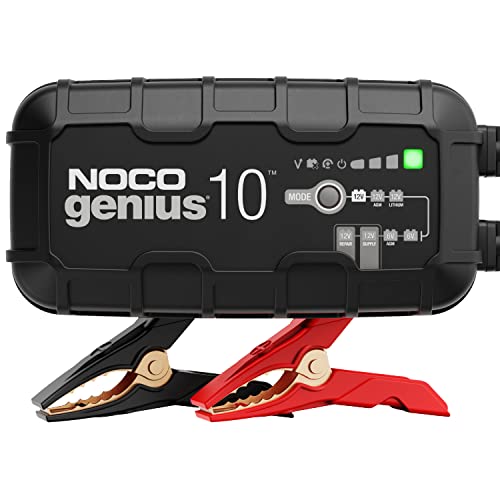
NOCO Genius G3500 Smart Battery Charger
A multi-stage charger that performs an initial bulk charge and then automatically switches into a maintenance mode, covering both charger and maintainer roles in one device.

Battery Tender Jr 12V
A dedicated low-amperage maintainer built specifically to stay connected for extended periods, commonly used for motorcycles and seasonal vehicles over winter storage.
Frequently asked questions
Can I leave a basic battery charger connected all winter instead of buying a maintainer?
It’s risky, since most basic chargers keep pushing current even after the battery is full, which can cause overcharging damage over weeks of unattended connection; a maintainer or a smart charger’s maintenance mode is built specifically to avoid that.
How do I know if my charger has a maintenance mode or not?
Check the product description or manual for terms like float mode, trickle mode, or automatic maintenance stage; if it only describes a charging amperage with no mention of an automatic cutoff or float stage, it’s likely a basic charger not meant for indefinite connection.
Does a maintainer charge a fully dead battery from zero?
Most maintainers are designed to top off and hold a battery that still has some charge, and many won’t properly engage with a battery that’s extremely deeply discharged, in which case a basic charger should bring it up to a workable level first.
Is it bad to use a maintainer on a battery that’s already full?
No, that’s exactly what a maintainer is designed for, holding an already full battery at that level indefinitely through small corrective charges rather than continuously pushing current the way a basic charger would.
Can a smart charger replace both a basic charger and a maintainer?
Yes, many multi-stage smart chargers are specifically designed to handle both roles automatically, starting with a bulk charge and transitioning to a float or maintenance stage once the battery reaches full charge.
Do lithium batteries need a different type of maintainer than lead-acid batteries?
Yes, lithium batteries have different charging voltage and current requirements than lead-acid batteries, so a maintainer specifically rated for lithium chemistry should be used rather than a lead-acid-only device.
How long can a battery safely sit on a maintainer without being checked?
Many maintainers are rated for months of unattended use, but periodically checking connections and the battery’s physical condition every few weeks is still a reasonable precaution rather than assuming zero maintenance is ever needed.
Will a maintainer overcharge a battery if left on for too long?
No, that’s specifically what distinguishes a maintainer from a basic charger, its float or pulse algorithm is designed to prevent overcharging even across months of continuous connection.
Can I use a car battery charger on a motorcycle battery?
Many smart chargers include a motorcycle or small-battery setting that reduces output current to a level appropriate for a smaller battery, but a full-size car charger without such a setting can deliver too much current for a small motorcycle battery.
Why does my battery still go dead even though it’s on a maintainer?
This usually points to either a maintainer malfunction, a loose connection, or a battery that’s reached the end of its useful life and can no longer hold a charge regardless of how well it’s being maintained.
Is a solar trickle charger the same thing as a plug-in maintainer?
Functionally similar in purpose, holding a battery’s charge over time, but a solar trickle charger depends on sunlight exposure and generally delivers less consistent current than a plug-in maintainer connected to steady household power.
Does a maintainer use much electricity if left plugged in for months?
No, since it only draws meaningful power during the brief charging bursts needed to correct voltage drop, a maintainer’s overall electricity use over months of connection is minimal compared to most household appliances.
Can I tell from the amperage rating alone whether a device is a charger or a maintainer?
Roughly yes, since maintainers typically output a very low amperage, often under 1.5 amps, specifically to avoid overcharging, while basic chargers usually output several amps or more to charge a battery in a reasonable amount of time.
Do boat batteries need a different maintainer than car batteries?
Marine batteries often use a different internal construction than standard automotive batteries, so a maintainer specifically rated for marine or deep-cycle batteries is generally a safer match than a basic automotive-only maintainer.
Is it risky to use a maintainer on a battery that already has a slow internal short?
Yes, a battery with an internal short can’t actually hold the charge a maintainer delivers, so it will continue to show a low charge state regardless of how long it stays connected, which is itself a sign the battery likely needs replacement rather than more charging time.
Can a maintainer be used on a battery still installed in the vehicle?
Yes, most maintainers are designed to be connected directly to the battery terminals or a wiring harness while the battery stays installed, which is the standard way they’re used for seasonal vehicles parked in a garage.
The bottom line
The short answer is that a charger and a maintainer solve two different problems, bringing a battery up to full charge versus keeping it there, and treating them as interchangeable is exactly how batteries get quietly damaged during long storage periods. A dedicated maintainer or a smart charger with a real maintenance stage is the safer bet any time a battery is going to sit connected for weeks rather than hours.
Tony Russo
Tony trained as an automotive technician and spent years in service and parts retail before moving into writing. He focuses on garage tools, car care products and accessories from a hands-on maintenance perspective.