How Often Should You Rotate a Crib Mattress?
Most crib mattress manufacturers and sleep safety guidance recommend flipping or rotating a crib mattress every one to three months, mainly to even out wear and firmness from the infant sleeping in roughly the same spot night after night, not because rotation itself prevents any specific safety hazard. The bigger safety factor is firmness and flat fit in the crib, which rotation doesn’t restore, only delays losing. Rotation is best thought of as routine maintenance rather than a safety measure on its own. A quick monthly habit of checking and rotating is a small effort compared to what’s actually at stake with infant sleep surfaces.
What rotation is actually meant to fix
A mattress that’s always compressed under the same sleeping position can develop a slight indentation or softer spot over months, and rotating end-to-end or flipping top-to-bottom spreads that wear more evenly across the whole surface. This matters more for infants who spend long stretches of time in one preferred sleep position night after night rather than shifting around freely.
Why firmness matters more than rotation for safety
Safe infant sleep guidance calls for a firm, flat mattress specifically to reduce suffocation risk, and a mattress that’s already developed a noticeable soft spot or indentation should be replaced rather than just rotated, since rotation doesn’t bring back lost firmness. Pediatricians specifically call out firmness because a too-soft surface can allow an infant’s face to sink in slightly, which is the core mechanism behind the suffocation risk guidance addresses.
How to actually check if rotation is overdue
Pressing a hand firmly into different spots on the mattress and feeling for any give or indentation compared to a fresh area is a more useful, practical check than just following a fixed calendar schedule. Doing this check at the same time as a regular sheet change is an easy way to build it into an existing routine rather than needing a separate reminder. Writing the last rotation date on a sticky note inside the crib rail is a simple trick some parents use to avoid losing track of the schedule.
Two-sided vs. one-sided crib mattresses
Some crib mattresses are built with two usable firm sides, sometimes marketed with a slightly different firmness for infant use versus toddler use, and those should only be flipped according to the age guidance printed on the mattress, not swapped interchangeably. Using the wrong side for an infant’s age, even briefly, generally isn’t a serious safety issue on its own, but it does mean missing out on the firmness that side was specifically designed to provide.
Does the mattress cover affect wear
A quality waterproof cover reduces how much moisture soaks into the foam or innerspring core, and moisture absorption is one of the bigger contributors to uneven wear and odor over time, so cover quality affects how often rotation is actually needed. A cover that’s breathable as well as waterproof also reduces heat and moisture buildup overnight, which contributes to the mattress’s condition over time beyond just wear.
When rotation stops being useful
Once a mattress is a couple of years old and shows visible compression, retains odor, or no longer feels uniformly firm across its surface, rotating it is just delaying a replacement that should happen anyway for safe sleep. At that point, continuing to rotate a mattress that’s already lost firmness is really just rearranging where the problem sits rather than solving it.
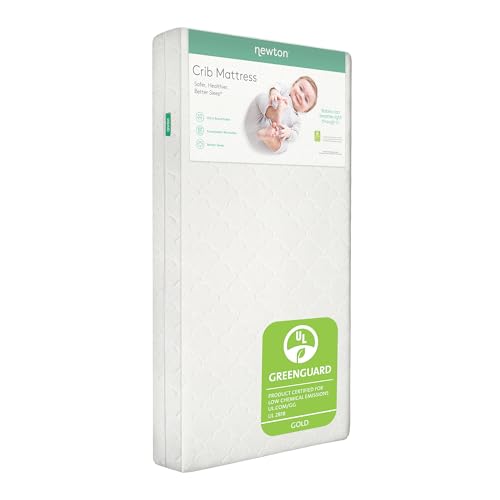
Newton Baby Crib Mattress
A breathable foam crib mattress designed with a washable cover and a core intended to resist the compression that leads to uneven firmness over time.

Graco Premium Foam Crib and Toddler Mattress
A dual-firmness two-stage mattress with a firmer infant side and a slightly different toddler side.
Questions worth asking
How do you know if a crib mattress needs replacing instead of rotating?
If pressing on the mattress reveals a noticeable soft spot or indentation that doesn’t even out, that’s a sign to replace rather than rotate, since rotation won’t restore lost firmness.
Is rotating a crib mattress actually necessary for safety?
Rotation itself isn’t the direct safety factor, firmness and flat fit are, but rotating does help delay the uneven wear that eventually compromises firmness.
Can a soft spot in a crib mattress be dangerous?
Yes, a soft or indented area can increase suffocation risk for a young infant, which is why firm, even support across the whole surface matters.
Do all crib mattresses have a flip side?
No, some are designed with only one usable sleep surface, so it’s worth checking the specific mattress’s instructions before assuming it can be flipped.
How long do crib mattresses typically last overall?
Many are designed to last through both infant and toddler use, often several years, though actual lifespan depends heavily on moisture exposure and how well it’s cared for.
Does a waterproof cover reduce how often you need to rotate?
Yes, by limiting moisture absorption into the core, a good waterproof cover slows the uneven wear process that rotation is meant to counteract.
Can you rotate a crib mattress with the baby still sleeping in the crib?
Yes, rotation is typically done during a regular sheet change rather than requiring the baby to be moved to another sleep space.
Is firmness more important than following a rotation schedule?
Yes, firmness is the actual safety factor, rotation is just a maintenance habit that helps preserve that firmness for longer.
Do two-sided infant and toddler mattresses need special handling?
Yes, they should only be flipped according to the age guidance printed on the mattress rather than rotated interchangeably like a single-firmness mattress.
How do you clean a crib mattress between rotations?
Wiping down with a mild cleaner appropriate for the mattress cover material, and allowing it to fully dry before putting sheets back on, is the standard approach.
Does humidity or moisture affect rotation frequency?
Yes, higher moisture exposure, from sweat, spit-up, or diaper leaks, speeds up uneven wear, which can mean rotating somewhat more often in humid conditions.
Is it safe to use a secondhand crib mattress if it still feels firm?
If it’s undamaged, still feels evenly firm, and meets current safety standards, it can be reasonable, though many parents prefer a new mattress given how central firmness is to safe sleep.
Can uneven wear from neglected rotation actually change how a baby sleeps?
A developing soft spot can affect sleep position and comfort over time, in addition to the firmness and safety concerns it raises.
Do innerspring crib mattresses need rotation as often as foam ones?
Both benefit from periodic rotation, though innerspring mattresses can develop more localized wear at specific coil positions compared to foam’s more gradual compression.
Is there a difference in rotation needs between budget and premium mattresses?
Higher-density foam or better-constructed mattresses generally resist compression longer, which can mean slightly less frequent rotation is needed to maintain even firmness.
How do you test crib mattress firmness at home?
Pressing down firmly in several spots and checking that the mattress springs back quickly and evenly, without a lingering indentation, is a simple practical test.
Should rotation schedule change once a toddler starts standing or jumping in the crib?
Yes, increased weight-bearing activity can accelerate wear in specific spots, which may call for checking and rotating somewhat more frequently at that stage.
Can a mattress pad or topper help extend time between rotations?
A thin, breathable mattress pad can offer a small amount of added protection against moisture and wear, though it shouldn’t be used to alter the required firmness of the mattress underneath for infant sleep safety.
Our take
Rotation is a maintenance habit, not a safety guarantee on its own. The real check is firmness: if the mattress presses back evenly everywhere, rotating every one to three months keeps it that way longer, but any lasting soft spot means it’s time to replace it instead. A mattress that still feels evenly firm everywhere after a year or two of regular rotation is doing its job well, and one that doesn’t is worth replacing regardless of how recently it was last flipped. Firmness is the number that actually matters, rotation is just the habit that helps protect it.
Rachel Simmons
Rachel previously worked in child-product retail and brings a practical, detail-first eye to gear reviews, focusing on safety standards, ease of use and the fine print that matters most for new caregivers.


