How Often Should You Resole Leather Boots?
There’s no fixed calendar interval, resoling is driven by wear, not time, and most well built leather boots with a Goodyear welted or similarly replaceable sole need their first resole somewhere between 1 and 3 years of regular wear, depending on how often they’re worn and on what surfaces. The real signal to watch for is the outsole tread flattening down to the midsole or the welt stitching becoming visible through worn rubber, not a date on the calendar.
Why resoling is even possible on some boots and not others
Welted construction, such as a Goodyear welt or a Blake stitch, attaches the sole in a way that a cobbler can unstitch and replace without damaging the upper. Cheaper boots with a cemented or glued sole generally cannot be resoled cleanly, so the resoling question only really applies to boots built with a specific replaceable construction in the first place.
What actually triggers a resole, not a date
The practical signal is tread worn smooth or down to the midsole, water starting to seep through a thinning sole, or visible stitching wear along the welt line. Uneven wear from how a particular person walks can also mean one side needs attention before the other.
How wear frequency changes the realistic timeline
Daily work boot wear on concrete or gravel wears a sole down considerably faster than occasional weekend wear, so a boot worn five days a week outdoors may need a resole within a year, while an occasionally worn pair can stretch past three years before needing the same attention.
What happens if a resole is put off for too long
Once wear reaches into the welt stitching itself, moisture and debris can start to damage the welt, turning what should have been a simple resole into a more involved and more expensive welt repair, or in bad cases making the boot not worth repairing at all.
What a resole actually involves at the cobbler
A cobbler removes the worn outsole, replaces it with a new sole, often a Vibram rubber sole or a leather sole depending on preference, and re-stitches it at the welt. This is exactly why welted boots are marketed as a long term investment despite costing more upfront than a glued pair.
How to extend the time between resoles
Rotating between two pairs of boots so no single pair takes all the daily wear, adding a thin sole protector early before the original sole wears down, and keeping the leather upper conditioned all help stretch the practical interval between resoles.
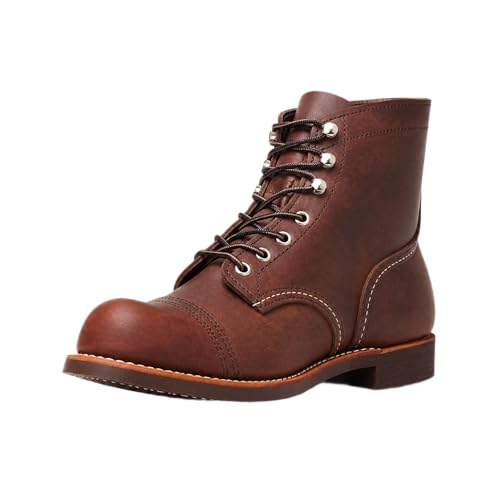
Red Wing Iron Ranger Boots
An iconic Goodyear-welted boot built specifically to be resoled repeatedly over its lifespan rather than replaced once the original sole wears out.

Thorogood American Heritage Work Boots
A popular welted work boot known for holding up to daily wear while still being repairable at a cobbler once the sole eventually wears down.
Questions worth asking
How do you know if a boot can even be resoled?
Check whether it has a welted construction, Goodyear welt and Blake stitch are the most common, since cemented or glued soles generally can’t be removed and replaced cleanly by a cobbler.
Is a worn-smooth tread always a sign a resole is needed?
It’s the clearest sign, especially once the tread pattern is fully flattened, since a smooth sole also means less traction and a higher slip risk on wet or uneven ground.
Can a boot be resoled more than once over its lifetime?
Yes, welted boots are specifically designed to go through multiple resoles over many years, which is a large part of why they’re considered a longer term investment than glued boots.
Does the type of terrain change how quickly a sole wears out?
Yes, rough surfaces like gravel or concrete wear soles down faster than softer ground, so a boot’s resole interval depends heavily on where it’s actually worn, not just how often.
Is it cheaper to resole a boot or buy a new pair?
A resole is almost always cheaper than a comparable quality new pair, which is the main financial argument for choosing welted construction in the first place.
Can you tell a resole is overdue just by looking at the heel?
Heel wear is one indicator, but checking the ball of the foot area and the welt stitching for wear gives a more complete picture than the heel alone.
Do work boots need resoling more often than casual leather boots?
Generally yes, since work boots see more frequent, harder daily wear on tougher surfaces, which accelerates sole wear compared to boots worn occasionally for casual use.
What’s the difference between a Goodyear welt and a Blake stitch?
A Goodyear welt uses a strip of leather stitched around the boot’s perimeter before the sole attaches, while a Blake stitch sews directly through the insole and sole, both allow for resoling but with slightly different construction methods.
Can a cobbler add a protective layer to extend the life of an original sole?
Yes, a thin rubber half-sole or toe cap can be added early to protect the original sole from wearing down, delaying the need for a full resole.
Is it normal for one boot to wear out faster than its matching pair?
Yes, uneven gait or weight distribution means many people wear down one boot’s sole faster than the other, so both boots should still be checked individually rather than assuming they wear evenly.
Does conditioning the leather upper affect how often resoling is needed?
Not directly, since conditioning protects the upper leather rather than the sole, though a well maintained boot overall is more likely to be worth the cost of repeated resoling.
Can a boot be resoled with a different sole type than it originally had?
Yes, cobblers can often swap in a different sole material, such as switching from a leather sole to a more weather-resistant rubber sole, during a resole.
Is there a maximum number of times a boot can be resoled?
There’s no fixed number, but the welt itself eventually wears from repeated resoling, so very old, many-times-resoled boots may eventually need a welt repair rather than just another sole swap.
Do seasonal changes affect how quickly boot soles wear down?
Wearing boots more heavily during wet or snowy seasons, especially on salted or gritty surfaces, can accelerate sole wear compared to drier conditions.
Should new leather boots be resoled preventively before they show wear?
No, resoling before the sole has actually worn down wastes money and the sole’s remaining life, so waiting for the actual wear signs is the more practical approach.
Does the type of sole material affect how long it lasts before resoling?
Yes, a rubber sole generally outlasts a leather sole in wet or rough conditions, so the original sole material chosen affects how soon the first resole becomes necessary.
Can a cobbler tell how much life is left in a sole without a full resole?
Yes, most cobblers can visually assess remaining tread depth and welt condition during a quick inspection, which can confirm whether a resole is needed now or can reasonably wait.
Does wearing boots with thick socks affect how quickly the sole wears?
Not significantly on its own, sole wear is driven mainly by ground contact and walking surface, though thick socks can affect overall boot fit, which indirectly influences wear pattern.
The bottom line
Resoling is really a wear based decision disguised as a time based question. A boot worn daily on rough ground earns its first resole far sooner than one worn occasionally, and the construction type, welted versus glued, is what determines whether the question is even relevant in the first place. Keeping a simple log of purchase date and resole dates for a favorite pair of boots makes it easier to compare wear patterns over time and anticipate the next cobbler visit before a small problem becomes a bigger one.
Priya Nathan
Priya spent years in apparel buying and merchandising for a multi-brand retailer before moving into editorial work. She focuses on fit, fabric and construction quality across everyday wear, activewear and accessories, reading past marketing copy to the details that affect how a garment actually wears and holds up.


