How Often Should You Descale a Coffee Maker?
Most manufacturers recommend descaling every one to three months for regular use, but the real driver is water hardness, not the calendar, since hard water with more dissolved minerals builds scale far faster than naturally soft water does. A noticeably slower brew cycle, odd-tasting coffee, or a mineral crust visible around the water reservoir are all signs it’s overdue regardless of how recently the last descale happened.
What scale buildup actually is
Scale is calcium and magnesium minerals dissolved in tap water that precipitate out as solid deposits every time the machine heats water, gradually coating internal tubing, valves, and the heating element with a hard mineral crust.
Why hard water changes the timeline so much
Areas with notably hard tap water can need descaling monthly, while households using soft or filtered water with the same machine might comfortably stretch to four to six months between descaling sessions.
How scale actually degrades a coffee maker
Buildup narrows internal tubing, which slows water flow and can lower brew temperature, insulates the heating element so it has to work harder and less efficiently, and can eventually clog valves entirely if left unaddressed for too long.
Signs that point to overdue descaling
Longer brew times, sputtering or gurgling sounds during brewing, visibly reduced water flow, a white crust forming at the reservoir or water line, and flatter-tasting coffee from inconsistent brew temperature all point to scale that’s overdue for removal.
Descaling solution versus plain vinegar
Commercial descalers are formulated to dissolve mineral scale specifically without leaving a lingering smell or taste the way vinegar’s acidity can, and vinegar’s acidity can also degrade certain rubber seals and plastic components in some machines over repeated use.

Durgol Swiss Espresso Decalcifier
A widely used descaling solution formulated for espresso machines and drip coffee makers alike, designed to dissolve mineral scale thoroughly.
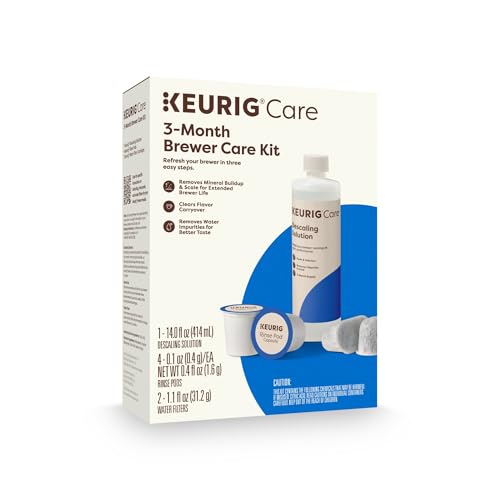
Keurig Descaling Solution
The official descaler made specifically for Keurig single-serve brewers, sized and formulated for that machine’s internal components.
Common questions
Can you use plain white vinegar instead of a commercial descaler?
Yes, diluted white vinegar can dissolve scale effectively, though it can leave a lingering smell or taste that takes several rinse cycles to fully clear, and its acidity may affect certain rubber seals over repeated use more than a formulated descaler.
How do you know if your tap water is hard enough to need frequent descaling?
A home water hardness test strip, available cheaply, gives a quick reading, and many municipal water suppliers also publish hardness data online for the local area that gives a good general estimate.
What happens if a coffee maker is never descaled at all?
Scale will continue accumulating until it noticeably slows brewing, affects taste, and in severe cases clogs internal components enough to require professional repair or outright replacement of the machine.
Does descaling improve coffee taste or just machine performance?
Both, since mineral buildup can alter brew temperature and water flow in ways that change extraction, so a properly descaled machine often produces more consistent-tasting coffee as a direct result.
Can scale buildup actually break a coffee maker permanently?
In severe, long-neglected cases, yes, since fully clogged valves or a heating element insulated too heavily by scale can fail outright rather than simply underperform.
Is bottled or filtered water worth using to reduce descaling frequency?
Yes, using filtered or low-mineral water measurably slows scale buildup, which can meaningfully stretch the interval between descaling sessions for anyone in a hard water area.
Why does my coffee maker’s descale light come on even after I just descaled it?
Some machines use a fixed brew-cycle counter rather than actually detecting mineral buildup, so the light may simply be on a preset schedule regardless of your actual water hardness or descaling habits.
Does a water filter attachment on the machine reduce how often you need to descale?
Yes, a built-in filter reduces the mineral content of water entering the machine, which can meaningfully extend the time between needed descaling sessions.
Can descaling solution be reused for multiple cycles?
Most manufacturers recommend using a fresh batch each time, since the solution becomes saturated with dissolved minerals after one use and loses much of its effectiveness for a second round.
Is it normal to see white flakes in the water reservoir between descales?
Yes, visible white flakes or a chalky film are a normal sign of mineral buildup in hard water areas and are a reasonable visual cue that a descaling session is due.
How long does a typical descaling cycle take start to finish?
Most descaling cycles, including the dedicated solution run plus a few rinse cycles with plain water afterward, take somewhere between thirty minutes and an hour depending on the machine.
Can you descale a coffee maker with lemon juice or citric acid instead?
Citric acid, often sold as a powder, works similarly to vinegar for dissolving scale and is a common household alternative, though it should still be followed by thorough rinsing to clear any residual taste.
Does running the machine with descaler in it damage the rubber seals?
Occasional descaling with a properly diluted solution generally doesn’t harm seals, but frequent use of straight, undiluted vinegar or descaler can degrade rubber gaskets faster over the long run.
Why do single-serve pod machines seem to need descaling more often than drip machines?
Pod machines often use narrower internal tubing that’s more sensitive to even modest scale buildup, so the same amount of mineral deposit can affect performance sooner than it would in a larger drip machine’s wider pathways.
Is it safe to drink coffee brewed right after a descaling cycle?
Yes, as long as the recommended number of plain water rinse cycles afterward has been run to clear any remaining descaling solution from the internal lines.
Can you tell scale buildup apart from mold by appearance alone?
Scale typically appears as a hard, white or grayish chalky deposit, while mold tends to look darker, fuzzy, or slimy, and the two require different cleaning approaches entirely.
Does descaling frequency differ between drip machines and espresso machines?
Espresso machines often need more frequent descaling since they use hotter water under pressure through narrower pathways, which can accelerate scale formation compared to a standard drip machine using the same water.
Can skipping descaling void a coffee maker’s warranty?
Some manufacturers specifically note in their warranty terms that damage traced to mineral scale buildup from neglected maintenance isn’t covered, so checking the specific machine’s documentation is worthwhile if warranty coverage matters.
Is distilled water a good long-term fix instead of regular descaling?
Distilled water has essentially no dissolved minerals, so it can dramatically slow scale formation, though some machines still benefit from occasional descaling to clear any residual buildup from before the switch or from any tap water used occasionally.
Does a louder brewing noise over time usually mean scale buildup?
Yes, increased gurgling, sputtering, or a noticeably louder brew cycle is a common symptom of scale narrowing internal passages and disrupting normal water flow, and is often one of the earliest noticeable signs before taste or speed changes become obvious.
Does hard water affect the taste of coffee even before scale becomes a visible problem?
Yes, high mineral content affects extraction and flavor on its own, separate from any scale buildup, so some of the taste improvement people notice after switching to filtered water comes from the water itself rather than only from reduced scale.
Can you tell how hard your water is just from how often you need to descale?
It’s a reasonable rough indicator, needing to descale every few weeks rather than every few months strongly suggests notably hard water, though an actual test strip gives a far more precise reading than inferring it from descaling frequency alone.
Our take
Watch your water more than the calendar, descale sooner if the brew slows down or a mineral crust appears, and lean on a dedicated descaling solution over straight vinegar if the machine sees regular daily use, since it clears scale more completely without leaving a taste behind.
Dana Whitfield
Dana spent eight years buying and merchandising for a regional kitchenware retailer before moving into editorial work. She has handled thousands of SKUs across cookware, small appliances and kitchen organization, and focuses on the practical differences that matter once a product is actually in daily use.


