How Often Should a Sprinkler Head Be Checked for Clogging?
A sprinkler system’s heads should be visually checked at the start of each watering season and then once a month during active use, with a closer look any time a specific zone starts showing dry patches or uneven coverage. Sediment and debris build up gradually, so by the time a head visibly stops rotating or spraying evenly, it has usually been partially clogged for a while already.
Why clogging happens gradually rather than all at once
Water carries fine sediment, mineral deposits, and small debris like grass clippings or dirt through the irrigation line, and a sprinkler head’s small nozzle opening is the narrowest point in the system. Buildup accumulates slowly along the nozzle edges, so coverage degrades gradually rather than the head stopping outright, which is why dry or thin patches are usually the first sign rather than a complete stoppage.
What a seasonal start-up check should cover
At the beginning of each watering season, running each zone briefly and watching every head confirm they pop up fully, rotate through their intended arc, and spray without visible sputtering catches most clogs or damage that occurred over winter storage or dormancy before they become a bigger water-waste or dry-spot problem.
Why monthly checks during the season matter
Even a well-maintained system accumulates some sediment during a full season of regular use, and a quick monthly walk-through while the system runs, watching for heads that spray weakly, spray in the wrong direction, or fail to retract afterward, catches problems early enough to fix with a simple nozzle cleaning rather than a full head replacement.
Signs that point to a clog specifically, not another problem
A head that sprays a reduced or uneven pattern, mists instead of streams, or has visibly reduced pressure compared to neighboring heads on the same zone usually points to clogging rather than a pressure or valve issue, since a true pressure problem typically affects most or all heads on that zone evenly rather than just one.
How water quality affects clogging frequency
Homes on well water or in areas with hard water and higher mineral content tend to see faster buildup inside sprinkler heads than those on treated municipal water, which can mean more frequent checks, sometimes every two to three weeks during peak season, are worth the extra effort for well-water households.
Simple cleaning versus needing a replacement
Most clogs clear with the head removed, nozzle soaked briefly, and debris flushed out with a toothbrush or fine wire, a job that takes a few minutes per head. A head that still sprays unevenly after a thorough cleaning, or one with visible cracks or a stuck riser, usually needs replacing rather than further cleaning attempts.
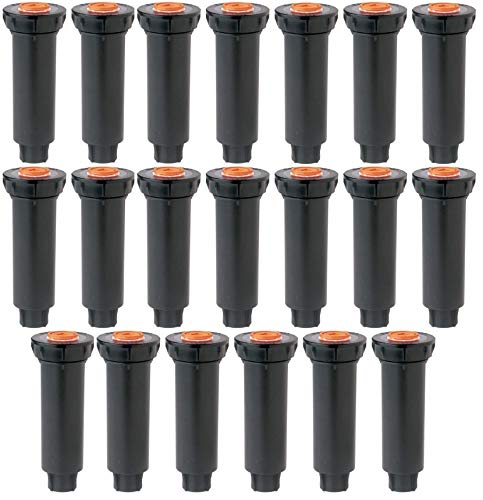
Rain Bird 1804 Pop-Up Sprinkler Head
A widely used pop-up spray head with a replaceable nozzle, commonly swapped out as a quick fix when cleaning does not resolve a persistent clog.

Hunter PGP Ultra Rotor Sprinkler Head
A gear-driven rotor head often used for larger lawn zones, with an internal filter screen that can be removed and rinsed as part of routine clog checks.
Frequently asked questions
How do I know if a sprinkler head is clogged versus broken?
A clogged head usually sprays weakly, unevenly, or mists instead of streaming, while a broken head typically fails to pop up, leaks continuously at the base, or shows visible cracking in the housing.
Can hard water cause sprinkler heads to clog faster?
Yes, higher mineral content in hard water or well water tends to build up inside the narrow nozzle opening faster than treated municipal water, often warranting more frequent checks.
Is it normal for only one sprinkler head on a zone to clog while others stay fine?
Yes, clogging is often localized to whichever head happens to trap debris or sediment at its specific nozzle opening, so uneven clogging across a single zone is common and does not indicate a wider system problem.
What tools do I need to clean a clogged sprinkler head?
A small screwdriver or head puller to remove the nozzle, a soft toothbrush or fine wire to clear debris, and a bucket of water for a quick soak are usually enough for routine cleaning.
Can leaving a clogged sprinkler head unaddressed damage the lawn?
Yes, an unaddressed clog can create persistent dry patches or uneven growth in that part of the lawn, since affected grass receives noticeably less water than the surrounding area over repeated watering cycles.
Does running the system too often increase clogging risk?
Not directly, since clogging depends more on water quality and debris content than frequency, though more total running hours do mean more total water, and therefore more sediment, passing through each head over a season.
Should sprinkler heads be checked before winterizing the system?
Yes, checking and clearing heads before winterizing helps ensure the system starts the next season without heads that were already partially clogged going into winter dormancy.
Can tree roots or dirt getting into the line cause recurring clogs?
Yes, if dirt or root intrusion is getting into the supply line itself rather than just the head, clogs will recur repeatedly even after cleaning individual heads, pointing to a line-level issue rather than a head-level one.
Do rotor heads clog less often than spray heads?
Rotor heads often have a slightly larger water path and sometimes an internal filter screen, which can make them somewhat less prone to full clogging than the narrower nozzle openings on fixed spray heads, though both need regular checks.
Is it worth installing filters on sprinkler heads to reduce clogging?
For households with notably sediment-heavy water, inline filters or filtered heads can meaningfully reduce how often individual nozzles clog, though for most municipal water supplies it is often not necessary.
How long does cleaning a single clogged sprinkler head usually take?
A few minutes per head is typical, covering removing the nozzle, soaking briefly, brushing out visible debris, and reinstalling, making it a quick enough task to do during a routine monthly walk-through.
Can a clogged sprinkler head cause higher water bills?
Indirectly yes, since a clogged head often runs longer or more frequently as an automatic timer tries to compensate for a dry patch, using more water overall without necessarily fixing the underlying coverage gap.
Does soil type affect how often sprinkler heads need checking?
Sandy or loose soil is more prone to sediment working its way into the system, particularly around heads sitting slightly low or uneven, which can modestly increase how often those specific heads need checking.
Can a partially clogged head still look like it is working fine from a distance?
Yes, a partial clog can reduce coverage or pressure just enough to create an uneven spray pattern that is only obvious up close or when compared directly to a neighboring head, which is why periodic close inspection matters more than a quick glance.
Does adding a filter at the main irrigation valve reduce how often heads clog?
Yes, a mainline filter can catch a meaningful amount of sediment before it ever reaches individual heads, often stretching out the interval between needed head cleanings across the whole system.
Can lawn fertilizer or topsoil contribute to sprinkler head clogs?
Yes, fine particles from recently applied topsoil, sand, or certain fertilizers can wash into nearby heads during the next watering cycle, making a check shortly after any lawn work a reasonable precaution.
Is it worth keeping a log of which heads have clogged before?
Yes, heads that have clogged once often clog again sooner than others on the same zone, so tracking repeat offenders helps prioritize which heads to check first during routine monthly inspections.
Can low water pressure from the municipal supply make clogging seem worse than it is?
Yes, low supply pressure can produce a weak, uneven spray that looks identical to a partial clog, so comparing a questionable head’s performance against others on the same zone helps rule out a pressure issue before assuming it needs cleaning.
Where this leaves you
Clogging is a gradual, mostly preventable problem rather than a sudden failure, which is exactly why a regular monthly check during the season catches it earlier and cheaper than waiting for an obvious dry patch to show up on the lawn.
Sierra Daniels
Sierra's background is in landscape design and nursery retail. She focuses on lawn and garden equipment, outdoor furniture and gear durability, weighing published specs against how materials actually hold up outside.

