How Often Should a Dog’s Teeth Actually Be Brushed at Home?
Daily brushing is the actual veterinary dental recommendation, not an exaggerated sales target, because plaque can begin hardening into tartar within roughly 24 to 36 hours. Brushing a few times a week instead of daily still meaningfully reduces plaque and tartar compared to not brushing at all, so it is a reasonable fallback for owners who cannot manage daily, just not the ideal.
Why daily is the real recommendation, not a sales pitch
Plaque is a bacterial film that forms continuously on a dog’s teeth, and it does not stay soft indefinitely. Within about a day or two it starts mineralizing into tartar, which bonds to the tooth surface and can no longer be removed by brushing alone. Daily brushing works by interrupting that process before it crosses into tartar, which is why the recommendation is based on biology rather than marketing.
What realistically happens with less frequent brushing
Brushing two or three times a week will not fully prevent tartar formation, but it still measurably reduces plaque buildup compared to never brushing at all. For owners who cannot realistically manage daily brushing, a consistent few-times-a-week habit is a legitimate, worthwhile target rather than an all-or-nothing failure.
Starting the habit early makes it far easier
Puppies accept having their mouths handled much more readily than adult dogs encountering a toothbrush for the first time. For an adult dog new to brushing, a gradual approach, starting with simply touching the mouth and gums, then introducing flavored dog toothpaste on a finger, and only later moving to an actual brush, usually works better than starting with a full brushing session on day one.
Signs your current brushing frequency is not enough
Visible yellow or brown buildup along the gumline, breath that smells distinctly beyond normal dog breath, and red or inflamed gums are all signs that either the frequency or the technique needs to improve. Catching these early is far easier to address than waiting until tartar has hardened significantly.
Why human toothpaste should never be used
Many human toothpastes contain xylitol, which is toxic to dogs even in small amounts, along with fluoride levels dogs are not meant to swallow the way people spit theirs out. Dog-specific enzymatic toothpaste is formulated to be safely swallowed and often uses flavors dogs tolerate better than minty human formulas.
What brushing cannot do on its own
Once tartar has hardened, especially below the gumline, brushing can no longer remove it, and only a professional dental cleaning under anesthesia can address it at that point. Dental chews, dental-specific diets and water additives can support a brushing routine, but none of them replace the mechanical removal brushing provides when plaque is still soft.
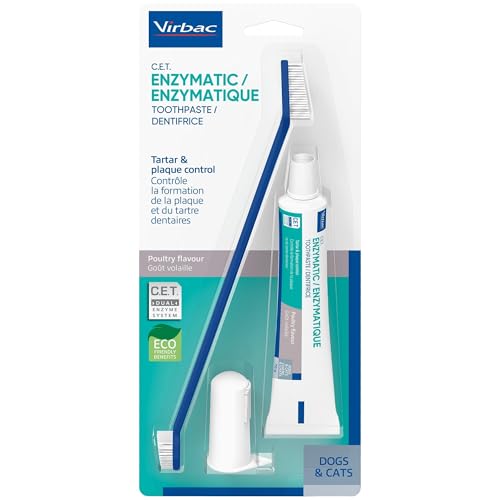
Virbac C.E.T. Enzymatic Toothpaste Kit for Dogs
An enzymatic toothpaste and brush kit designed to be safely swallowed, built around breaking down plaque chemically alongside the mechanical brushing action.

Arm & Hammer for Pets Tartar Control Kit
A baking-soda based toothpaste paired with a dual-headed toothbrush, aimed at everyday tartar control for dogs already in a regular brushing routine.
Good to know
Is daily brushing really necessary, or is a few times a week enough?
Daily is the ideal because plaque starts hardening into tartar within about a day or two, but a few times a week still provides real benefit for owners who cannot manage a daily routine.
What happens if I never brush my dog’s teeth at all?
Plaque will continue accumulating and hardening into tartar unchecked, which raises the risk of gum disease, bad breath, and eventually tooth loss or infection that may require professional treatment.
At what age should I start brushing a puppy’s teeth?
Starting early, often once baby teeth are in, makes the habit much easier to establish, since puppies generally accept mouth handling more readily than adult dogs encountering it for the first time.
Can I use regular human toothpaste on my dog?
No, human toothpaste often contains xylitol, which is toxic to dogs, and fluoride levels not meant to be swallowed, so a dog-specific enzymatic toothpaste should always be used instead.
How long does it take to get an adult dog comfortable with brushing?
It varies by dog, but a gradual introduction over one to two weeks, starting with simple mouth handling before introducing a brush, tends to work better than attempting a full session immediately.
Do dental chews work as a substitute for brushing?
They can help reduce plaque to some degree, but they are generally considered a supplement to brushing rather than a full substitute for the mechanical cleaning a toothbrush provides.
How can I tell if my dog already has tartar buildup?
Look for yellow or brownish deposits along the gumline, especially on the back teeth, along with breath that smells noticeably worse than typical dog breath.
Does breed or dog size affect how often brushing is needed?
Small breeds often have more crowded teeth and are more prone to dental disease, which can make consistent brushing even more important for them than for some larger breeds.
Is it too late to start brushing an older dog’s teeth?
No, it is still worthwhile at any age, though an older dog with significant existing tartar may need a professional cleaning first before a home brushing routine can be fully effective.
Can water additives replace the need for brushing?
No, water additives can help reduce bacteria in the mouth, but they do not provide the mechanical plaque removal that brushing does and work best as a complement rather than a replacement.
Why does my dog’s breath still smell bad even though I brush a few times a week?
This can mean brushing frequency or technique needs improvement, or it can point to existing dental disease that may need a professional evaluation rather than more brushing alone.
Is a finger brush as effective as a regular dog toothbrush?
A finger brush can work reasonably well, especially for dogs just starting out, though a longer-handled brush generally gives better reach and control for thorough cleaning of the back teeth.
How often should a dog get a professional dental cleaning in addition to home brushing?
This depends heavily on the individual dog and is best decided with a vet, but dogs with a consistent home brushing routine often need professional cleanings less frequently than dogs with no home routine at all.
Can brushing too hard damage a dog’s gums?
Yes, overly aggressive brushing can irritate or even cause minor bleeding in sensitive gums, so a gentle, consistent technique matters more than heavy pressure.
Do all dog breeds need the same brushing frequency?
Small breeds prone to crowded teeth and certain breeds with known dental sensitivity often benefit from especially consistent brushing, though the general daily guideline applies broadly across breeds.
Is it normal for a dog to resist brushing at first even with training?
Yes, initial resistance is common, and a slow, reward-based introduction over days or weeks tends to work better than pushing through resistance in a single session.
Can brushing an older dog’s teeth be riskier than brushing a younger dog’s?
Older dogs may have more existing dental issues, like loose teeth or gum recession, which makes gentle technique and awareness of problem areas more important than with a younger dog’s healthier mouth.
Does the direction I brush in matter for effectiveness?
Brushing at a slight angle toward the gumline, rather than straight across the tooth surface, generally removes plaque more effectively, similar to the technique recommended for human brushing.
Will my dog’s dental health improve noticeably after starting a brushing routine?
Many owners notice fresher breath and less visible buildup within a few weeks of starting consistent brushing, though existing hardened tartar will still need a professional cleaning to fully resolve.
Our take
Daily really is the honest target, not an inflated number meant to sell more toothpaste, because the biology of plaque hardening does not wait for a convenient schedule. That said, a consistent few-times-a-week habit beats an abandoned daily routine every time, so the right frequency is whichever one an owner will actually stick to long term.
Olivia Hartley
Olivia spent several years working at an animal shelter and a pet-supply retailer before joining the editorial team. She researches pet gear with an emphasis on safety, comfort and the fine print that owners often miss.