How Does a Nursing Cover Actually Help With Privacy Without Overheating?
A nursing cover works by draping opaque fabric over your chest and baby’s head, which blocks the direct sightline that would otherwise reveal feeding is happening, rather than hiding the act itself. The privacy comes almost entirely from fabric opacity and the angle it sits at, while the overheating problem comes from that same closeness, since the cover traps your body heat and baby’s body heat in the small pocket of air between you. The covers that handle both well pair a rigid neckline that holds fabric a few inches off your skin with a lightweight, breathable fabric like muslin, rather than a heavier opaque synthetic that blocks light well but also blocks airflow.
What actually creates the privacy
The fabric itself is doing almost all the work. A typical nursing cover is cut as an apron or poncho shape wide enough to drape past your shoulders on both sides, with the opaque layer angled so that someone sitting or standing in front of you sees fabric instead of skin. It does not block every angle; someone standing directly behind you or looking down from above can usually still see in, which is why most covers assume you are facing away from a crowd rather than standing in the open middle of a room.
Why the neckline design matters more than people expect
Many covers include a rigid strip, often called boning, sewn into the top edge of the fabric. That rigid piece holds the neckline open in a loop shape instead of letting it collapse flat against your chest, which does two things at once: it lets you tilt your head down and actually see your baby’s face while feeding, and it creates a small gap between the fabric and your body. That gap is also the main source of airflow under the cover, so a cover with a collapsed or missing neckline tends to run hotter even in the same fabric.
Where the heat actually comes from
The warmth under a nursing cover is not the fabric generating heat, it is two bodies’ worth of normal body heat with nowhere to go. Your torso and your baby’s head and body are both radiating heat into a small enclosed pocket of air, and the opaque fabric needed for privacy is the same fabric that stops that warm air from escaping. This is why a cover can feel noticeably hotter in a warm room or car even though the fabric itself is not thick.
Fabric choice changes the airflow more than the privacy
Lightweight, open weave fabrics like cotton muslin or bamboo blend still block enough light to be effectively opaque in most everyday lighting, but they allow more air to pass through the weave than a tightly woven canvas or polyester apron fabric does. Heavier opaque synthetic covers often feel more secure and structured, but they trade away some of that passive airflow, which is why many commonly recommended covers default to muslin rather than denser fabric despite muslin being thinner.
When overheating risk actually goes up
The risk is highest in situations that are already warm before the cover goes on: a parked car, a crowded indoor space without air conditioning, summer outdoor feeding, or a baby who was already swaddled or just woke from a nap and is running warm. In any of those situations, stacking a low airflow cover on top adds heat to a baby who has little ability to regulate their own temperature yet, which is the actual safety reason to watch for flushed skin, damp hair, or fussiness during a covered feed rather than just comfort.
Alternatives when privacy and airflow are both priorities
Nursing tops and dresses with hidden panel openings let your own clothing provide coverage close to the body, without adding a second layer of fabric on top, which generally keeps baby cooler than any cover. A thin cardigan or scarf draped loosely rather than clipped tight achieves partial privacy with far more airflow than a structured cover, though it offers less consistent coverage from certain angles, so the right choice usually depends on how much coverage a given situation actually requires.
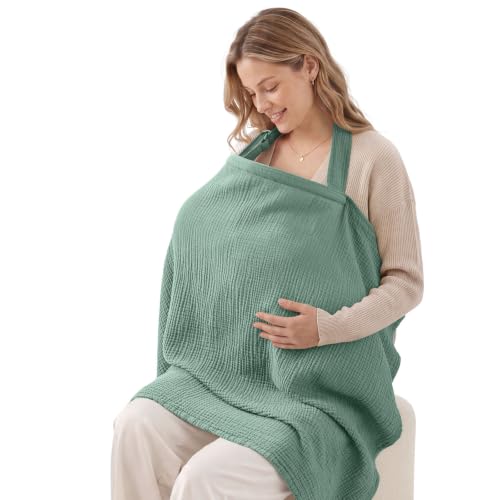
Bebe au Lait Premium Muslin Nursing Cover
A lightweight, breathable muslin cover with a rigid neckline that holds the fabric away from the body to improve airflow while nursing.

Itzy Ritzy Nursing Cover
A structured cover with a boned neckline and a built-in pocket, using a mid weight cotton blend fabric rather than muslin.
Good to know
Does a thinner nursing cover actually keep babies cooler?
Generally yes, since thinner open weave fabrics like muslin let more air pass through than heavier opaque fabric, even though both can be equally effective at blocking the view.
Why does my baby get sweaty or fussy under the cover but not without it?
The cover traps the combined body heat of both of you in the enclosed space, so a baby who is comfortable in open air can still overheat under fabric in the exact same room temperature.
Can you use a regular baby blanket instead of a dedicated nursing cover?
You can, but a regular blanket usually lacks the rigid neckline that holds fabric away from your body, so it tends to collapse against both of you and trap more heat than a cover built for this purpose.
Is muslin fabric actually opaque enough for privacy?
In most everyday indoor and outdoor lighting it is, since the tight weave blocks a direct line of sight, though it can look slightly more see through than heavier fabric when held up against bright backlighting.
What is the rigid piece at the top of a nursing cover called?
It is usually referred to as boning, a flexible but stiff strip sewn into the neckline that holds the loop shape open instead of letting the fabric collapse flat.
Do nursing covers get dangerously hot in a parked car?
They can contribute meaningfully to heat buildup in an already warm car, which is one of the riskier places to use a low airflow cover, since cars heat up fast regardless of the outside temperature.
What is the difference between a nursing cover and a nursing poncho?
A nursing cover is typically a single draped panel with a neckline opening, while a poncho style has a closed head opening worn like a garment, which some parents find stays in place better but can trap slightly more heat around the neck.
Will a baby refuse to nurse because of heat under a cover?
Some babies do become fussy or pull away when they are uncomfortably warm, which is often misread as refusing to nurse when it is actually a reaction to the enclosed heat rather than the feeding itself.
Are mesh panel nursing covers less private than solid fabric ones?
A well placed mesh panel positioned near the top, where you look down rather than where others look in, can improve airflow without meaningfully reducing privacy, since the panel usually is not in the direct sightline from the front.
Does the color of a nursing cover affect how hot it gets?
Darker colors can absorb slightly more heat in direct sunlight than lighter colors, though indoors this effect is minor compared to fabric weight and how much airflow the neckline design allows.
How can you tell if a cover is too warm for the situation you are in?
Watch for flushed or red skin, damp hair at the neckline, or a baby becoming unusually fussy partway through a feed that normally goes smoothly without a cover.
Is it safe for a baby’s air circulation to be fully covered while feeding?
As long as the baby’s face and airway stay uncovered and the parent can see and hear normal feeding and breathing, a properly draped cover over the shoulders is not considered the same airway risk as a blanket fully over a sleeping baby’s face.
Do nursing covers work the same way for bottle feeding?
Yes, the same privacy and airflow mechanics apply whether a baby is nursing or taking a bottle under the cover, since the concern is coverage and heat, not the feeding method itself.
What is an apron style cover compared to a scarf style cover?
An apron style cover ties around the neck and drapes down, usually with a rigid neckline, while a scarf style cover is a looser length of fabric draped over one shoulder with less structure and typically less consistent coverage.
Can overheating from a nursing cover actually be dangerous, not just uncomfortable?
In most short feeding sessions it is a comfort issue rather than a medical emergency, but repeated overheating in warm conditions can contribute to dehydration or heat stress in a young baby, which is why watching for the warning signs matters more than most parents expect.
Where this leaves you
A nursing cover’s privacy and its heat problem come from the same source: fabric held close to two bodies. The covers that actually solve both are the ones with a rigid neckline holding that fabric a few inches off your skin, not necessarily the thickest or most opaque option on the shelf. If overheating keeps happening despite a good cover, the honest fix is often to change where and how you are using it rather than buying a different cover entirely.
Rachel Simmons
Rachel previously worked in child-product retail and brings a practical, detail-first eye to gear reviews, focusing on safety standards, ease of use and the fine print that matters most for new caregivers.


