How Does a Flea Comb Actually Catch Fleas Without Chemicals?
A flea comb works entirely through mechanical spacing, not any chemical or scent-based repulsion. The metal tines sit close enough together, usually gaps under a millimeter, that an adult flea’s body cannot pass through without getting physically caught or scraped off the hair shaft as the comb moves through the coat. It removes what is already there rather than killing or repelling anything on its own.
A purely mechanical design
The defining feature of a flea comb is tine spacing narrower than a flea’s body, often around a sixteenth of an inch or less between teeth. Fleas and their debris simply cannot slip through gaps that tight, so they get caught between the tines or dislodged from the hair shaft as the comb passes through, with no chemical or scent component involved at all.
What actually gets caught in the comb
A thorough combing session typically turns up three things: live adult fleas, flea eggs, which are tiny white ovals that often fall off the hair before you can see them clearly, and flea dirt, which is dried blood excrement that looks like small dark specks and confirms an active flea presence even when live fleas are not immediately visible.
Why technique matters as much as the comb itself
The comb has to reach all the way down to the skin, not just skim the top of the coat, since fleas cluster close to the skin where it is warmest. Working in small sections, combing against the direction of fur growth in some areas, and dipping the comb into a bowl of soapy water between passes to drown any live fleas caught in the tines all make a real difference in how many fleas actually get removed per session.
Why combing alone rarely clears a real infestation
The fleas visible on a pet typically represent a small fraction of the total flea population in an infested home, since eggs, larvae and pupae that have already dropped into carpet, bedding and furniture make up the majority. A flea comb removes what is currently on the animal, but it does nothing about that much larger population developing in the environment.
Where a flea comb is most genuinely useful
It is especially valuable for kittens and puppies too young for most chemical flea treatments, for monitoring whether an existing treatment plan is actually working, and for owners of cats that react poorly to certain topical products and need a chemical-free option for day-to-day checking.
How combing compares to chemical flea treatments
A topical or oral flea preventative keeps killing fleas continuously for weeks after application, while a flea comb only removes what is physically present at the moment of combing and has no lasting effect afterward. The two work best as a combination rather than as competing alternatives, since combing catches what a preventative has not yet killed.

Safari Flea Comb for Cats and Dogs
A classic fine-toothed metal flea comb with tightly spaced tines designed to reach close to the skin on both cats and dogs.
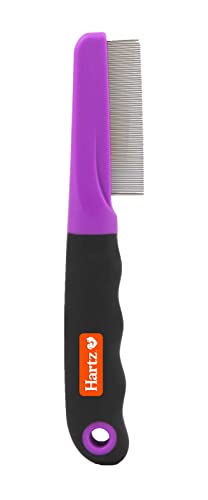
Hartz Groomer’s Best Flea Comb
A double-row fine-tooth comb aimed at catching both fleas and flea eggs in a single pass through the coat.
Common questions
Does a flea comb kill fleas on its own?
No, the comb only physically captures fleas and debris. Live fleas caught in the teeth need to be dropped into soapy water to actually be killed, since the comb itself does nothing chemically.
Why does soapy water matter when using a flea comb?
Plain water lets fleas use surface tension to escape or survive briefly, while soap breaks that surface tension, making it much harder for a flea to climb back out of the bowl once dropped in.
Can a flea comb catch flea eggs as well as adult fleas?
It can catch some eggs, but flea eggs are not firmly attached to the hair and often fall off into the environment before the comb reaches them, so combing catches fewer eggs than adult fleas.
How do I know if the specks in the comb are flea dirt or just regular debris?
A simple test is to place the specks on a damp white paper towel. Flea dirt is dried blood and will turn a reddish brown color when wet, while ordinary dirt will not.
Can a flea comb be used safely on kittens too young for flea medication?
Yes, this is one of its most useful applications, since combing has no age restriction and chemical flea treatments often carry minimum age or weight requirements.
How often should I use a flea comb if my pet has an active infestation?
Daily combing during an active infestation is common practice, both to physically reduce the flea load on the pet and to monitor whether other treatments are working.
Is a flea comb enough to get rid of fleas in my house?
No, a flea comb only addresses fleas currently on the pet. The much larger population of eggs, larvae and pupae already in carpet, bedding and furniture needs separate environmental treatment.
Why does the comb need to reach all the way to the skin?
Fleas cluster close to the skin where body heat is strongest, so a comb that only passes through the top of the coat will miss most of the fleas actually present.
Can a flea comb be used on cats that react badly to topical flea treatments?
Yes, combing is chemical-free and generally well tolerated, making it a practical option for cats with known sensitivities to certain topical or spot-on products.
Does combing hurt or stress out most pets?
Most pets tolerate it reasonably well if done gently, though a pet already irritated from flea bites may be more sensitive to handling during a combing session.
How tight does the tine spacing need to be to actually work?
Spacing needs to be narrower than an adult flea’s body width, generally under a millimeter between teeth, which is why standard wide-tooth grooming combs do not catch fleas effectively.
Can a flea comb be used alongside oral or topical flea preventatives?
Yes, and this combination is common, since combing catches fleas that are still present on the pet while a preventative continues working over the following weeks.
Will a flea comb pick up flea larvae too?
Rarely, since flea larvae typically live in the environment rather than directly on the pet’s coat, so a flea comb mostly catches adult fleas, eggs and flea dirt rather than larvae.
Can a flea comb be used on long-haired pets as effectively as short-haired ones?
It works on both, though long-haired pets generally need more time and more sections to reach the skin thoroughly, since fur length can hide fleas from a quick pass.
Does the color of the comb’s teeth make fleas easier to see?
Many flea combs are made in a light color specifically so dark fleas and flea dirt stand out clearly against the tines, which makes visual checking easier.
Can a flea comb be used around a pet’s face and ears safely?
Yes, gently, though extra care is needed in sensitive areas like around the eyes and ears, where a slower, more careful pass works better than a quick comb-through.
How long should a single flea combing session take?
A thorough session on a medium-sized pet often takes ten to fifteen minutes to properly cover the whole body in small sections down to the skin.
Is it normal to find no fleas even though my pet is scratching a lot?
Yes, scratching can have other causes like allergies or dry skin, and a thorough combing that turns up no fleas or flea dirt is a reasonable way to rule out fleas as the cause.
Final word
The comb itself has no active ingredient and needs none, since spacing alone does the work. It is a genuinely useful chemical-free tool for monitoring and reducing fleas on the animal itself, but anyone dealing with a real infestation still needs to treat the home environment separately, since that is where most of the flea population actually lives.
Olivia Hartley
Olivia spent several years working at an animal shelter and a pet-supply retailer before joining the editorial team. She researches pet gear with an emphasis on safety, comfort and the fine print that owners often miss.


