How Does a Circular Saw’s Bevel Adjustment Actually Change the Cut Angle?
The bevel adjustment tilts the saw’s entire motor and blade assembly on a pivot relative to the flat base shoe, changing the angle at which the spinning blade meets the material from a square 90 degree cut down to an angled cut, commonly up to 45 or sometimes 56 to 60 degrees depending on the model. Because the blade now travels diagonally through the material rather than straight down, the actual depth of cut changes along with the angle, not just the visible face of the cut.
What is physically moving
The bevel knob or lever loosens a pivot connecting the base shoe to the motor housing, letting the entire blade assembly rotate on that pivot while the shoe itself stays flat against the material’s surface throughout the cut.
Why a beveled cut is not just a tilted straight cut
Because the blade enters the material at an angle, it travels a longer diagonal path to pass all the way through the same thickness, which is why a saw’s maximum cut depth, usually listed at 0 degrees, drops noticeably once the bevel angle increases.
Why the printed bevel scale is a starting point, not gospel
A factory bevel scale and detent are usually accurate to within a degree or two, but that accuracy can drift slightly with wear or a loose bevel lock over time, so trim and furniture grade work typically gets verified with a separate angle finder or protractor rather than trusting the saw’s printed scale alone.
Common bevel ranges and what they are built for
Most consumer circular saws bevel from 0 to 45 or 50 degrees, with some extended-range models going to 56 or 60 degrees for specific trim and siding angles. The common detent stops at 0, 22.5, and 45 degrees exist because those are the most frequently used framing and trim angles.
Why bevel cuts dull blades faster on thick material
A beveled blade engages more total tooth-to-material contact per pass through thicker stock than the equivalent straight 90 degree cut would, generating more heat and friction along the blade’s edge.
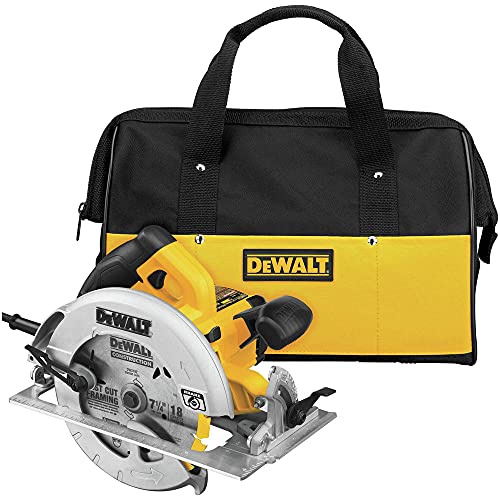
DeWalt DWE575SB 7-1/4 Inch Circular Saw
A widely used corded circular saw with a standard bevel range up to 57 degrees and clear detent stops, a good reference for the mechanism described above.

Makita 5007MG Magnesium Circular Saw
A popular circular saw known for a sturdy bevel pivot and accurate detents, often used by professionals making repeated bevel cuts.
Good to know
Does changing the bevel angle also change how deep the saw can cut?
Yes, cut depth capacity decreases as the bevel angle increases, since the blade now has to exit the material along a longer diagonal path for the same physical blade exposure.
Why does my bevel cut come out slightly off from the number on the scale?
Factory bevel scales are a reference rather than a calibrated instrument, and small amounts of wear or an insufficiently tightened bevel lock can shift the actual cut angle by a degree or two.
Can I switch between a bevel cut and a 90 degree cut without re-squaring the saw?
Usually yes, most saws return close to true 90 degrees at the zero detent, though it is worth spot-checking with a square before any cut where precision really matters.
Is a 45 degree bevel the same thing as a 45 degree miter cut?
No, bevel tilts the blade relative to the material’s face, while miter angle changes the cut direction across that face on a miter saw or sled. The two are different axes and can be combined on the same cut.
Why do some circular saws bevel past the common 45 degree mark?
Extended bevel ranges, like 56 or 60 degrees, exist mainly for specific trim, siding, and crown molding tasks that call for steeper angles than standard framing work ever needs.
Does a dull blade make bevel cuts noticeably less accurate?
Yes, a dull blade tends to wander and burn more on an angled cut because of the increased contact length, which can visibly affect the cut line even when the bevel setting itself is correct.
Can the bevel lock loosen on its own mid-cut?
On a worn or lower-quality saw, vibration can gradually loosen a bevel lock lever that was not fully tightened beforehand, which is why many woodworkers double check it before every cut.
Why does the base shoe sometimes lift slightly during a steep bevel cut?
At a wider bevel angle, the shoe’s flat bearing surface against the material effectively shrinks, making it easier to accidentally lift or rock the saw if it is not held firmly.
Is more splinter or tearout normal on bevel cuts compared to square ones?
Yes, especially on the exit side of the cut, since the blade’s angled path shears wood fibers differently than a straight pass does.
Do all circular saws share the same bevel detent stops?
No, exact detent positions vary by brand and model, though 0, 22.5, and 45 degrees are the most commonly included stops across most consumer saws.
Can a track saw be bevel cut the same way as a handheld circular saw?
Yes, track saws use the same bevel pivot principle, generally with tighter manufacturing tolerances that give more repeatable, precise results on contractor and cabinet-grade models.
Why does the blade guard’s position shift when I change the bevel angle?
The guard is linked to the shoe and blade assembly geometry, so its resting position adjusts along with the bevel tilt to keep covering the blade appropriately.
Does the bevel angle affect which side of the blade the offcut falls on?
Not directly, that depends on which side of the cut line the shoe runs on, though a steep bevel angle can change how the offcut piece physically clears the saw during the cut.
Does blade tooth count matter more at steeper bevel angles?
Yes, a higher tooth count generally leaves a cleaner edge on angled cuts, since more teeth engage the longer diagonal path per rotation, which reduces tearout compared to a low tooth count blade.
Is it safe to bevel cut without a riving knife or splitter engaged?
Some riving knives are designed mainly for straight 90 degree cuts and automatically disengage or shift position at a bevel, so checking the manual for bevel-specific guard behavior matters before cutting.
Why does the bevel lever feel stiffer near the saw’s maximum angle?
Some saws are built with slightly tighter pivot tolerances near their maximum bevel range on purpose, intended to resist drift at the angles where accuracy matters most.
Does bevel cutting change kickback risk compared to a straight cut?
Yes, a beveled cut changes how the blade engages the material and can alter how the saw reacts if it binds, which is part of why maintaining firm control and the correct body position matters more at steeper bevel settings.
Can a circular saw bevel in a negative direction below zero degrees?
Standard circular saws bevel in one direction only, from zero up to their maximum angle, rather than offering a true negative angle, since the shoe design is built around a single pivot direction.
Do bevel cuts ever require a different blade than square cuts?
Not usually a different blade, though a blade with more teeth designed for cleaner crosscuts can help reduce tearout specifically on the longer exposed edge a bevel cut creates.
Does the shoe’s material affect how well the bevel angle holds over time?
Yes, a stamped steel shoe can flex or wear slightly differently than a cast magnesium or aluminum shoe, which can subtly affect how consistently the bevel angle holds across repeated cuts.
Where this leaves you
Bevel cutting is simple in concept but easy to underestimate in practice, since tilting the blade changes both the visible angle and the effective depth of cut at the same time. Anyone doing precision bevel work is better off verifying the actual angle with a separate tool rather than trusting the saw’s printed scale alone.
Jake Monroe
Jake worked as a residential contractor for over a decade before shifting to full-time writing. He evaluates power tools, hand tools and workshop gear through the lens of someone who has actually used them on job sites, not just read the box.


