How Does a Bird Feeder’s Design Keep Squirrels Out Without Blocking Birds?
Squirrel resistant feeders rely on a handful of physical tricks rather than one single design: weight activated mechanisms that close access ports when something heavier than a bird lands on them, cage style outer barriers sized to let small birds through but block a squirrel’s body, and spring loaded or tilting perches that dump a squirrel off before it can get a secure grip.
Weight activated closure systems
A spring loaded perch or base is calibrated to hold the weight of typical songbirds but compress or tilt under a squirrel’s heavier weight, which drops a shield over the feeding ports or rotates the perch away from the seed entirely.
Cage and dome barriers
An outer wire cage with openings sized for small birds to slip through physically blocks a squirrel’s larger body from reaching the seed ports inside, while a wide dome mounted above a feeder blocks squirrels from dropping or climbing in from directly above.
Baffles on the pole or hanging line
A dome or cylinder shaped baffle mounted below a hanging feeder or around a support pole prevents a squirrel from climbing up from underneath, since the smooth, angled surface gives it nothing to grip.
Why placement matters as much as the feeder itself
A squirrel proof feeder hung too close to a tree branch, fence, or roofline can be bypassed entirely by a squirrel jumping in from above rather than climbing up, so distance from launch points, often cited as at least 10 feet horizontally and several feet below any overhanging branch, matters just as much as the mechanism itself.
Seed choice reduces the incentive
Safflower seed and seeds treated with capsaicin are generally avoided by squirrels but still eaten by most common feeder birds, which reduces squirrel interest even on a feeder with no specialized mechanism at all.
No design is completely squirrel proof
Determined squirrels learn mechanisms over time and some will chew through plastic parts, so the realistic claim for most squirrel proof feeders is squirrel resistant, meaningfully reducing access rather than guaranteeing zero squirrel feeding.

Brome Squirrel Buster Plus
A widely used weight activated feeder that closes its seed ports when a squirrel’s weight presses down on the perch ring.
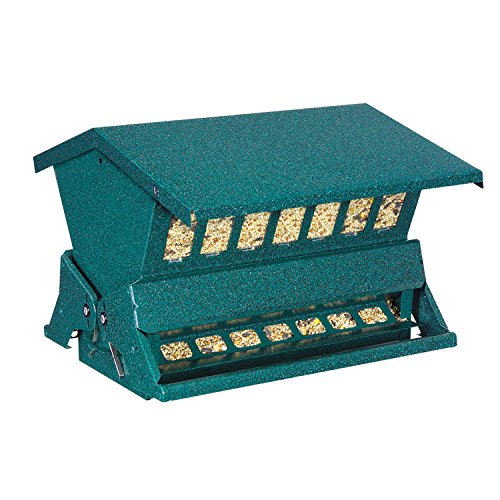
Woodlink Audubon Absolute II Squirrel-Proof Feeder
A feeder using a weighted perch system combined with a sturdy metal cage body to deter squirrel access.
Good to know
Do weight activated bird feeders ever accidentally block birds too?
Large or clustering birds landing together can occasionally trigger the mechanism, though most designs are calibrated with enough margin above typical songbird weight to avoid this in normal use.
Can squirrels eventually learn to beat a squirrel-proof feeder?
Yes, persistent squirrels have been known to figure out timing tricks or physically damage weaker plastic components, which is why metal construction tends to hold up better long term.
How far from a tree does a feeder need to hang to stop squirrel jumps?
A commonly cited minimum is around 10 feet horizontally from the nearest launch point, including fences and rooflines, plus several feet of clearance below any overhanging branch.
Does a baffle work on a pole-mounted feeder the same way as a hanging one?
The principle is the same, a smooth, angled surface with nothing to grip, though pole baffles are typically mounted below the feeder while hanging baffles sit above or around the support line.
Is safflower seed actually disliked by squirrels, or just less preferred?
Most squirrels will eat it if nothing else is available, but they generally prefer sunflower seed and corn, so safflower reduces squirrel interest without being a guaranteed deterrent.
Can capsaicin-treated seed harm birds the way it deters squirrels?
No, birds lack the receptor that makes capsaicin feel hot to mammals, so the seed does not bother them, while it does deter squirrels and other mammals.
Do cage-style feeders block larger birds like cardinals too?
Some cage designs with smaller openings can exclude larger birds along with squirrels, so opening size needs to be matched to the target bird species for the feeder to work as intended.
Why do some squirrel-proof feeders still get chewed through?
Plastic components are more vulnerable to persistent gnawing than metal ones, which is why many of the more durable squirrel resistant designs rely heavily on metal cages and bases.
Is a dome baffle better than a cylinder baffle for pole feeders?
Both work on similar principles, though cylinder baffles tend to be more effective against climbing since there is no edge for a squirrel to grab onto compared to some dome shapes.
Can squirrels climb a smooth metal pole without a baffle?
Surprisingly, yes, many squirrels can grip and climb even smooth metal poles, which is exactly why a properly positioned baffle is still necessary even on metal pole setups.
Does feeder material (metal vs plastic) affect how squirrel-resistant it is?
Yes, metal components generally resist chewing and prying far better than plastic, making metal construction a meaningful factor in long term squirrel resistance.
Is it true squirrels can jump several feet horizontally to reach a feeder?
Yes, squirrels are capable of impressive horizontal jumps, often several feet, which is why distance guidelines from trees and structures tend to be more generous than people initially assume.
Do weight-activated feeders need recalibrating for heavier bird species?
Some adjustable models allow tuning the trigger weight higher to accommodate larger birds like doves or jays without closing the ports on them.
Can placing a feeder over water or a slope help deter squirrels?
Yes, removing easy ground access or creating a water barrier can meaningfully reduce squirrel attempts, since most squirrels avoid swimming to reach a feeder.
Can raccoons bypass the same mechanisms designed for squirrels?
Raccoons are generally heavier and less agile at precise climbing than squirrels, so many squirrel resistant mechanisms incidentally deter them too, though a determined raccoon can sometimes still knock a feeder down entirely.
Does feeder color or finish affect how quickly squirrels notice it?
Squirrels locate feeders primarily by scent and visual movement of birds rather than color, so finish and color have little practical effect on whether a squirrel targets a feeder.
Are pole-mounted feeders generally easier to squirrel-proof than hanging ones?
Yes, a single vertical pole with a baffle is simpler to fully protect than a hanging feeder, which can be reached from multiple directions including nearby branches, fences, or other hanging points.
Can a motion-activated spinning perch feeder actually deter squirrels effectively?
Yes, these feeders detect a squirrel’s weight and spin the perch rapidly, which most squirrels find unpleasant enough to abandon the attempt after a try or two.
Does the type of birdseed mix attract squirrels regardless of the feeder design?
Yes, seed mixes heavy in sunflower, corn, or peanuts attract squirrels strongly regardless of feeder design, which is part of why pairing a resistant feeder with a less squirrel appealing seed works best.
Is it true cayenne pepper flakes sprinkled on seed work as well as capsaicin coating?
Loose pepper flakes can wash off or separate from seed over time, making a proper capsaicin coating applied directly to the seed shell generally more consistent and longer lasting than sprinkled flakes.
Can grease or petroleum jelly on a pole help deter climbing squirrels?
It can work temporarily by making the surface too slippery to grip, though it needs reapplication regularly since it collects dust and loses effectiveness, and it is not usable on a rough or textured pole.
Do squirrel-proof feeders need more frequent cleaning than standard ones?
The added mechanisms like springs and cages can collect seed debris and moisture in more hidden spots, which means some squirrel resistant designs need slightly more thorough cleaning to prevent mold buildup.
Our take
The best squirrel resistant feeders combine more than one trick at once, weight sensing, a physical barrier, and smart placement, because any single mechanism alone eventually gets figured out by a determined squirrel. Treat the design as resistance, not a guarantee, and placement does as much work as the feeder itself.
Sierra Daniels
Sierra's background is in landscape design and nursery retail. She focuses on lawn and garden equipment, outdoor furniture and gear durability, weighing published specs against how materials actually hold up outside.


